
“THE ROSES, WHERE ARE THE ROSES?”
Chronicles and reflections on expressions of affection for Sara and Sandro, and on the anti-Mafia movement as a tool for counter-insurgency
During the night of Thursday 19th to Friday 20th March, a loud bang shook the neighbourhoods of eastern Rome near the Parco degli Acquedotti; inside the park, an explosion caused part of an abandoned farmhouse to collapse. The explosion and the collapse killed two of our comrades, Sara and Sandro. Their unwavering consistency between idea and action led them to take risks and cross the line between life and death.
Following this tragic event, the state attempted to take possession of their bodies, with the aim of rewriting their history; of concealing the love, respect and fraternity that surrounded them; of erasing their ideas and of erasing the proof that it is possible to act against this system.
It is possible that their bodies were located and identified in the hours immediately following the explosion, but the news of their deaths was kept hidden for a long time and only released in the afternoon via the mass media, through which everyone, including their families, learned of the tragic event. The State was thus able to decide how to tell this story, how to describe the two comrades, attempting to impose its own narrative on everyone and manage the affair according to its own ends.
If one of the aims they had set themselves was to secure a dissociation from our comrades and their disavowal, this could never have happened for the simple reason that these wretched loopholes never belonged to us.
Immediately, numerous statements were issued clarifying that Sara and Sandro are our comrades, comrades who were known, respected and loved, comrades who fell in action.
At this point, the state attempted to seize their bodies, holding them for days, thereby venting a belated vengeance against those prey who had never been captured and had now escaped forever from the courts and prisons.
Their bodies were suddenly released, and the families were forced to bury them immediately. This haste was intended to make it difficult for those who wished to pay their last respects, to make the two comrades appear as isolated and abandoned individuals, and to try to prevent this farewell from becoming an occasion for public commemoration of their figures, or for the vindication of their ideas and deeds.
Here are the details. On 25 March, news began to circulate that Sara’s funeral would take place on 27 March, with the timetable and programme of the service being released. It was decided to respect the family’s wish for a church funeral, whilst arrangements were made for a fitting tribute to our comrade’s revolutionary legacy at the cemetery. Comrades from all over Italy rushed to organise their travel to attend, booking flights, ferries and trains. The following morning, everything was cancelled and the funeral postponed until the following week. The public prosecutor, despite the request for ‘clearance’ having been submitted, stated that he needed time to decide whether to sign it. The situation is so unusual as to leave not only comrades and friends bewildered – from whom, moreover, in such dramatic and hurried circumstances, a communication error might have been understandable – but in fact it is the funeral home itself, which had already organised everything and officially published the notices, that has been caught off guard. Even more seriously, police and judicial circles have led the family to believe that the funeral would be postponed by at least a week (thus playing on their emotions, leaving them in a state of consternation, even regarding practical arrangements, at a time when it is already difficult enough to deal with such matters). A few hours pass and there is a new twist: the public prosecutor has signed off on it, so the funeral will go ahead as planned (and in fact will start twenty minutes early). Because of this “joke” in very poor taste, a few dozen people – not just activists, but also friends and family members – will be unable to attend.
In Sandro’s case, no schedule was ever published. On Saturday 28 March, his comrades had to gather to ‘guard’ the laboratory where his coffin was being kept; they even had to chase the hearse for over two hundred kilometres along the motorway in order to arrive in time for the burial.
Despite these cowardly attempts, the authorities have come unstuck and their attempt to isolate Sara and Sandro from the world to which they belong has failed. Comrades came to pay their last respects, undeterred by the intimidation of the police lurking like vultures near the graves; together with relatives, friends and supporters, they took part in these farewells, which were a moment of both intimate closeness and collective struggle, a moment in which memory and vindication, the acceptance of responsibility and the profession of love, the eulogy of deeds and personal reflection.
The attempt to prevent our comrades from attending the funerals is in line with the ban on public funerals that applies to organised crime. For us, this represents yet another demonstration of how practices used in the fight against the Mafia have been transferred to the realm of political repression, and thus a demonstration of the political role assumed by the anti-Mafia movement. Just like the application of the 41 bis prison regime to our comrades—a regime against which Sara and Sandro fought with all their might, alongside all of us, by taking part in the mobilisation in support of the hunger strike carried out by the anarchist Alfredo Cospito.
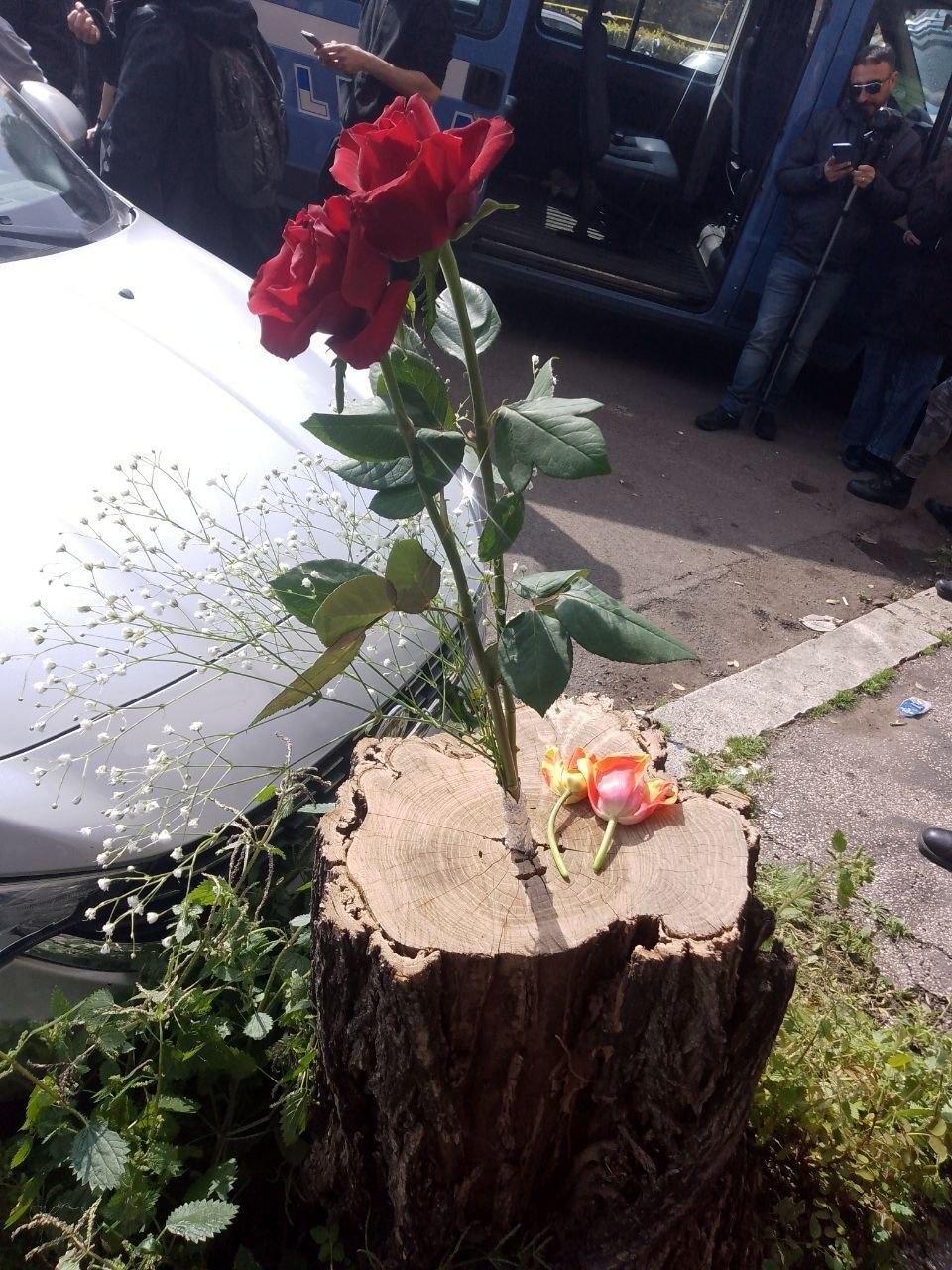
That Sara and Sandro struck fear into the State whilst alive and continue to do so in death was finally made clear on Sunday 29 March, the date on which anarchists gathered to lay flowers at the spot where they died whilst carrying out an action.
This initiative was banned by the Rome police commissioner, and the large urban park was manned by a substantial police presence, including mounted officers, who stopped anyone deemed suspicious and surrounded the majority of the protesters outside the park, preventing them from entering. Nearly a hundred protesters who were stopped were subsequently transferred to cells at the immigration office of the Rome police headquarters and held there until the evening.
The following day, the Prime Minister, Giorgia Meloni, would claim credit for what was in fact the first application of the so-called ‘preventive detention’ measure provided for in the recent ‘security packages’. A stance which, in its arrogance—it must be acknowledged—represents a politically significant element regarding the nature of the repressive turn and the role of this specific instrument, the necessity of which is asserted in terms of order and security: to prevent a commemoration.
Despite all this, anarchists and others travelled to the event from various cities across Italy; Sara and Sandro were remembered and honoured as our comrades, and flowers were laid at the spot where they lost their lives. Everything took place in a composed manner, as had been decided.
In the afternoon, a demonstration of around a hundred people (even though just as many were still in custody) marched through the eastern districts of the capital, setting off from Quarticciolo and arriving at the Alessandrino neighbourhood where Sara and Sandro lived.
Despite the bans and intimidation, we did everything we said we would.
In the weeks that followed, this grim charade continued. As police surveillance around the infamous cottage eased, bouquets of flowers, handkerchiefs, T-shirts and flags began to pile up once more; inadequate material symbols of grief and pride. Yet, at regular intervals, these tributes continue to be ‘cleared away’ and hidden, making them vanish from view.
But that’s not all. A week later, on Easter Monday (6 April), Sara’s friends, colleagues, neighbours and comrades decided to get together for their traditional picnic in memory of their departed comrade: the gathering took place on the meadows along the River Nera, in the hamlet of Castel San Felice in Umbria, where Sara had lived for much of her adult life. This was not a political initiative, but a heartfelt gesture born of people with very different life paths and beliefs, united by the desire to share a moment of remembrance together. But even this was too much for the self-righteous. The local page of the daily newspaper ‘Il Messaggero’ unleashes a media outcry against the initiative; the mayor and the parish council (owners of this green space) intervene, hastening to clarify (by lying) that this initiative had not been notified and that, in any case, it is certainly prohibited. This attempt also comes to nothing; on the morning of 6 April, the police decide to take a softer line this time, limiting themselves to observing the event from a distance: the lawns are occupied and everything proceeds peacefully.
The state’s show of force has proved to be a futile and pitiful attempt to stop what it cannot stop; the memory of our comrades will remain indelible, and the honours they deserve have been bestowed upon them and always will be. The radiance of revolutionary violence, like a light illuminating this bleak world, has been reclaimed.
Italy is at war. The State knows that an external front – that of the conflicts it supports in Ukraine, Palestine and Iran – corresponds to an internal front against the exploited, who bear the brunt of the war on their shoulders. In this war, the State knows that we are its enemies, but we too know that we are at war and that we are proudly enemies of the State and the capitalist system, just as Sara and Sandro always were.
Sara and Sandro fell fighting the class war raging on the Italian home front. There is little point in prattling on about revenge. This word, though it may seem extreme, on closer inspection conceals a victim mentality: as if the State had wronged us. We can find reasons for revenge every day: for those who die at work, for those who die in prisons, for those who die at sea, for the victims of the wars in which the Italian state plays a leading role. By all accounts, Sara and Sandro were preparing that revenge. The issue, then, is much deeper and involves our sharing in their pain, in keeping with the integrity of these comrades, as we consider ourselves their moral accomplices in their actions.
In this war, the Italian state employs the typical tools of counter-insurgency: not only through repressive violence, but also through the symbolic repression of the enemy’s commemorations.
In this regard, the state can boast years of experience gained in the fight against the Mafia. Tactics such as those employed against Sara and Sandro have already been successfully used against Mafia bosses when they die in prison: public funerals banned, burials carried out at night and with as little fanfare as possible, the suppression of grief as itself a form of empathy towards the enemy.
This happens not only during times of mourning, but also in other expressions of solidarity. There is outrage over the occasional incidents where a religious procession veers off course to pass beneath the home of an alleged mafia boss detained under the 41 bis regime, to perform the so-called ‘bow’, using the saint in the procession to bless the prisoner and offer moral support to the family. Whenever this happens, the establishment press, particularly on the left, cries scandal, and not only are investigations and complaints launched in a great hurry, but new laws are also drafted to prevent similar incidents, in a neurotic, emergency-driven approach to the law that is rewritten whenever a story causes too much of a stir on television.
Another example is the persecution of a section of Neapolitan neo-melodic music and its artists, suspected of sympathising with the Camorra.
In this regard, we find the words read out by Alfredo Cospito during the preliminary hearing of the “Sibilla” trial on 15 January 2025 in Perugia (via video link from Sassari prison) particularly relevant:
“What better way to silence radical movements and opposition than through an emergency regime that is already in place and tried and tested. A state of exception in which many rights are suspended, in which absolute censorship reigns, already tried and tested over decades of practice on the ground. Who will be the first to experience this special regime first-hand? The comrades fighting for Palestine? The anarchists who undaunted continue to speak of revolution? The communists who have never surrendered? Four of them have been resisting with pride for decades under this regime in the most absolute isolation, without ever yielding.
If the West’s imperialist war spills over from the borders of Ukraine and bursts into our homes, if social conflicts exceed the sustainable limit of a shaky mechanism, or even if a smooth and gradual transition to the regime proves unfeasible, Article 41 bis, precisely because of its veneer of legality, will be the ideal repressive tool for forced social anaesthesia, a sort of castor oil to bring the recalcitrant back into line, a gradual coup d’état carried out in accordance with the law.”
These are essentially correct observations, but they should be extended beyond the scope of the 41 bis regime. In fact, they concern the entire anti-Mafia legislation. In the case of the bodies of Sara and Sandro, and before them that of the militant communist Mario Galesi, as well as in the transfer of revolutionary prisoners to 41 bis, we are witnessing the extension of anti-Mafia policies as a military tool of counter-insurgency.
Let us start from the premise that, if the State reacts in this way, it is admitting from the outset its own relative weakness. If the displays of affection were not so well attended, if the funerals were deserted, if the families of the prisoners and martyrs were isolated, the State would not be so nervous about these demonstrations. At most, it would mock them through its subservient press. To take offence at a ‘bow’ to the mafia boss’s house, to ban funerals, to arrest 91 people showing solidarity with anarchists killed in action is in itself an admission that these events had a mass character (in the case of the preventive detention, even numerically certified) and that this ‘popularity’ of the enemy unnerves it.
There is, however, a fundamental difference that should not be overlooked. Unlike Mafia power, which instils fear and can still promise benefits to those who respect and honour it, showing solidarity with ‘terrorists’ who have died in action offers no advantages whatsoever, only disadvantages. To put it in Sara’s own words, read out during the hearing on 15 January 2025 in Perugia:
“Individual responsibility, on the other hand, is a cornerstone of anarchism. I neither take orders nor give them: neither from anyone nor to anyone. I act solely in accordance with my conscience, which has no parameters of interest or advantage and remains the only voice I can listen to.”
It is true that, as materialists, we might say that with death we cease to exist, and that our bodies become mere remains in which we no longer have any interest.
In reality, this is not the case, because we continue to act even after death; the testimony we bore in life lives on. All those who have died for freedom in the past speak to us and support us on our journey towards the future.The bodies of dead anarchists thus take on meaning for their living comrades, for the ideas that define them and for the struggles they undertake (hence the state’s attempt to seize them).
This is why the expressions of grief, solidarity and complicity with Sara and Sandro are not only stronger than death, as has been written, but also stronger than political expediency, self-interest and prudence.
They are proof that within our class, however marginal and very much in the minority, there exists a component that does not lay down its arms. That its fury is that of a faith, and not merely in an enterprise (which may generate a surplus or fail, but remains entangled in that entrepreneurial logic). Honouring the dead thus becomes a message above all for the living. An inviolable pact to continue on the path of radical emancipation.
The State will never be able to repress this element, because it operates on a logic that is radically autonomous from that of punishment and self-interest. The logic of those who wish to destroy it and are willing to pay any price to try to do so.
A few incapable of reform
Source: La Nemesi