Total mail blockade to anarchist comrade Alfredo Cospito persists.” Updates on the detention situation of anarchist Alfredo Cospito and the mail censorship to which he is subjected (Circolo Anarchico “La Faglia” July 2025)
TOTAL BLOCKADE OF CORRESPONDENCE TO ANARCHIST COMRADE ALFREDO COSPITO PERSISTS.
Update to early July 2025. In these days news arrives again regarding the particularly afflictive situation that the management of the Bancali prison, probably in concert with the Ministry of so-called justice, is imposing on our anarchist comrade Alfredo Cospito, particularly with regard to epistolary correspondence.
Recall that censorship of incoming and outgoing mail is a constitutive element of the 41 bis regime to which the comrade is subjected. For a long time Alfredo has received no letters, postcards, telegrams or communications of any kind. This is despite the fact that many of us are continuing to write to him, even with collective correspondence initiatives such as the one that took place in Foligno last May 31. In addition, the prison management has long since stopped notifying the prisoner of the notice of censorship, a document against which to appeal in order to receive the epistolary material placed under seizure. The mail simply disappears into thin air.
This behavior is in addition to a long series of persecutory dispositions aimed at the psychological and political destruction of his comrade: from denying him access to books already ordered and authorized, to CDs or headphones to listen to music, to reporting him to the bar association for his defenders guilty of shaking his hand and giving him a kiss at the time of the interview-that is, guilty of treating him as a human being.
All this in an already enormously afflictive context such as that of 41 bis, which provides for two hours of air per day in groups of a maximum of four people decided by the ministry, one hour of interview per month with a family member separated by glass or alternatively ten minutes of phone calls during which the authorized family member must go inside a barracks to call. As well as, as mentioned above, the censorship of correspondence and the inability to read books dealing with subjects deemed sensitive (and the great difficulties in finding any books in general).
We firmly denounce that this doggedness is evidently a state vendetta for the intransigence and determination with which the hunger strike of 2022-23 and the international solidarity mobilization were conducted, putting the spotlight on the shadowy zone that is 41 bis with unprecedented intensity, going to pickaxe that phony celestial aura that surrounds the anti-mafia-anti-terrorism structure.
Moreover, a doggedness that comes in the aftermath of Undersecretary Delmastro’s 8-month sentence for revelations of an official act, which matured precisely in the scoundrel’s attempt to smear Alfredo Cospito during his hunger strike.
The misery of these characters in the face of the consistency of an anarchist who never bowed his head jumps to the eye. On the one hand one who kneecaps a nuclear witch doctor, on the other who on New Year’s Eve high on cocaine in a moment of rare consistency shoots himself in the legs.
In the climate of world warfare these days, we reiterate that these incidents should be read as real policies of war against the enemy within. Great are the challenges that engage revolutionaries in such a historical period, but all the more so we cannot and will not leave anyone behind. For whoever forgets the prisoners of the revolutionary struggle, forgets the revolutionary struggle itself.
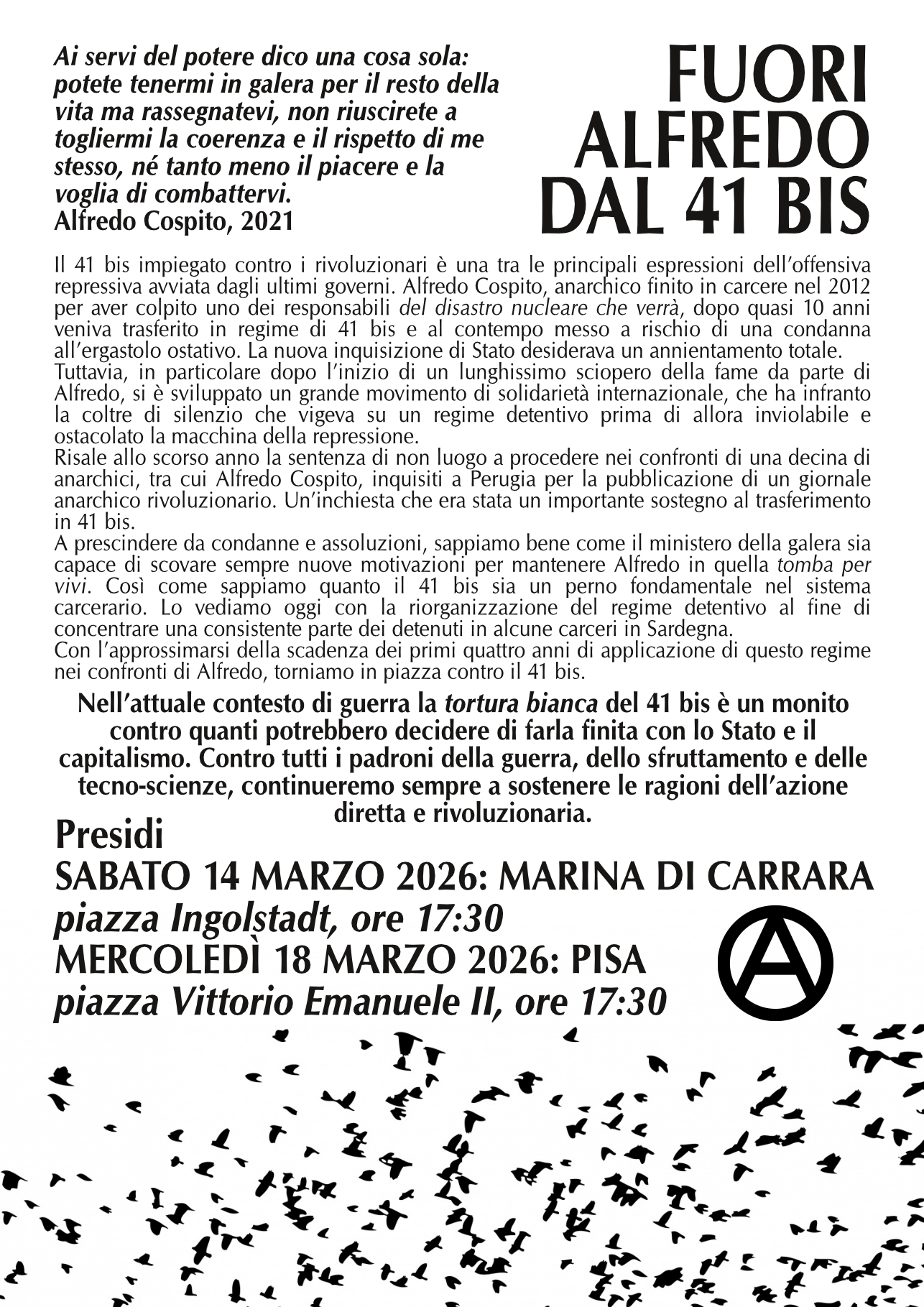
In view of the possible renewal of 41 bis for Alfredo Cospito in May next year, let us make sure that this, too, returns to being a battlefield fraught with contradictions for the state.
Circolo Anarchico “La Faglia” – Foligno
July 2025
circoloanarchicolafaglia@inventati.org – t.me/circoloanarchicolafaglia
Source: La Nemesi