
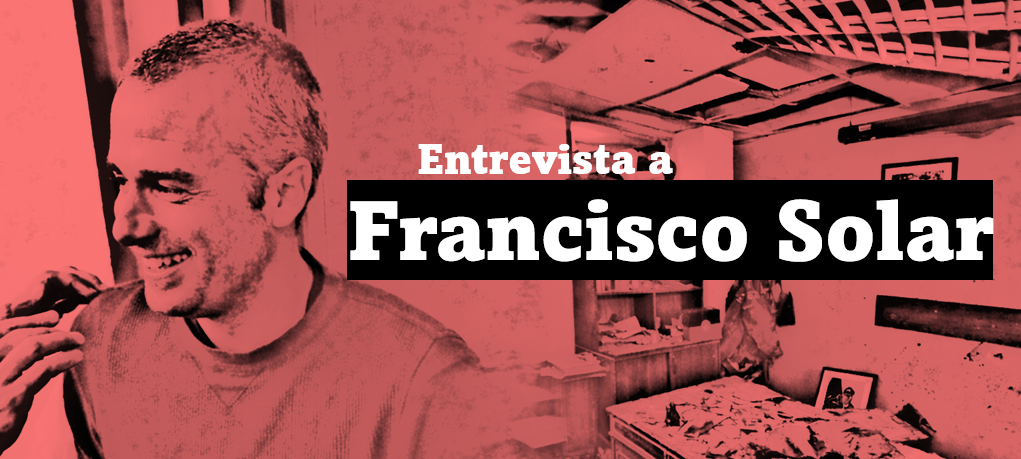
In this fourth interview, we engaged in a dialogue with our anarchist comrade Francisco Solar, acting as a bridge to spread his words and delve deeper into various topics and contexts of interest. His perspective and participation in grassroots projects are vitally important, as they break with the inaction that prison seeks to impose. Throughout this conversation, we address not only aspects related to his personal experience in prison, but also broader political reflections on the ongoing struggles and challenges facing anarchist circles.
1.- How are you doing now? Could you tell us a little about your experience in La Gonzalina prison? What differences do you see between the prison systems in Europe and Chile?
Almost a year ago, I left the maximum security wing where I had spent almost five years and moved to a high security wing with a normal regime, which basically means eight hours of yard time and the possibility of conjugal visits.
Based on the above, my situation is clearly more favorable, as I am not subject to the restrictions of a maximum security regime. However, sharing my daily life with fellow anarchists and subversives who were already in this unit makes prison life much more bearable. Escaping at times from the harmful authoritarian dynamics that exist among prisoners and trying to practice relationships that are contrary to these is a constant challenge and struggle that involves constant questioning. It is clear that we are not an island within this unit; we deal with contradictions and obviously sometimes reproduce behaviors that we say we reject. However, our dynamics, those of the anarchist and subversive prisoners, are different from those of the rest of the prisoners. Our relationships are not based on the stark authoritarianism of the other prisoners, and that is evident.
My daily routine consists of playing sports in the yard, talking and walking with my compañeros, and reading. As I have pointed out in other writings, it is important to have a daily routine, which, at least in my case, allows me to maintain a certain mental clarity and avoid falling into prison despair.
The differences between the Chilean prison system and that of Spain lie mainly in control. The Spanish prison system has managed to discipline life inside prisons through constant and prolonged adjustments to its control strategies. Through the FIES (Ficheros de Internos de Especial Seguimiento, Special Investigation and Security Unit) and dispersion, the Prison Service has pacified Spanish prisons, even managing to turn prisoners into their own jailers, as can be seen in the increasingly numerous “respect modules.”
Although the Chilean prison system is moving towards exercising control in the “Spanish” (or European) manner, the truth is that it is still a long way from achieving this. The control mechanisms are much more precarious and ineffective, which leads, among other things, to the establishment of certain “rules” imposed by the prisoners themselves within prison life. These rules are based on extreme authoritarianism that produces and reproduces relationships of outright slavery among the prisoners themselves. If solidarity was once present in these dynamics, today such relationships have been virtually relegated to make way for ostentation and the aforementioned authoritarianism that makes prison life a hostile environment.
2.- How important were and are counter-information projects? Do you think they continue to be a means for dialogue and anarchist propaganda? Have they lost ground to social media?
The importance of counter-information media in strengthening anarchist environments is undeniable. It is no coincidence that at a time when anarchist spaces were multiplying, anti-authoritarian initiatives were proliferating, and attacks were occurring non-stop, counter-information media such as Publicación Refractario, Contrainfo, Liberación Total, Material Anarquista, among others, together with various anarchist newspapers, formed an important part of the anarchist galaxy that complemented the active work of those years.
Along with the information made available that allowed us to keep up to date with what was happening around us, these media constituted and continue to constitute spaces for promoting and developing debates that gave life to our movement. Extensive debates that qualified reflections and positions that could not be developed in the fleeting portals of Instagram.
In this sense, in my opinion, social media and its immediacy have diminished the quality of arguments and, with this, the strength of our positions. It is clear that counter-information media have lost ground to social media, which today present themselves as the place from which to carry out the struggle. Little or nothing remains of the elaborate and meticulous reflections, giving way to the empty slogans and cult of aesthetics that characterize social media.
The decline of counter-information media is yet another sign of our movement’s loss of power and stagnation. The importance and prevalence of social media reflects our growing lack of reflection and the scarcity of new ideas.
3.- In the text “A necessary complicit dialogue,” you refer to the concept of “large-scale anarchic actions,” while in “The risks of multiformity” you ask yourself and argue that: “Are large-scale actions and ‘simple’ actions the same thing? Is placing an explosive in a police station the same as spraying graffiti on a wall or painting a banner? Clearly not. They are not the same in terms of their planning, dedication, or what is at stake. They are not the same in terms of their impact or the repercussions they generate.” From reading these communiqués, we note that you apply the concept of “large-scale” to define direct destructive actions, while you define propaganda actions as “simple.” However, both definitions are categorized as “actions.” Would it then be appropriate to redefine the concept of “action,” or is the adjective that follows it sufficient?
I think that the important thing about language, whether written or spoken, is that what you want to communicate is understood. From your question, I gather that I made myself perfectly clear in what I tried to express in those texts, so the function of language in this case fulfilled its purpose. Therefore, it doesn’t matter what you call what you want to express, as long as the meaning is ultimately understood.
Now, every action involves energy that alters reality in one way or another, so making a banner and putting it up is clearly an action, as is painting a mural or filling the streets of the city with posters. Clearly, planting an explosive device, shooting at the police, or any other complex attack also correspond to actions for the same reason mentioned above. However, as I stated in the writings, there are differences that mean they cannot be assessed in the same way. It is therefore important to make a distinction in language when addressing them, as it is clear that we are not talking about the same type of actions.
Complex actions, large-scale actions, violent revolutionary attacks: these are terms I use to refer to the same type of action. These are acts that, due to their characteristics, involve greater risks and a different level of decision-making, among other aspects, which differentiate them from other types of actions. In short, since the latter are also actions, I think it is most appropriate to describe the former with an adjective to make their difference and particularities with respect to the others explicit.
4.- “Cómplices Sediciosos / Fracción por la Venganza” claims responsibility for sending two parcel bombs to the 54th police station in Huechuraba and the office of former interior minister Rodrigo Hinzpeter, an attack for which you later claimed responsibility. The statement reads: “We took all necessary security measures to ensure that the devices exploded only in the hands of the people targeted by our action. Our enemies are clear; we are not interested in or seeking to harm or injure anyone (…)”. Can this be interpreted as a distinction between selective violence and indiscriminate violence? If so, how would you explain the differences between selective and indiscriminate violence?
As I stated in my closing remarks at the trial, violent anarchist actions have never been indiscriminate. Historically, they have always targeted individuals, groups of people, or symbols that represent or wield power. It is fascists who have carried out indiscriminate attacks, such as the massacre at the train station in Bologna, Italy, in 1981.
And, a few years ago, a misanthropic trend emerged that attempted, without much success, to carry out indiscriminate attacks. Their stance, which was closer to a religious position due to its clearly sacred overtones, was full of contradictions, causing them to disappear as quickly as they appeared. It does not warrant further analysis.
Focusing on the question, indiscriminate attacks are those whose targets are anyone, so the locations for attacks are generally open spaces that are as crowded as possible. Busy bus stops, street markets, among others, are ideal locations due to the large crowds they attract. Selective attacks, on the other hand, are those directed, as I pointed out, at representatives, holders, or symbols of power. They are attacks carried out against our enemies. They are complex actions that, in most cases, are understandable in themselves.
Now, I understand that we are all responsible to a greater or lesser extent for the maintenance and reproduction of oppression, but that is no reason to identify every human being as a target. Our actions must necessarily aim high, higher and higher, in order, among other things, to send a signal to the powerful that their decisions will at some point provoke a forceful response.
5.- There has been a general decline in terms of action, from incendiary outbreaks in universities and high schools, nighttime raids involving roadblocks, barricades throughout the city, and incendiary and/or explosive actions. Could you analyze this? Could it be due to constant police raids and increased security in the city? Or is it a consequence of something you mention in the text “Considerations on Freedom,” when you criticize the phrase: “I have the freedom to do what I deem appropriate, even, when the time comes, to break commitments I have made”; because “such is the argument (or phrase) wielded under that nefarious conception of individual freedom, which is nothing more than a childish justification for irresponsibility. This not only makes any joint initiative unfeasible, as it instills mistrust, but it also throws away the coherence that is the result of the historical work of our comrades who preceded us and which is valued as part of our theoretical and practical arsenal that distinguishes us from other revolutionary tendencies.”
As you rightly point out, the decline of large-scale actions in this territory is noticeable and undeniable. And I believe that this is not only true in this area, but that it is present in practically all areas of our practices. I think we are experiencing a change of cycle that implies the end of one process and necessarily the beginning of another. The approaches and practices of insurrectionary anarchism, anarchic nihilism, and revolutionary anarchism have lost strength and no longer generate the interest they did a few years ago. In this sense, I think it is important to take note of this change of cycle, to take note of this decline so that, based on this observation, we can take action and overcome this period of inaction.
Certainly, the decline in counter-information media, together with the limited presence and permanence of physical spaces where we can meet to share ideas and carry out activities, are part of this general decline affecting our movement.
Now, as for the decline in large-scale actions, I think that the repressive blows and, above all, the severity of the sentences have achieved their goal: to intimidate and demobilize a large part of the combative anarchist sector which, with a few exceptions, has been unable to respond to these blows. On the other hand, the Southern Prosecutor’s Office, with prosecutor Orellana and a small team of police officers, has effectively dismantled practically every action group that had been constantly striking. Therefore, repression has indeed influenced this decline.
The lack of real commitment that comes with this strange way of understanding individual freedom represents, in my view, a cross-cutting element that not only influences the current moment of inaction, but also constitutes one of the foundations of our general decline. Not doing what one says or failing to do what one has freely committed to do reflects the lack of rigor and seriousness that is increasingly prevalent in our spaces. I believe that this is both a cause and a consequence of the current situation. This situation, together with what has already been mentioned, responds to broader causes—which go beyond the anarchist world—that influence and affect us.
There is a kind of general disillusionment with the revolutionary sentiment triggered by the outcome of the October uprising. An event of such magnitude, with a clearly anti-authoritarian meaning, which many of us were eager to experience, whose outcome has been marked by institutionalism and then by the advance of post-fascism, has led to a feeling of defeat in much of the subversive and even rebellious world. And this has obviously also had an impact on our circles.
Had the anger expressed since October 2019 led to the proliferation of autonomous combat groups (as was the case in Italy in the 1970s), there was a rapid shift to a climate of demobilization, which has grown over the years.
I repeat: it is essential to acknowledge this decline, to express it and analyze it, in order to jointly explore ways out of this quagmire and breathe new life into anarchy.
6.- Our comrades from Nueva Subversión, in the pamphlet “We are an ancient wind that persists in its blowing,” reflect on action groups and environments, arguing that “we face the challenge of how to develop illegal practices while maintaining the rhythm of our environments so as not to isolate ourselves or lose the reflections that arise as tensions grow. The challenge of maintaining a sense of interaction exponentially nourishes the health of our refusals, making the amplification of the subversive atmosphere a danger to the enemies of freedom.” What can you tell us about the public and illegal link, attending activities and/or projects while simultaneously sustaining actions? Is it feasible to maintain coexistence between both initiatives?
First of all, I would like to express my appreciation for the Nueva Subversión project and all the cells and groups that comprise it. In the difficult times we are going through (described in the previous questions), launching an offensive project and venturing into attack is admirable given the complexity of the issue. When everything calls for passivity, when intimidation has permeated much of our spaces and taking risks seems to be a thing of the past, this interesting initiative challenges all defeatist sentiments. Despite their increasingly sporadic appearances, they demonstrate that the insurrectionary stance that speaks through actions still persists.
However, I think it is essential to maintain that link between illegal action and participation in public spaces. Isolating oneself in an action group gives way to bureaucratic practices that hinder the necessary breadth of vision. While it is possible to keep abreast of debates and the generation of ideas through virtual counter-information, I believe that having a real presence in spaces allows for the finer points of collective reflection to be managed. It allows us to maintain that face-to-face connection with our comrades that nourishes our perspectives and positions.
However, considering the advances in security and surveillance technology, I believe it is essential to rethink this position.
As I stated in the text “The Tightrope,” it is necessary to learn from experiences of clandestinity in order to combat it. Control is becoming increasingly suffocating, and the network of surveillance cameras in the city is becoming more difficult to avoid every day, so we must necessarily have clandestinity as an option. A real clandestinity that allows us to move more freely when it comes to taking action.
This rethinking of positions represents an advantage of informality insofar as its implicit dynamism makes it possible to analyze concrete reality in order to adapt our practices, which are always oriented toward combat. In this sense, this suffocating reality requires a rethinking and considering clandestinity as a possibility if the aim is to strike permanently.
7.- In the text “Faced with covert life imprisonment, action is always worthwhile,” you comment that the stagnation of anarchist actions may be due to “a post-revolt effect that seems to have led to demobilization in various environments and among individuals.” We believe that the effects of the revolt are still present within anarchist circles, from the lack of criticism and/or self-criticism regarding individuals who have participated in elections and continue to be part of anarchist projects, or the hybrid created between anarchists who understand electoral submission for the defense of social and human rights and the outdated rhetoric that a right-wing government will exercise the police state more forcefully, when the left has been responsible for strongly reinforcing that position of control. Do you think that anarchist individuals have lost their anti-state essence by defending issues such as social and human rights? How do you think reflection can help us rediscover the positions we have defended?
There has undoubtedly been a lack of self-criticism in our circles regarding our role in the uprising and what could have been done. The enthusiasm for the new constitution that led many people in our circles to vote “yes” and then, as if that weren’t enough, to elect and, in some cases, campaign for Boric, clearly shows that we do not all understand freedom in the same way, nor are we all pulling in the same direction.
With our comrades at Kalinov Most magazine, we have written several articles pointing out how surprising it is to have to address the issue of electoral participation, an issue that seemed to have been resolved years ago. Anarchism has historically positioned itself as alien to and opposed to elections, and it is important to maintain that position and even strengthen it. Therefore, we find it tedious and boring to discuss this issue again. The fact that individuals and some groups participated in the electoral circus shows that at crucial and decisive moments there are “comrades” who set aside the basic principles of anarchism. It also shows that our movement is not as solid as we think, as there are sectors that freely embrace democratic options that have nothing to do with ours.
Throughout this interview, I have referred to the “movement” as the broad anarchist world with its different tendencies that share certain basic principles that translate into concrete practices. However, I also understand that within these tendencies there are those who are committed to the creation of affinity groups to advance anarchy. Personally, I subscribe to the latter view, as I believe that affinity groups are the most appropriate way for anarchists to relate to each other because of the freedom and dynamism they afford us. On that basis, I generate affinity with comrades with whom I share ideas and practices, and with whom I obviously have no insurmountable differences.
Therefore, I could never participate in an affinity group with people who choose to take part in elections, let alone those who have decided to campaign for any candidate. However, this is an individual decision and it is up to each affinity group to establish criteria and interact with whomever they please.
8.- In a statement published in July 2021, together with Mónica Caballero, you affirm that “assuming that anarchists should only relate to anarchists reflects an absurd purism and sectarianism that is undoubtedly an expression of authoritarianism. Establishing coordination and joint initiatives for struggle only among those who define themselves as ‘anarchists’ greatly restricts and limits our relationships and, with that, our possibilities for growth. It is stupidly locking ourselves into dogmatisms that restrict us and prevent us from freely associating. Thus, we see how, in the name of freedom, some propose the absolute opposite, establishing sects based on labels. This does not mean that we establish relationships indiscriminately or that we do not have any kind of filter.“ Reading these words, we are reminded of a slogan that has been circulating for years and that has to do with ”unity in action.” We believe that publicly defending these elements represents a real danger to our values and theoretical aspirations in times of madness and passivity. Is it really a reason for coexistence to act alongside cadres, popular groups, and even sectors that could advocate indiscriminate attacks in the name of illegality?
We return to the issue of informal criteria freely set by each affinity group. I maintain the position that it is unfeasible and illusory to seek to establish political relationships and links only with anarchist comrades. The experience during the October uprising demonstrated this, as did everyday life and the various struggles that have taken place inside the prison. However, these ties must be based on horizontal criteria, that is, care must be taken to ensure that no party (whether groups or individuals) sets itself above another. From the moment any group or individual attempts to control, direct, and take the reins of coordination, action must necessarily be taken. Either remove those who seek to control, or simply step aside and seek other paths based on relationships that suit us.
Just as the above represents an insurmountable line, so too does raising or supporting indiscriminate and anti-human positions, as well as participating in the electoral circus, for the reasons outlined in the previous question. I am clear in stating that what I am proposing is at the individual level, that is, these are sufficient reasons why I would not establish any kind of political link or relationship, whether within a group of affinity or in a broader coordination. I cannot and it is not my business to refer to the relationships that other groups of affinity establish or may establish.
Now, anarchist affinity groups must obviously be composed of anarchist individuals insofar as they share the same language, which allows for greater fluidity. I believe (and this has been my experience) that establishing broader relationships, not necessarily with anarchist comrades, is necessary in the case of political coordination and for initiatives that are generated and developed in special contexts, such as prison. Sharing certain subversive codes within the prison with prisoners of other political tendencies has allowed for the development of interesting initiatives of struggle, demonstrating in practice the possibility and even the opportunity that broadening one’s view of political relations represents.
On the other hand, although there were experiences of broad horizontal coordination during the revolt, the creation of strong, action-oriented coordination would have made it possible, in some way, to deepen the conflict by intensifying the attacks, which would have broadened our perspectives.
9.- Recently, several anarchist comrades from different territories have died in action, accidents, suicides, illnesses, etc. Kyriakos, Belén, Tortuga, Risue, Snizana, and Lupi are some of them. At the same time, a discourse full of purism and dogmatism has spread, similar to that of militarized leftist groups, which draws boundaries between comrades who have died in combat and those who have not. Do you consider the suicide or natural death of a comrade in struggle to be a perpetual descent into oblivion? What should be the meaning, value, and practice of memory in the face of the death of our comrades in struggle?
Starting with the end of the question, I have no doubt that the meaning and practice of memory must necessarily be an action that is far removed from and contrary to any victim mentality. Memory that translated into action is the most appropriate way to remember our dead comrades. Understanding memory in this way strengthens the anarchist world with a focus on combat. It undoubtedly strengthens our offensive practices by attempting to reproduce and multiply the permanent attack.
However, I believe that in this particular aspect, a concept comes into play that is often repeated in our circles but rarely practiced. I am referring to the development of an iconoclastic position, understood as the rejection of the sacralization of figures, whether human or not. The glorification of dead comrades, even those of other political tendencies, is a custom that runs through the entire subversive culture of this territory, including, of course, the anarchist world. People talk and write about iconoclasm and the need not to turn our dead into heroes or martyrs, but at the same time they are elevated as unquestionable figures, continuing, in one way or another, the leftist tradition on this issue. Because I think it is undeniable that the exaltation of our dead comrades in our spaces, in form and substance, corresponds to a legacy of the militarist left. It is an element that we have adopted, reproducing it, perhaps, with a few nuances. I believe we must question this continuity.
It is essential to reflect and draw collective conclusions regarding the necessary iconoclastic stance and the vindication of our dead in order to develop our own position that is free from any kind of sacralization. Along with this, there seems to be an urgent need to focus our efforts on vindicating our dead, and I think it is because of this need that in recent years, with no comrades having fallen in combat, we have begun to vindicate comrades who have left us for causes and in circumstances unrelated to war.
I am not saying that these comrades should be forgotten. It is essential to promote an active memory that keeps them present through action. However, their memory must point to the essence, it must point to the actions that the comrade carried out and for which they left us on the physical plane. Ultimately, the content must prevail over the figure, otherwise we will only be creating heroes and martyrs.
10.- Closing remarks, as a call to action, invitation, greeting to comrades, groups, projects, etc.
I thank my comrades at Informativo Anarquista for the opportunity to address important issues within our spaces that provide the indispensable dynamism that allows us to remain active and continue growing. Thank you for giving me the chance to keep taking part in discussions and debates even though I am locked up. With this initiative, you show that the Powers That Be fail when they try to pigeonhole us as mere “prisoners,” since we continue to be anarchist comrades who can contribute our vision/opinion on issues that go beyond prison and what happens inside it.
Greetings to our anarchist and subversive comrades who are resisting in different Chilean prisons. To the anarchist prisoners in Italy and Greece, always active. To every space, publisher, magazine, and counter-information media outlet that persists and stubbornly commits to anarchy even in difficult times. A special hug to our comrades in the “Nueva Subversión” project: your blows are the joy of anarchist prisoners.
Source: Informativo Anarquista