
On the night of January 30-31, we turned up outside the Lafayette pharmacy in Ramonville, south of Toulouse, which houses the brand-new Medadom telemedicine booths. We left a “FUCK TELEMEDECINE” tag and smashed some windows.
We wanted to show our rejection of these little machines. Once again, we find ourselves witnessing the eternal story of empty coffers, while staggering sums are being invested in armaments, of course, but also in the policy of digitization, patient files and privatization.
Digitization imposes itself on our very flesh and blood, when we need it most. Who wants to live in a world where you can’t talk until you click, where the spectacle of high tech masks the most disgusting of precariousnesses, that of not being able to treat yourself. In cities and rural areas alike, where it has become impossible to get an appointment with a general practitioner, telecabins are presented as a solution to a shortage created out of thin air.
Care cannot be reduced to taking blood pressure, pulse or temperature, or answering protocol questions. It’s a matter of meeting and accompanying, taking into account our work and experience. What about psychological suffering, for which continuity of care is essential, and which needs company other than that of a screen? Telemedicine accentuates the relationship with health as the delivery of a prescription, essential in a medicine whose aim is to get people back to work. The relationship to our bodies as mere machines that need to be repaired to maintain their efficiency.
If it’s in the interests of the economy to keep the shop window looking good, then we’re in for a bit of a rude awakening. Because the new healthcare system that’s on the way will isolate us even further, while the state and start-ups will continue to hold hands.
Source: lille.indymedia
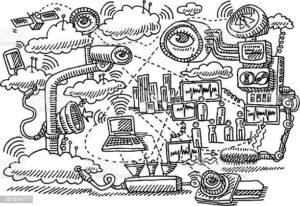 other, depending on the location. One only has to look around to see the continuous installation of new repeaters, or the continuous installation of new antennas on existing ones. What few people know is that there will be many ‘mini-antennas’, camouflaged both in street furniture (lampposts, manhole covers, bus stops, etc.) and in everyday objects, not to mention the thousands of satellites that have been launched, and will continue to be launched, into space, to connect even the most remote places on earth. What is known to date about the network already in use is that it causes serious and irreversible damage genetically, biologically and to the reproductive system, which makes it clear that its enhancement (by means of the installations we have just discussed) will cause even greater damage to all living things, further aggravating a situation which already today appears dramatic.