Category: Social Control
“The Possibility of a Historic Moment is Now” – Burkhard Garweg

… from the German newsite “nd” …
Below we document a letter from Burkhard Garweg, which was sent exclusively to »nd«. Garweg is one of the most wanted people by German police authorities because of suspected RAF membership and several robberies in which millions of euros were stolen. His letter is a critical outline of the history of the Red Army Faction (RAF) and at the same time a response to Caroline Braunmühl, daughter of RAF victim Gerold von Braunmühl, who in January in the »nd« was critical of her brother’s »call for clarification« , but also responded to a previous letter from Burkhard Garweg. Burkhard Garweg now addresses Braunmühl’s statements in his current text. He criticizes the RAF for a phase lasting from 1977 to around 1990 in which the urban guerrillas made military confrontation with the state the focus of their politics and neglected social revolutionary struggles. The author, born in 1968, comes from the autonomous squatter movement and now lives illegally, alternates between two levels in his text: one that analyses and evaluates from today’s perspective and a second, in italics, that speaks very personally from the past and his youth. Burkhard Garweg’s contribution is fully documented below.
“The possibility of a historic moment is now”
On the history of the RAF and the question of the reconstruction of an anti-capitalist, social revolutionary, anti-patriarchal and internationalist movement in the present day.
“The possibility of a historic moment is now”
On the history of the RAF and the question of the reconstruction of an anti-capitalist, social revolutionary, anti-patriarchal and internationalist movement in the present day.
In her text in »nd.Die Woche« of January 18, 2025, Caroline Braunmühl presents an alternative position to the bourgeois attitude that attempts to depoliticize the history of militant and armed resistance by reducing its content to violence and negating a political conflict.
In my statement of December 2024, it was also important to me to present resistance to capitalism in the context of the relations of violence – exploitation, the rule of man over man, nationalism, militarism and war – and thus to conduct the debate according to historical reality and to counter the historiography of the rulers and their attempts at manipulation.
The aim of bourgeois historiography is to delegitimize and criminalize anti-capitalist resistance and its history. Its elites have a fundamental interest in maintaining the conditions of exploitation and oppression and in being able to continue to make profits. This is what the proclamation from the ranks of its elites in the 1990s, which has gone down in history, stands for: “there is no alternative.”
Caroline Braunmühl associates the RAF and other militant groups, such as the Rote Zora, with radical resistance against the “violence of socially dominant groups and individuals against socially subordinates – such as class justice, patriarchal violence or transnational relationships of exploitation, oppression and war, from which the economic elites in the Federal Republic of Germany have profited and continue to profit today.” She identifies the justification for militant resistance against violent relations and at the same time denies the legitimacy of targeted assassinations by the RAF in its history.
She criticizes my statement from a feminist perspective and for lacking criticism of the RAF.
I agree with her that a reflective picture of the history of the struggles with the ability to see their weaknesses is necessary. The main thing is to be able to draw conclusions for the struggles of the future.
The world of the dominant capitalist system is moving at an increasing pace towards social and global erosion: war, poverty, displacement and the destruction of the planet’s ecological basis for life. The bourgeois state – and this affects the entire capitalist center of Europe and the USA – is increasingly using right-wing and authoritarian means. It uses the construction of a “national community” to differentiate itself from migrants, Muslims, refugees and the poor. It uses racism, nationalism and rapid militarization both internally and externally. This has repercussions – some of which are also intended – on bourgeois society.
This is becoming radicalized by the deeply rooted racist, patriarchal and social forms of differentiation, exclusion and oppression within society. The world is unmistakably moving towards an infernal tipping point of social, ecological and military erosion.
Capitalism offers no solution to this. It would also be a contradiction in terms. The elites’ solutions to the crisis are now authoritarianism, fascism, war and the process of unifying bourgeois and fascist politics. This is nothing other than a journey into the possible abyss with clear parallels to the historical crises that culminated in the world wars of 1914 and 1939 – albeit with an extremely increased global destructive potential in modern times.
Anyone who wants to prevent this should focus less on the hopeless rescue of bourgeois democracy as a facet of capitalism and the associated retention of the fundamental relations of violence, but rather on social revolutionary alternatives that can only be achieved as a result of social revolutionary and emancipatory struggles.
Existential questions arise: In which steps, initiatives and processes can the reconstruction of an anti-capitalist, social revolutionary and internationalist left be achieved?
But also: What do we take with us into the future from the struggles and concepts of history, from the attempts to overcome the thoroughly violent capitalism and imperialism? How do we as revolutionary leftists discuss and write history from below and appropriate it for the struggles of today and tomorrow and against the propagandistic, depoliticizing and criminalizing historiography from above? Continue reading ““The Possibility of a Historic Moment is Now” – Burkhard Garweg”
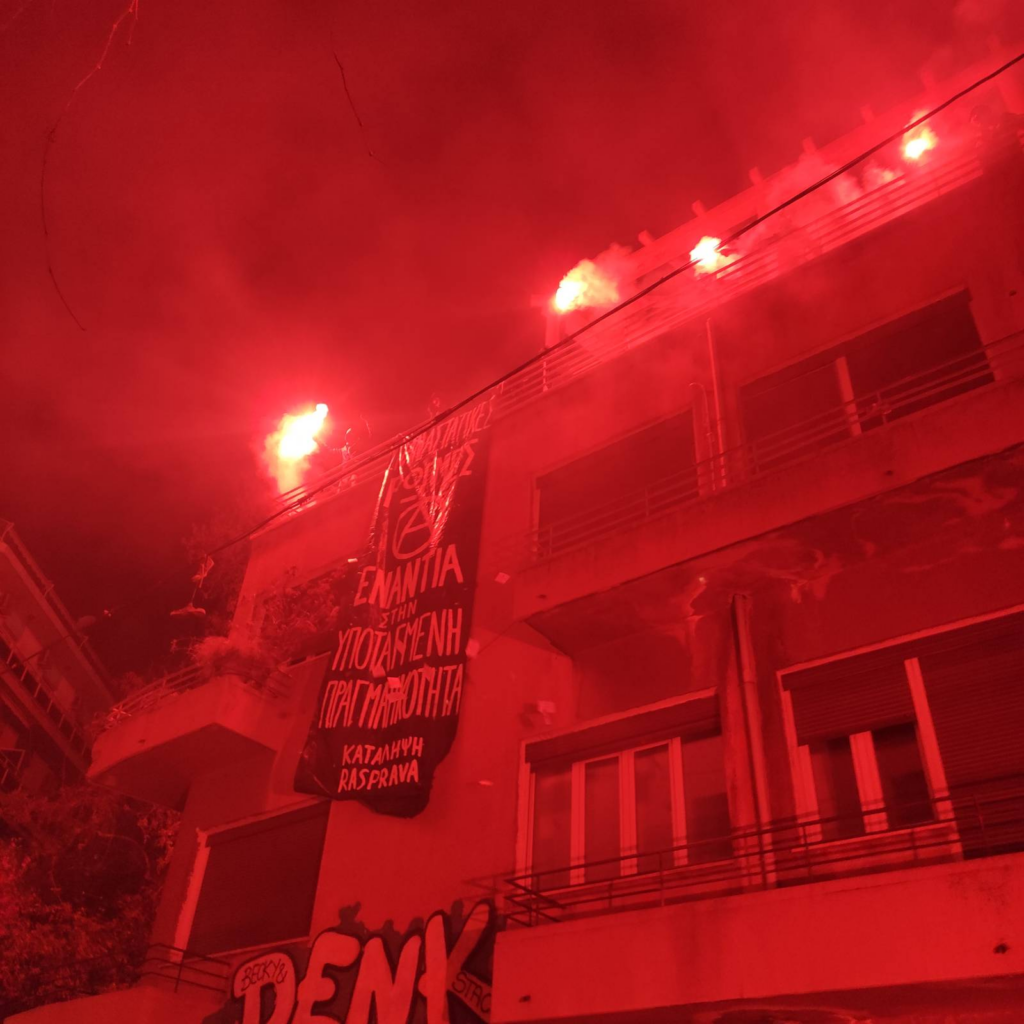
Thessaloniki, Greece: Against anthropocentrism and metropolitan domination, on the occasion of the Flyover
“Flyover” is part of a programme of 30 projects aimed at transforming Thessaloniki into a “metropolis of the Balkans”. Through it, a complex of environmental destruction, capitalist expansion and tightening social control is revealed. Opposing this design through a radical perspective allows us to attribute a material basis to a system that would like us to believe is unmistakable.
The project includes the overhaul of 13.5 km of Thessaloniki’s regional road and the addition of a 4 km Flyover, for which 187 hectares of the Sheih Su forest will be destroyed. To ensure social acceptance of the Flyover project, managed by the AVAX-Mytilineos consortium, a conscious green-washing practice is used. Its main argument is better regulation of traffic to reduce CO2 concentrations in the city. However, it is proven that larger transport infrastructures tend to increase traffic. In addition, Flyover will further cement the nature of the area, harming fauna and flora and favouring the ‘heat island’ effect, i.e. the rise in local temperature due to the heat-absorbing property of the cement.
In other words, this is all bullshit! But even if the project was viable, it would remain problematic. This is an issue with important socio-political implications which should not be dealt with solely from an environmental point of view.
Control: the spacetime of the metropolis
Capitalism needs infrastructure to ensure its enforcement and maintenance. Infrastructures like Flyover help to further control the movement of people and therefore define the relationships we build with each other.
In recent decades, global capitalism has been reorganized around regional metropolises. A network of production units that destroy the earth, exploiting the lives of humans and non-animals. With rural reforms and the use of land for infrastructure, quality of life and employment opportunities are becoming increasingly scarce in rural areas, forcing their inhabitants to move to cities. And in turn, this exponential growth of metropolises leads to further destruction of natural areas. The continuous expansion of the metropolises strengthens the power, strengthening our dependence on the capitalist-state system.
As the metropolis expands, city centres are refined and standardised. What used to be a place of residence, meeting and organisation, it is now becoming a showcase for attracting business and tourism. In the metropolis, the city itself is a product. Those who disturb the superficial ideal, the “undesirables”, the working class, the immigrants and the squatters, are pushed to the periphery. This ‘cleansing’ is made possible as roads, the metro and other modern means of transport allow displaced people to move daily from the degraded neighborhoods where they live to the shops, offices and factories where they are exploited. And as the metropolis expands, so does the portion of their day devoted to commuting. As a result, leisure time is constantly being reduced, absorbed by overtime work and transport.
At the same time, public spaces become smaller, more controlled, uninviting (when they simply do not disappear), or are replaced by cafeteria terraces, parking lots or Christmas markets. The “third places” are exhausted, with every corner of the city being used for financial profit. There is no place for socialisation without honor, let alone political organisation, which is increasingly difficult as spaces that offer alternatives (squats, universities, squares, etc.) are attacked. The only form of protest that is accepted is not only the non-violent, but the one that either does not disturb the production-consumption cycle or actively feeds it. Political discussions are transferred to the online world, social media posts replace our presence on the streets and walls of the city. We are building our own surveillance. Our opposition to the system is expressed solely through our lifestyle, from where and what we consume. Therefore, activism, as it lacks its necessary social character, turns into individual consumer practice, supplying dominant systems instead of opposing them.
So, through the control of space and time facilitated by roads and modern transportation, governments direct our behaviors to prevent any disruption to the capitalist machine.
Moreover, for this transport system to work, it requires a high level of organisation and specialisation of work that only the state can provide. It creates a vicious circle where it is at once the means, the consequence and the source of capitalist expansion. It operates in every aspect of the economy: urbanisation, fossil fuel extraction, agribusiness and nature management. A chain reaction, where the capitalist-state system spreads like a virus until it consumes every living creature, every piece of land and wildlife.
Disconnection: the nature of the metropolis
To assert and maintain its dominance, the capitalist-state system must appear as the logical evolution of our civilisation, inevitable if not desirable. And to trap our consciousness, it shapes our horizon.
In the world of the metropolises, the ground is covered by behemoths and shopping malls, motorways and railways, parking lots and data centres. People penetrate the mountains with tunnels and dig the land for minerals. They mix the limestone and the clay they get with sand from exhausted beaches to make cement and concrete. Containers and giant fishing boats empty the seas, while planes fill the skies. And as capitalism colonises wildlife, the smell of fresh air, the sense of grass and the songs of the birds disappear from our daily lives. In the smell of exhaust fumes, in the sounds of car horns and in the hasty crowd of the city-worker, we find isolation and alienation. By separating us from the natural world, the capitalist-state system separates us from each other.
In the name of the god of profit, it plunders fauna and flora, reducing them to resources that are sacrificed on the altar of civilisation. Non-human animals become meat, winds become kilowatts, trees become oxygen, soil becomes building materials, people become labour. Everyone and everything becomes a commodity.
Although capitalism has driven ecosystem destruction to unprecedented levels, most civilisations have been promoting human domination over other species for centuries. Anthropocentrism, the idea that human civilisation is separate from nature, that man comes first, allowed them to naturalise the unbridled exploitation of the rest of the living beings. A multitude of dipoles runs through our world to ensure the machine runs smoothly: male-female, white-non-white, civilisation-nature.
Many environmental discussions don’t question anthropocentrism and therefore don’t challenge the system. But it is not about “conserving our natural resources” to ensure the future of humanity, nor about “defending nature” as an unattainable ideal separated from us. It’s about refusing to stay on paths that others have mapped out for us. The non-human world is not ours to destroy or protect.
WE ARE NATURE DEFENDING ITSELF
THE DEFENSE OF THE FORST IS SELF-DEFENSE
Defend Seih Sou
defendseihsou@espiv.net
Source: Blessed Is The Flame
[Update] Gathering in solidarity with the anarchists accused in Scripta Scelera operation postponed to April 1, 2025 (Massa, Italy)
[UPDATE] We inform that during the hearing of February 14th, it was decided by the judge to postpone that one scheduled for the following 28th, for which a solidarity gathering had been called. The new hearing has been set for Tuesday, April 1st, the times remain unchanged.
GATHERING IN SOLIDARITY WITH THE ANARCHISTS ACCUSED IN SCRIPTA SCELERA OPERATION – MASSA, APRIL 1, 2025
August 8th, 2023. Following a request for ten arrests in prison, Scripta Scelera operation leads to nine precautionary measures against as many anarchists accused for the publication and distribution of the internationalist anarchist fortnightly ‘Bezmotivny’. A proceeding with which the State intended to ‘normalise’ the precautionary measures for charges concerning revolutionary publications. Scripta Scelera represents another ‘chapter’ in the war policies of the Italian state, in continuity among other things with recent repressive manoeuvres aimed at removing political practicability from ever wider social sectors.
April 1st, 2025. After just over a year, the trial against four accused comrades is coming to an end. Public prosecutor Manotti of the DDAA (“Anti-Mafia and Anti-Terrorism District Directorate”) of Genoa will deliver his indictment, with the requests for sentencing. Regardless of the prosecutor’s inquisitorial hypotheses on alleged instigatory and terrorist capabilities, the reasons that the State intends to strike are the ones of those who opposed the war also by denouncing the Italian industries involved in the production of armaments, as well as those who supported the 2022-’23 mobilisation against 41 bis prison regime and life imprisonment without the possibility of parole developed with Alfredo Cospito’s hunger strike.
WE WILL MEET ON TUESDAY, APRIL 1st, IN MASSA:
12:00 h. – SOLIDARITY GATHERING IN PIAZZA FELICE PALMA
15:00 h. – PRESENCE IN FRONT OF THE COURT IN PIAZZA DE GASPERI
* * *
We remind the account details for the solidarity fund and the e-mail address for organising benefit initiatives or receiving copies of the texts about Scripta Scelera operation:
Postepay card number: 5333 1711 9250 1035 – IBAN: IT12R3608105138290233690253 – Account holder: Ilaria Ferrario – For contacts: solidaliscriptascelera[at]paranoici[dot]org
Czech Republic: ‘I will not be intimidated’ – Lukáš Borl

In the past, I have published an extensive analysis of how specific individuals and groups try to isolate me, attack my private life, they’re threatening my safety and sabotage the Anti-militarist activities I engage in. One of the examples given was a description of how a member of the Trhlina infoshop told a friend of mine that I was at risk of a strong reaction from militant anti-fascists. In other words, the person from Trhlina was threatening me. At that time it was not yet clear whether the threat would come true. Now it is clear. On Saturday, February 8, 2025, I was physically attacked by one such militant anti-fascist in Prague’s Club 007.
What happened?
The attacker waited until most of my friends had left the club, followed me into the toilets, where he punched me several times in the face. No, I’m not surprised he chose such an insidious method. I’ve seen so much scheming from his cronies that I expect nothing but meanness, unscrupulousness and hypocrisy from them now.
Before “Mr. Hero” physically attacked, he also tried to “explain” to me in a few words that I should not oppose the defense of Ukraine. He did not give me any chance to express my arguments as to why I do not support the defence of Ukraine or the defence of Russia, the defence of the Czech Republic or the defence of any other state. I am an anarchist, therefore I fight against all states. Against fascist states, as well as democratic, stalinist, monarchist…
Instead of defending Ukraine – that is, a particular state and its regime – I prefer to support and defend the working class living on Ukrainian territory, because on the one hand it is now being massacred by Putin’s invasion, on the other hand it is being subjected to persecution and repression by the Ukrainian government, as well as to severe exploitation by Ukrainian capitalists.
I think explaining something like that to the person who attacked me would be pointless anyway. I doubt he would understand the basic gist of it. It wasn’t the first time he’s shown me that he has a strong penchant for harsh macho posturing but lacks serious political analysis.
I can’t keep quiet
I think it’s important to talk openly about this incident in public. It is a concrete example of the hypocrisy of those who spread statements on the Internet in which they style themselves as innocent victims who are being harmed, while in reality they are inciting and supporting aggression against opponents from the anarchist milieu.
I won’t hide the fact that I was shaken by this incident. I really felt a lot of frustration, anger and a sense of helplessness. But I soon processed these strong emotions. Thanks, among other things, to the people who stood up for me, gave me the emotional support I needed and reassurance that I was not alone in this.
Even though I know there are legitimate reasons to use violence against some people, I don’t feel like retaliating right now. It’s just that, just as a cornered animal can bite hard to get out of danger, I suppose I might act the same way in a similar situation. I’m not a pacifist , and I know there are times when one’s bare hands are not enough to defend oneself. Anyone who attempts to attack me and/or my friends again in the future should be aware of this.
My black eye and the pain in my face will certainly fade with time, but my willingness to support anti-war activities will remain. I’m sure of it. Whoever attacked me may not realize it, which is why it’s important for him and his macho crew to read this: I will not be intimidated! What happened that night only makes me want to continue on the path I’ve set out on.
For those who also want to follow this path, I would like to recommend supporting the fundraising for deserters and war refugees organized by the Anti-Militarist Initiative (AMI).
I also recommend getting the publication Voices from Ukraine. In these publications, the anarchist collective Assemble from Kharkiv illustrates the positions of revolutionaries living in a place where war is raging.
Anna Beniamino: Pathophysiology of the prison monster: poisons and antidotes (October 2024)

Anna Beniamino: Pathophysiology of the prison monster: poisons and antidotes (October 2024)
Article translated and published in Spanish in “Tinta de Fuga,” periódico anárquico contra las prisiones y la sociedad carcelaria, no. 7, segundo semestre 2024.
PHYSIOPATHOLOGY OF THE PRISON MONSTER:
POISONS AND ANTIDOTES
Stories of mice and men
In pharmacology laboratories, antidepressants are tested with an experiment of exquisitely human cruelty: a mouse, drugged or “nature,” is submerged in a glass cylinder half-filled with water and the time of desperate swimming before immobility overtakes is calculated.
Usually the rodent without psychotropic support tries to climb along the cylinder and jump for 5 minutes before giving up; antidepressants lengthen desperate swimming attempts by a few minutes before resignation overtakes.
Stripped of the cynicism it conveys, the Porsolt or “desperate swimming” test is a useful allegory to illustrate the current situation in Italic jails and this summer’s trickle of suicides and riots in the overcrowded, dilapidated communal sections1, a charcoal of forced cohabitation in cramped spaces, in a word humiliating human dignity: drug-induced apathy and depression, the ubiquitous “therapy,” desperate attempts at reaction that often take self-harming forms, backyard hegemonies, desolidarization, childish brawls, where there is a constant pouring of suggestions and models from TV dramas, which is then the lobotomizing diversion that overcomes “therapy” in the pervasive echoing from cell to cell.
To the pathological infantilization of the individual, the prison works methodically, depriving him not only of freedom of movement, but also of that of minimal choice in the course of the day: the idiotic and incomprehensible regulations, the extreme bureaucratization of every minutia of daily survival. Depersonalizing mechanisms that deprive one’s humanity, the application of which essentially serves to establish the pressure of the repressive structure (and the individual’s capacity for resistance or adaptation), are handled aseptically, feeding a meat grinder where reactions can cover the entire range between anesthetized apathy and revolt as an assertion of subsistence in life rather than claim.
This Dantesque bedlam is overlaid and counterbalanced by the fragmentation and consequent isolation of differentiated sections and circuits. In most compas one finds oneself as well as in small numbers, divided from the rest of humanity in chains, locked between high-security sections and, even more isolated, in 41bis2 circuits.
High-security sections have an additional internal separation to avoid contact between those accused of “terrorism,” domestic and international (AS2) and those of “mafia-style criminal conspiracy” (AS3) and related offenses, to avert, in the eyes of the legislature, monstrous criminal chimeras due to cross-species interbreeding3. Or, more prosaically, even if only to prevent the spread of a basic knowledge of one’s rights as a prisoner, a subject on which political prisoners are normally better versed, as they come from more literate backgrounds on the subject and are more prone to the consequent dialectic.
In AS, with the rubber stamp of the “mafia” or “terrorism” formula, an opposite strategy is applied to the overcrowded common sections: separation between prisoners, removal from the place of residence to make contact with family members more difficult, reduced contact with the outside world (fewer interviews, 4 hours monthly, and fewer phone calls, 2 monthly of 10 minutes each), heavier sentences, with less if any possibility of alternative sentences under the aegis of 4bis o.p. 4.
Then there is 41bis, the bottom of the well, the bottleneck of the repressive funnel where it is easier to get in than to get out, in the highest degree5, with a further exacerbation of solitary confinement, intracarceral and extracarceral: a one-hour interview per month with partitioned glass and audio-video recording; almost total postal censorship; limitation of items allowed in the cell, including books and music CDs, the purchase of which is in any case made very difficult, if not impossible; one hour of air time per day in cramped, netted yards and with socializing with up to three other prisoners (in fixed groups selected by management).
This prologue, unpleasant, is to explain a minimum the difficulties and contradictions experienced, as antiauthoritarians, in facing and fighting prison these days in these shores.
The strategy of isolation, sterilization of human contacts and rescission of solidarity networks is obviously not an Italian prerogative but, as our Chilean comrades are well understanding, a practice that is spreading and being perfected there as well, as in the aggravation of Francisco’s conditions of isolation and the restructuring of the Alta Seguridad. Just as everywhere the restructuring of detention facilities combines punitive logics toward the individual refractor with those of a “Fordist” efficiency of preventive repression aimed at creating compartmentalized and incommunicative levels to more effectively and aseptically manage control, inside as well as outside. Continue reading “Anna Beniamino: Pathophysiology of the prison monster: poisons and antidotes (October 2024)”
Gathering in solidarity with the anarchists accused in Scripta Scelera operation (Massa, Italy, February 28, 2025) EN/IT
GATHERING IN SOLIDARITY WITH THE ANARCHISTS ACCUSED IN SCRIPTA SCELERA OPERATION – MASSA, FEBRUARY 28, 2025

August 8th, 2023. Following a request for ten arrests in prison, Scripta Scelera operation leads to nine precautionary measures against as many anarchists accused for the publication and distribution of the internationalist anarchist fortnightly ‘Bezmotivny’.
A proceeding with which the State intended to ‘normalise’ the precautionary measures for charges concerning revolutionary publications. Scripta Scelera represents another ‘chapter’ in the war policies of the Italian state, in continuity among other things with recent repressive manoeuvres aimed at removing political practicability from ever wider social sectors.
February 28th, 2025. After one year, the trial against four accused comrades is coming to an end. Public prosecutor Manotti of the DDAA (“Anti-Mafia and Anti-Terrorism District Directorate”) of Genoa will deliver his indictment, with the requests for sentencing. Regardless of the prosecutor’s inquisitorial hypotheses on alleged instigatory and terrorist capabilities, the reasons that the State intends to strike are the ones of those who opposed the war also by denouncing the Italian industries involved in the production of armaments, as well as those who supported the 2022-’23 mobilisation against 41 bis prison regime and life imprisonment without the possibility of parole developed with Alfredo Cospito’s hunger strike.
WE WILL MEET ON FRIDAY, FEBRUARY 28th, IN MASSA:
12:00 h. – SOLIDARITY GATHERING IN PIAZZA FELICE PALMA
15:00 h. – PRESENCE IN FRONT OF THE COURT IN PIAZZA DE GASPERI
* * *
We remind the account details for the solidarity fund and the e-mail address for organising benefit initiatives or receiving copies of the texts about Scripta Scelera operation:
Postepay card number: 5333 1711 9250 1035 – IBAN: IT12R3608105138290233690253 – Account holder: Ilaria Ferrario – For contacts: solidaliscriptascelera[at]paranoici[dot]org Continue reading “Gathering in solidarity with the anarchists accused in Scripta Scelera operation (Massa, Italy, February 28, 2025) EN/IT”
Strasbourg/Cherbourg, France: Two examples of the widespread use of police drones

Drones, the new Swiss army knives of the border police
La Presse de la Manche, January 11, 2025 (excerpt)
For the past year, drones have been used at the port of Cherbourg-en-Cotentin to monitor the restricted zone. This high-tech equipment is now being used for other missions.
For just over a year, the Prefect of the Manche department has authorized the use of drones to monitor the border zone of the port of Cherbourg-en-Cotentin, the restricted access zone (ZAR) and its immediate surroundings. This is where migrants are accustomed to moving around. The drones can be adjusted to suit the weather conditions, providing high-quality images and precise positioning.
“They can fly at a maximum altitude of 120 meters, in complete silence. This means they can access places that were previously inaccessible by car, such as the rock face near the Mielles area, which is a common hiding place for migrants”, explains Chief Brigadier Anthony, a remote pilot based in Cherbourg. The thermal cameras fitted to their drones also help them to discover where migrants are hiding, particularly at night. Continue reading “Strasbourg/Cherbourg, France: Two examples of the widespread use of police drones”
Perugia, Italy: Further statements by anarchist comrades Matteo Monaco, Sara Ardizzone & Paolo Arosio at the Sibilla proceedings

Statement read by Matteo Monaco during the preliminary hearing in the Sibilla proceedings
I take the floor well pleased to be able to do so in person this time.
I would have liked to be here as early as October 10 on the occasion of the preliminary hearing that was then postponed, but unfortunately the work commitments to which I have to submit for a living and the one thousand five hundred kilometers separating my residence from this courtroom prevented me from doing so. I am not going to rage about the gross errors, certainly not mine, that led to the failures of notification against me and resulted in the postponement of the hearing. They qualify themselves. And they also qualify much more actually. I face this hearing, as well as the eventual trial that will ensue, with serenity. Aware that I have nothing to defend myself against in a political trial such as this one. Proud to be on the stand together with some of the comrades dearest to me. Happy to finally be able to greet to Alfredo and express all my closeness and solidarity with him. Determined to look those who claim the right to judge me in the face.
We are here because we have to answer, in particular, the charge of incitement to commit crimes for the purpose of terrorism and subversion of the democratic order. Good. I’m not interested in going into the merits of the charges, let alone, as already mentioned, defending myself against these crimes of opinion. What I am interested in is to make my considerations clear with respect to this charge.
In my conception of anarchism, as well as of life itself, there is no instigator-instigated binomial, there are no empty heads to be filled, there are no masses to be directed and steered, and I do not claim to instigate anything. The very term “instigation” has a negative, devious meaning, implying a kind of persuasion of the other by deception or trickery or manipulation. And that is precisely why, gentlemen, I believe that there is no better instigator of crime than the state itself. What do you think engenders feelings of revenge and revolt among the exploited and oppressed all over the world? The export of war or anarchists? Are you really convinced that if someone decides to take charge of his life and revolt, it is because the anarchists whispered it in his ear? Does it not occur to you that the systemic violence perpetrated through laws, institutions and repressive apparatuses, always directed toward the proletariat and always in defense of the bourgeoisie, may genuinely produce a backfire? What then is the question? If anarchism propagates ideas of revolt? Whether I as an anarchist point to the destruction of this miserable system? Of course I do. If I write and applaud theories and practices of subversion? That seems like an open secret to me.
The truth is that the state, capital, its apparatuses and their concrete personifications, including you, are afraid. Not afraid of anarchists let’s be clear, they are afraid that the situation will get out of hand, that the control they claim to have over the world may falter. Any sick system inevitably tends to put itself on the defensive, taking measures to try to maintain an internal balance and trying to annihilate threats, whether internal or external. The creaks of this imbalance can be felt just about everywhere, and slowly they are beginning to become more and more evident and, above all, the perpetrators increasingly clear in people’s eyes: economic disasters, environmental disasters, wars, pandemics. Crises, you know, generate discontent, discontent very easily turns into anger, anger triggers riots. And this, all of you, you certainly cannot afford. So you try to act in a preventive way, going to strike relentlessly at those who have already declared war on you for a century and a half and those who consider you enemies regardless of crisis and discontent, trying to prevent certain ideas from spreading among those who have begun to harbor a certain distrust and resentment toward you. Because they are dangerous ideas for your stability and for your comfortable places in ivory towers. Continue reading “Perugia, Italy: Further statements by anarchist comrades Matteo Monaco, Sara Ardizzone & Paolo Arosio at the Sibilla proceedings”
Italy: Statement read by Michele Fabiani during the preliminary hearing in the Sibilla proceedings
Statement read by Michele Fabiani during the preliminary hearing in the Sibilla proceedings
Legalitarian rhetoric sees trials as a moment in which truths are established, in which a person endowed with willpower must willingly or unwillingly assume responsibility with respect to malicious episodes. To the point that one is in effect acquitted when it is established that the accused is not of sound mind. I have never believed anything like that in my entire life: I think it is an ideological junk typical of bourgeois liberalism to crush necessity, need, material conditions, personal formation, innate impulses within the concepts of guilt and innocence. But today I want to follow, in the economy of this speech, the commonplace. Not least because today marks the likely beginning of a particular trial, a trial against books and newspapers.
What kind of truth does Operation Sibilla conceal? And what responsibility are the protagonists taking on?
For consistency I start with my own, of responsibilities. I have written articles, I have published and disseminated anarchist press, I have published anarchist books. I published, through Monte Bove Editions, the book Which International? by Alfredo Cospito and many others. And I am so proud of having done that, that just last October-in a deliberately provocative gesture toward the previous preliminary hearing-I printed its third edition.
However, there are responsibilities that will also have to be assumed by those who support the prosecution, in a trial in which the body of the crime are books and newspapers. I say this with extreme sincerity, I just do not understand how the state cannot comprehend such elementary evidence: since the world began, he who is censored, gagged, interned, tortured for his ideas gains popularity and fame from the very action of censorship. Everyone knows who Socrates and Giordano Bruno are, I don’t think anyone in here knows the names of Meleto or Cardinal Giulio Antonio Santorio.
Which side of the story do you sit on?
When it comes to accountability there is one that is greater than all and frankly crushes jurisprudential technicalities. When it comes to truth, I cannot be silent about the most shameful truth of this trial. As we discuss criminal procedure there is an elephant in the room. Right in here.
I just cannot keep quiet about the scandal that there is a co-defendant of mine, a comrade of mine, locked up in 41 bis and connected by video conference. When we talk about truth, no one can deny that this investigation played a central role in the decision to lock Alfredo Cospito up in 41 bis. The minister of justice spoke about it in parliament, chief prosecutor Cantone himself spoke about it during a hearing.
This is a scandal not only because 41 bis is an international disgrace, a torture prison regime to which no one should be subjected. Above all, it is a scandal because we anarchists say things clearly. In this book, Which International?, you will not find a cabal of cryptic messages. The writings of anarchists are not pizzas! Nor will you find orders, because anarchists have no leaders and take orders from no one. Continue reading “Italy: Statement read by Michele Fabiani during the preliminary hearing in the Sibilla proceedings”