Skip to content

Dark Nights

For Mutual Aid & Solidarity

  • Contact
  • Distro
  • Direct Action
  • PGP Key
  • Financial Solidarity

Two contributions by Juan Sorroche: “The Mutual Agreement of Non-Systemic Revolutionary Anarchism or the Myth of Systemic Revolutionary Anarchism” and “A Misinterpretation of the Concept of Anarchist Individualism”

Posted on 2025/03/14 by darknights

Two contributions by Juan Sorroche: “The Mutual Agreement of Non-Systemic Revolutionary Anarchism or the Myth of Systemic Revolutionary Anarchism” and “A Misinterpretation of the Concept of Anarchist Individualism”

– THE MUTUAL AGREEMENT OF NON-SYSTEMIC REVOLUTIONARY ANARCHISM –
OR
– THE MYTH OF SYSTEMIC REVOLUTIONARY ANARCHISM –

Should ideological principles, concepts if not deepened nor confronted nor recognized in anarchism be assumed, assumed and accepted?

Once again, workers’ organization, strike, general strike, direct action, boycott, sabotage and armed insurrection itself are but means. Anarchy is the end.
Errico Malatesta, Syndicalism and insurrectionist organization, Monte Bove Editions, 2023

This is the second response in continuation of the critical-dialectic to certain evaluations and analyses regarding the article in “Vetriolo,” No. 7, “Revolutionary Anarchism versus Desistance.” I will use the text of “Vetriolo” as a compass for my reflections and to set forth conclusions. I don’t think they are anything groundbreaking, just a mixture of old and “new” ideas and concepts remixed. However to be honest it is also because of my little ability to write and follow with linearity certain discursive concepts that are very complex for me. And that the article touches, and they are different notions such as ideological principles, even historical, the organizational methods: the economic question in anarchism, as written in the first text, and different and very different tactics and strategies of struggle in anarchism. It also touches on what we call the more “visceral” subjective-objective conceptions of individual anarchist sensibilities. It also touches on anarchy-utopia if we want to deal in depth with the concept of revolutionary anarchism and thus the individual-collective notion of organizing.
These different notions as we see in reality are very complicated and complex of much of action anarchism. So please don’t blame me if I will be long-winded and use the writing of “Vetriolo” as a crutch and to thus develop my ideas with more linearity of analysis and criticism, more complex. But I want to try to write and take advantage to deepen the theories of the experiences of my individual vision of anarchism and anarchism-utopian. Without delegating to others.
And finally, for convenience, I will come out with separate and specific chapters as I go along. But as I said in the previous paper, which came out in the journal “Days and Nights [I giorni e le notti]” No. 15, it will be part of a whole, of a fuller pamphlet that I will title: “The Anarchist Organization of Change” “The Middle Way Planning” and “The Individual-Anarchist-Action.”
To begin to question the comparison of a complex range of concepts for me it is essential first, to understand each other, to have a conceptualization of mutual agreement. And, mind you, in common in sharing does not mean to flatten it into the all the same, but rather to be recognized in diversity in order to understand each other a little more deeply.

The article begins with this big question, “Revolutionary Anarchism?”

To begin to clarify. In part, only in part, I agree with the article by “Vetriolo,” who writes that “the revolutionary principle is inseparable from the anarchist idea.” So yes, anarchists and the whole anarchist movement and anarchism historically to date is in its majority revolutionary. So I could follow the same logic and say that even in the great majority it has been ideologically of anarchist-communist principles.
But, be careful, because to say that “the revolutionary principle is inseparable from the anarchist idea” to me is not really correct, either personally or historically.
Because in anarchism from the late 1800s until today there are anarchist individualities who do not believe, and have not been willing to take on, consciously denying it, the revolutionary principle.
Of course can I, can we, say that these anarchist comrades can be counted on the fingers of my hand? Yes. But they have been there and this cannot be erased by a majority criterion.
I believe that in anarchism, and in anarchism in general, one should not, by force of majorities or minorities, attach reasons or principles, and all the more so if they come from principles of revolutionary anarchism. Because I sincerely believe that so principles become absolute single idea, with their perfect method that everyone must adopt, they become myths, beliefs.
I believe that we must accept of the past and present the various diversities as such in anarchism, even those that are not in the least for revolutionary social transformations. But moved by other infinite motives and interests that of anarchist individualities have assumed for themselves:
For individual enjoyment? Revenge? Love? Despair? Revolt? Selfish egoism? For the sake of chaos? For the pleasure of destruction?, etc.
And this is beyond whether one likes it or not, or whether these different principles are conflicting. Just as there is no denying that there have been these non-revolutionary anarchist comrades, and that they have made their own contributions to anarchism of attack and not surrender. And I say all this from firsthand experience because I was one of these anarchist comrades who only believed in destruction and chaos and did not think about it, nor was I absolutely and consciously interested in social and revolutionary change. And this I do not want to ignore as if it were nonexistent, but instead as a constant development and part of me as an anarchist and of the contribution to anarchism that, however limited, I was able to make. This is a fact.
I would like to remind that concepts should be usable in both intuitive and logical relationships, and practical! And above all, first thoroughly discussed and shared, then acknowledged and accepted. And then, when they are accepted and enter into our articulation of theoretical-practical notions, then, for me, they are part of an anarchic collective whole. For me collective should be thoughtfully chosen by mutual agreement. Which very often, and systematically, is not done. It is a self-criticism. Continue reading “Two contributions by Juan Sorroche: “The Mutual Agreement of Non-Systemic Revolutionary Anarchism or the Myth of Systemic Revolutionary Anarchism” and “A Misinterpretation of the Concept of Anarchist Individualism”” →

Posted in Prison StruggleTagged A misinterpretation of the concept of anarchist individualism, Anarchism of Action, Anarchist Prisoners, Emile Armand, Individualist Anarchist, Italy, Juan Sorroche, Revolutionary Anarchism, Text, Vetriolo

Greece in turmoil and pain – Rage, massive protests and riots for the 57 dead of the train crash

Posted on 2025/03/14 - 2025/03/14 by darknights

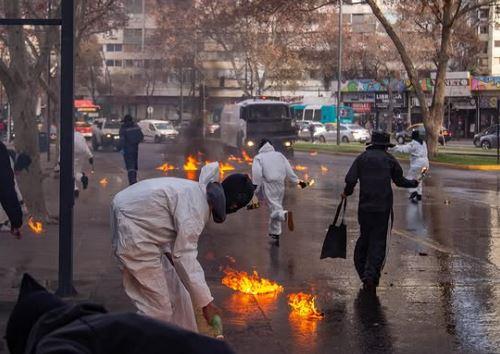
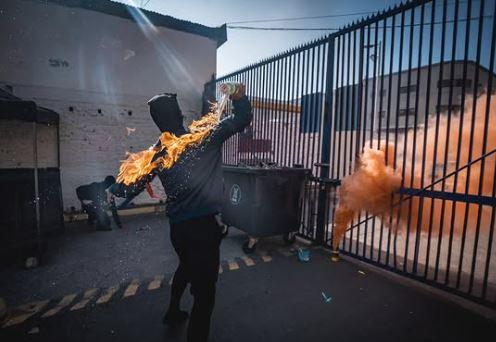
Posted in Direct ActionTagged Athens, Greece, Incendiary Attack, Molotov Attack, Molotov Cocktail, Riot, Tempi Train Crash 2023, Thessaloniki

Heraklion, Greece: Incendiary attack against a bus belonging to the GEK TERNA conglomerate

Posted on 2025/02/18 by darknights

What a beautiful sight a burning bus is!

The GEK TERNA conglomerate counts among its losses a staff transport bus, on 24/01/2025, due to arson. A giant company that is responsible for the greatest disasters in the Cretan environment, the Greek territory, but also internationally.

It does business and secures its profits by destroying forests and leveling mountains. It uproots people, animals and plants.

Capitalism has its own ethics: profit above all else. Arguments, logic and justice are unnecessary. As long as they’re profitable, they’ll keep going, even if they leave behind nothing but debris.

It’s not the metal sheets or the tires that are burning and smelling, it’s not the financial damage, even though they make us happy. The fire speaks for itself. It chases the sky, however elusive and distant it may seem. From the spark to the flame, and from the flame to the fire. May we bring fire to the cities, may we burn to ashes the ethics of profit and its supporters.

Source: Blessed Is The Flame

Posted in Direct ActionTagged Anti-Civilization, Crete, environmental destruction, GEK TERNA, Greece, Heraklion, Incendiary Attack

Thessaloniki, Greece: Against anthropocentrism and metropolitan domination, on the occasion of the Flyover

Posted on 2025/02/18 by darknights

“Flyover” is part of a programme of 30 projects aimed at transforming Thessaloniki into a “metropolis of the Balkans”. Through it, a complex of environmental destruction, capitalist expansion and tightening social control is revealed. Opposing this design through a radical perspective allows us to attribute a material basis to a system that would like us to believe is unmistakable.

The project includes the overhaul of 13.5 km of Thessaloniki’s regional road and the addition of a 4 km Flyover, for which 187 hectares of the Sheih Su forest will be destroyed. To ensure social acceptance of the Flyover project, managed by the AVAX-Mytilineos consortium, a conscious green-washing practice is used. Its main argument is better regulation of traffic to reduce CO2 concentrations in the city. However, it is proven that larger transport infrastructures tend to increase traffic. In addition, Flyover will further cement the nature of the area, harming fauna and flora and favouring the ‘heat island’ effect, i.e. the rise in local temperature due to the heat-absorbing property of the cement.

In other words, this is all bullshit! But even if the project was viable, it would remain problematic. This is an issue with important socio-political implications which should not be dealt with solely from an environmental point of view.

Control: the spacetime of the metropolis

Capitalism needs infrastructure to ensure its enforcement and maintenance. Infrastructures like Flyover help to further control the movement of people and therefore define the relationships we build with each other.

In recent decades, global capitalism has been reorganized around regional metropolises. A network of production units that destroy the earth, exploiting the lives of humans and non-animals. With rural reforms and the use of land for infrastructure, quality of life and employment opportunities are becoming increasingly scarce in rural areas, forcing their inhabitants to move to cities. And in turn, this exponential growth of metropolises leads to further destruction of natural areas. The continuous expansion of the metropolises strengthens the power, strengthening our dependence on the capitalist-state system.

As the metropolis expands, city centres are refined and standardised. What used to be a place of residence, meeting and organisation, it is now becoming a showcase for attracting business and tourism. In the metropolis, the city itself is a product. Those who disturb the superficial ideal, the “undesirables”, the working class, the immigrants and the squatters, are pushed to the periphery. This ‘cleansing’ is made possible as roads, the metro and other modern means of transport allow displaced people to move daily from the degraded neighborhoods where they live to the shops, offices and factories where they are exploited. And as the metropolis expands, so does the portion of their day devoted to commuting. As a result, leisure time is constantly being reduced, absorbed by overtime work and transport.

At the same time, public spaces become smaller, more controlled, uninviting (when they simply do not disappear), or are replaced by cafeteria terraces, parking lots or Christmas markets. The “third places” are exhausted, with every corner of the city being used for financial profit. There is no place for socialisation without honor, let alone political organisation, which is increasingly difficult as spaces that offer alternatives (squats, universities, squares, etc.) are attacked. The only form of protest that is accepted is not only the non-violent, but the one that either does not disturb the production-consumption cycle or actively feeds it. Political discussions are transferred to the online world, social media posts replace our presence on the streets and walls of the city. We are building our own surveillance. Our opposition to the system is expressed solely through our lifestyle, from where and what we consume. Therefore, activism, as it lacks its necessary social character, turns into individual consumer practice, supplying dominant systems instead of opposing them.

So, through the control of space and time facilitated by roads and modern transportation, governments direct our behaviors to prevent any disruption to the capitalist machine.

Moreover, for this transport system to work, it requires a high level of organisation and specialisation of work that only the state can provide. It creates a vicious circle where it is at once the means, the consequence and the source of capitalist expansion. It operates in every aspect of the economy: urbanisation, fossil fuel extraction, agribusiness and nature management. A chain reaction, where the capitalist-state system spreads like a virus until it consumes every living creature, every piece of land and wildlife.

Disconnection: the nature of the metropolis

To assert and maintain its dominance, the capitalist-state system must appear as the logical evolution of our civilisation, inevitable if not desirable. And to trap our consciousness, it shapes our horizon.

In the world of the metropolises, the ground is covered by behemoths and shopping malls, motorways and railways, parking lots and data centres. People penetrate the mountains with tunnels and dig the land for minerals. They mix the limestone and the clay they get with sand from exhausted beaches to make cement and concrete. Containers and giant fishing boats empty the seas, while planes fill the skies. And as capitalism colonises wildlife, the smell of fresh air, the sense of grass and the songs of the birds disappear from our daily lives. In the smell of exhaust fumes, in the sounds of car horns and in the hasty crowd of the city-worker, we find isolation and alienation. By separating us from the natural world, the capitalist-state system separates us from each other.

In the name of the god of profit, it plunders fauna and flora, reducing them to resources that are sacrificed on the altar of civilisation. Non-human animals become meat, winds become kilowatts, trees become oxygen, soil becomes building materials, people become labour. Everyone and everything becomes a commodity.

Although capitalism has driven ecosystem destruction to unprecedented levels, most civilisations have been promoting human domination over other species for centuries. Anthropocentrism, the idea that human civilisation is separate from nature, that man comes first, allowed them to naturalise the unbridled exploitation of the rest of the living beings. A multitude of dipoles runs through our world to ensure the machine runs smoothly: male-female, white-non-white, civilisation-nature.

Many environmental discussions don’t question anthropocentrism and therefore don’t challenge the system. But it is not about “conserving our natural resources” to ensure the future of humanity, nor about “defending nature” as an unattainable ideal separated from us. It’s about refusing to stay on paths that others have mapped out for us. The non-human world is not ours to destroy or protect.

WE ARE NATURE DEFENDING ITSELF

THE DEFENSE OF THE FORST IS SELF-DEFENSE

Defend Seih Sou

defendseihsou@espiv.net

Source: Blessed Is The Flame

Posted in Eco Struggle, General, Social ControlTagged anthropocentrism, Anti-Civilization, Defend Seih Sou, Greece, metropolis, Thessaloniki

Bristol, UK: Windows smashed of BAM construction offices

Posted on 2025/02/17 - 2025/02/18 by darknights

Received by email & transmitted:

Bristol, UK: Windows smashed of BAM construction offices

On 16th February we decided instead of partaking in the vomit enducing show of ‘romantic capitalism’ to break the windows of BAM construction in Stoke Gifford, Bristol.

BAM construction are one of the biggest construction companies internationally, who contribute to the Leviathan nightmare. We’re sick of seeing their lifeless glass and concrete buildings everywhere, there’s nothing wild and natural about these smart cityscapes.

BAM have their artificial hands on nearly every construction project you can name. Our minds cast back to their involvement in the construction of a ‘humane prison’ Dedermonde in Belgium. More locally they built the new Engineering building at the University of West England that contains its new robotics lab & they are also responsible for helping to construct the new ‘Temple Quarter Enterprise Zone.’ Another brick in the transformation of Bristol into a silicon valley of the UK, where technological and scientific startups along with hubs will be let to reign free. If this wasn’t enough BAM have been chosen as one of the key partners for the ‘UK Small Modular Reactors (SMR) Programme’. We laugh cynically at the idea that the UK state is implementing a net zero carbon target or even tackling climate change with this charade that shows ‘green capitalism’ is an absolute lie, just a displacement of ecological destruction elsewhere, whether it is the lithium extraction plant in Cornwall or nuclear waste from these mini Fukushimas. Clean power our arses!

“Leviathan is turning into Narcissus, admiring its own synthetic image in
its own synthetic pond, enraptured by its spectacle of itself.
It is a good time for people to let go of its sanity, its masks and
armors, and go mad, for they are already being ejected from its pretty
polis.”

Eco-Anarchists – ‘Fredy Perlman’ Gang

Posted in Direct ActionTagged 'Temple Quarter Enterprise Zone', 'UK Small Modular Reactors (SMR) Programme', BAM Construction, Belgium, Bristol, Cornwall, Dedermonde prison, Eco-Anarchists - 'Fredy Perlman' Gang, Fredy Perlman, Fukushima Nuclear Disaster, Lithium Mining, Nuclear Industry, Nuclear Waste, Prison Profiteer, Robotics, Smart Cities, UK, University of West England

[Update] Gathering in solidarity with the anarchists accused in Scripta Scelera operation postponed to April 1, 2025 (Massa, Italy)

Posted on 2025/02/17 by darknights

[UPDATE] We inform that during the hearing of February 14th, it was decided by the judge to postpone that one scheduled for the following 28th, for which a solidarity gathering had been called. The new hearing has been set for Tuesday, April 1st, the times remain unchanged.

GATHERING IN SOLIDARITY WITH THE ANARCHISTS ACCUSED IN SCRIPTA SCELERA OPERATION – MASSA, APRIL 1, 2025

August 8th, 2023. Following a request for ten arrests in prison, Scripta Scelera operation leads to nine precautionary measures against as many anarchists accused for the publication and distribution of the internationalist anarchist fortnightly ‘Bezmotivny’. A proceeding with which the State intended to ‘normalise’ the precautionary measures for charges concerning revolutionary publications. Scripta Scelera represents another ‘chapter’ in the war policies of the Italian state, in continuity among other things with recent repressive manoeuvres aimed at removing political practicability from ever wider social sectors.

April 1st, 2025. After just over a year, the trial against four accused comrades is coming to an end. Public prosecutor Manotti of the DDAA (“Anti-Mafia and Anti-Terrorism District Directorate”) of Genoa will deliver his indictment, with the requests for sentencing. Regardless of the prosecutor’s inquisitorial hypotheses on alleged instigatory and terrorist capabilities, the reasons that the State intends to strike are the ones of those who opposed the war also by denouncing the Italian industries involved in the production of armaments, as well as those who supported the 2022-’23 mobilisation against 41 bis prison regime and life imprisonment without the possibility of parole developed with Alfredo Cospito’s hunger strike.

WE WILL MEET ON TUESDAY, APRIL 1st, IN MASSA:
12:00 h. – SOLIDARITY GATHERING IN PIAZZA FELICE PALMA
15:00 h. – PRESENCE IN FRONT OF THE COURT IN PIAZZA DE GASPERI

* * *

We remind the account details for the solidarity fund and the e-mail address for organising benefit initiatives or receiving copies of the texts about Scripta Scelera operation:

Postepay card number: 5333 1711 9250 1035 – IBAN: IT12R3608105138290233690253 – Account holder: Ilaria Ferrario – For contacts: solidaliscriptascelera[at]paranoici[dot]org

Posted in Social ControlTagged 41 bis, Alfredo Cospito, Bezmotivny, DNAA (Direzione Nazionale Antimafia e Antiterrorismo), Hunger Strike, Italy, Massa, Operation Scripta Scelera, Repression, Solidarity Gathering, Trial

New PGP Key

Posted on 2025/02/16 - 2025/03/14 by darknights

—–BEGIN PGP PUBLIC KEY BLOCK—–

xjMEZ7IAchYJKwYBBAHaRw8BAQdA/WJMTvtOIxNZG4WdDQAEKd3y6QjHwX4n7QKW
OUvDEtXNGkROIDxkYXJrbmlnaHRzQHJpc2V1cC5uZXQ+wo8EExYIADcWIQQbsC9h
/XDDaIm048A9Nnxm4eZDuwUCZ7IAcgUJBaOagAIbAwQLCQgHBRUICQoLBRYCAwEA
AAoJED02fGbh5kO7M1ABAL4vtntE25/nfvVSNllDNwLW7ZeZwUUX+Ultbkzi7PxB
AQCqB1hD6K8zvPVAbtWEc7oKR7fUOe9unSBa1wtO7PcLD844BGeyAHMSCisGAQQB
l1UBBQEBB0BiZjuVLqvhVJNfAhpfNYuX9Y1WEwOVolUGEv1/st/TSAMBCAfCfgQY
FggAJhYhBBuwL2H9cMNoibTjwD02fGbh5kO7BQJnsgBzBQkFo5qAAhsMAAoJED02
fGbh5kO7p8oA/0E2HkWoyPDMTpPwad3E/IUD5asgmhpVeWDdSOHGmHpfAQDCSeyb
Ym1fp4VIuWz2WidX9MjQGURTdDe3lWZS/ZtsDQ==
=Ks5/
-----END PGP PUBLIC KEY BLOCK-----
Posted in General

Chile: Interview with Synthesis anarchists Boina Anarquista

Posted on 2025/02/16 - 2025/02/17 by darknights

Chile: Interview with synthesis anarchists Boina Anarquista

Interview between synthesis anarchists Boina Anarquista in Chile and JURNAL ANARKI in Indonesia.

1. What motivates you to create this counter-information newspaper?

A: Hello, good day. Well, the platform began as a newspaper, edited precariously with Word. What motivated us was that nearly 11 years ago, in 2013, when the waves of the student movement in Chile were still present, we started researching and came across a book about anarchist propaganda in Chile. We were amazed by how much of it existed in the 1920s.

Around that time, there were other physical-format newspapers: El Surco (2009-2013), El Amanecer (from Chillán, in central-southern Chile) (2011-2013), El Sol Ácrata (from Calama, northern Chile; 2011-2024), Acracia (from Valdivia, far south of Chile; 2012-2019) and Solidaridad, a Libertarian-Communist newspaper, aligned with the branch closest to especifismo or platformism (2010-2016).

It was within this context that we decided to found a newspaper called Periódico La Boina (2014), which only released 7 issues. Financial problems, time constraints, and lack of coordination led to its discontinuation, but we noticed that the website’s visits kept growing, reaching over 100,000 per year.

The need to communicate, reflect, critique, share, and discuss with other comrades enriches our ideas and fosters camaraderie, especially through printed propaganda. What I see as a downside—and something we are also guilty of—is that there’s a lot of digital propaganda circulating on social media. While it’s positive to have more contact with comrades from other places, the information becomes more instantaneous, preventing deeper reflection. It also introduces anxiety over likes, making everything faster.

We believe it’s necessary to return to printed propaganda without neglecting the digital. It’s essential to discuss and reflect as the anarchists of the past used to do.

2. In our informal conversation, you mentioned your involvement in a historical archive project. Could you tell us more about it?

A: Yes, I am currently part of a group called Archivo Histórico La Revuelta, which has existed since 2009. The mission of the archive is to preserve the memory of anarchist history. Archivo La Revuelta publishes a magazine called Acontratiempo, where we present research by comrades on the history of anarchism in Chile and elsewhere.

The issue is that, according to some historians, anarchism arrived in Chile in the 1890s and lasted until 1930, when the last mass anarchist unions existed (of course, there were experiences in the 1950s and 1960s, and we have found active comrades in the 1970s, but they are marginal compared to Marxist groups). After that period, anarchism experienced a revival, gradually growing with counterculture and punk in the 1990s. So the archive has the mission of preserving anarchist memory in this region, both from the 20th century and from the late 1990s and early 2000s. There are many struggles led by younger comrades, as young as 16 years old, who may not be as familiar with the struggles fought in the early 2000s, for example.

That’s why the archive doesn’t just focus on the history of anarchism from 100 years ago but also on the present. We aim to collect and reconstruct the history of anarchism from the 1990s, when there were many zines and the first newspapers, to understand what interested comrades of those years and to share those struggles and discussions with younger comrades so they can learn about the efforts and ideas of those who came before them.

On the other hand, anarchist research has emerged in recent years. Its main historians might include Eduardo Godoy, Manuel Lagos, or study groups like the Grupo de Estudio José Domingo Gómez Rojas, which has the Editorial Eleuterio.

Currently, the archive operates in a physical space called Casa Anarquista La Termita, which is shared with other anarchist projects. Also, with comrades dedicated to research, we are also organizing the IV Congress on Research about Anarchism(s) – Santiago – October 2025. The first Congress was held in Buenos Aires, Argentina (2016); its second edition was in Montevideo, Uruguay (2019), and São Paulo, Brazil (2022).

Continue reading “Chile: Interview with Synthesis anarchists Boina Anarquista” →

Posted in InterviewsTagged Anarcho-Nihilist, Archivo Histórico La Revuelta, Augusto Pinochet, Caso Bombas 2010, Chile, Coordinadora Arauco-Malleco (CAM), Frente Patriótico Manuel Rodríguez (FPMR), Individualist Anarchist, Indonesia, JURNAL ANARKI, Mapu-Lautaro, Mapuche, Mapuche National Liberation Movement, Mauricio Morales, Military Junta, Movimiento de Izquierda Revolucionaria (MIR), Periódico Anarquista La Boina, Resistencia Mapuche Malleco, Synthesis anarchism, Weichán Auka Mapu

Chile: Interview with the band La Lira Libertaria

Posted on 2025/02/16 - 2025/02/16 by darknights

Chile: Interview with the band La Lira Libertaria

Interview between the band La Lira Libertaria in Chile and JURNAL ANARKI in Indonesia.

1. What motivates you in creating this band? The song “Armate” feels like a homage to the memory of insurrectionary Mauricio Morales, how do you elaborate your music and band with anarchist revolt?

The band was formed to show political solidarity and fill the spaces that we frequented around 2009 and a little before: squat houses and social centers mainly. At first the Lira was a paper piece of popular poetry that we printed that year and that rescues the tradition of the popular poets of the late 19th century and early 20th century, but with anarchist content. The formation as a musical band began later around 2010 in the context of the “Bombs Case” and sought to contribute to the spaces that were hit. The song Ármate is undoubtedly a tribute to the comrade Mauricio Morales Duarte who fell in action on May 22, 2009. The lyrics are an adaptation of one of his poems, and the girl who sings it with us was his partner, which is little known. We wrote it for the second commemoration of his death, and we presented it at the now defunct “Cueto con Andes” social center, where Punky Mauri himself visited and contributed to. Some time later, comrade Luisa Toledo would make her words even more well-known: beautifully violent. Sometimes people confuse this and think that they are words from our dear grandmother Luisa, but she took them because it was her favorite song by the band. That way, the songs and its stories are directly related to our recent political processes, and to the revolt and resistance against the neoliberal model in Chile.

2. From our informal discussion in the past you hinted that most of you come from the specific tendency of combative anarchy, can you tell us more about this?

Yes, we all met at the time we were studying, around 2006 onwards, and we were part of the riots and street-based struggles, like so many young people in Santiago. That is why we lived through the processes of the student rebellions of those years and the protests for the release of political prisoners, environmental projects, the denunciation of capitalist democracy and the anarchist movement.

The insurrectional anarchist movement was constantly attacking the system in that decade and even later, when the band was already formed. That’s what our songs are about, that’s why in them there are stories of attack, escape, prison and joyful rebellion too. The band grew up with this marginal discourse, and with the October 2019 revolt it achieved greater notoriety, since it had been talking about the contradictions of the capitalist model for a long time.

3. People from non-latin speaking countries are amazed by the growing anarchist tension in Chile, especially the diverse anarchic movement, the regeneration of the youth, and the especially heavy repression that the anarchists faced amidst all of this yet still retain their combative and insurrectionary action – what’s really making all of this possible?

As I see it, the commitment to the struggle is explained since it is part of generations and generations of combatants, since the times of dictatorship (1973-1990) and even before. It is linked to our families, to our disappeared detainees, and to the indigenous culture itself, which tells us that the Mapuche tirelessly resisted the Spanish.

In that political environment we grow. This is even stronger considering that democracy stained its hands with the blood of the fighters against the dictatorship, and imprisoned those who continued fighting against capitalism. Figures like Claudia López, murdered in the commemoration of the coup d’état in 1998, and so many other Chilean and Mapuche young people, this fueled since childhood our desire to fight, our desire for freedom and our love for our compañeros.

Perhaps that is the most important component, and what explains everything: the love of the struggle and the memory of the comrades who fell fighting and those who still fight to this day. That is why anarchists, despite being beaten time and time again, maintain their action, because it is also a way of carrying within us our beloved compañeros who were taken from us. Continue reading “Chile: Interview with the band La Lira Libertaria” →

Posted in InterviewsTagged Bombs Case, Chile, Chilean "Revolt" October 18, Claudia López, Colonialization, Conspiracy of Cells of Fire, Día del Joven Combatiente, Greece, Indigenous, Indonesia, Joven Combatiente, JURNAL ANARKI, La Lira Libertaria, Luisa Toledo Sepúlveda, Manuel Vergara, Mapuche, Mauricio Morales, Punky Mauri, Vergara Toledo brothers

February 2025, ticket machines and entrance gates were smashed with hammers in Amsterdam (Netherlands)

Posted on 2025/02/16 - 2025/02/16 by darknights

In the night of 4 to 5 February, ticket machines and entrance gates were smashed with hammers at the Jan van Galenstraat metro station and Lelylaan metro/train station in Amsterdam and the message “Thales kills” was left with paint.

Thales is a global military company (52 percent military) with production and research facilities in 68 countries on all continents. The head office is located in Paris.

Thales is responsible for supplying and maintaining the ticket machines and access gates of public transport in the Netherlands and can therefore be found everywhere and in just as many places you and I can break them.

source

Via: Act for freedom now!

Posted in Direct ActionTagged Amsterdam, Arms Industry, Hammer Attack, Metro, Metro Attack, Netherlands, Spray Attack, Thales

Posts navigation

Older posts
Newer posts
Honour to the combative memory of Snizana Paraskevaidou
Video: Conspiracy of Cells of Fire – Phoenix Project – An account of the FAI/IRF Project ‘Phoenix’ (Black International) 2015

Counter Information

  • A2Day (Belarus, Ukraine, Russia)
  • Act for freedom now! (Greece, World)
  • Anarchist Federation (World)
  • Asranarshism (Middle East)
  • Athens IMC (Greece)
  • Attaque (France, World)
  • Avtonom (Russia)
  • Bandilang Itim (Phillipines)
  • Barrikade (Switzerland, World)
  • Blessed is the Flame (Greece, World)
  • Chronik (Germany)
  • Contra Info (Latin America, World)
  • Contra Toda Nocividad (Spain)
  • Corrispondenze Anarchiche (World)
  • Czarna Teoria (Poland)
  • Deutschland IMC (Germany)
  • Earth First! (UK)
  • Finimondo (Italy, World)
  • Il Rovescio (Italy, World)
  • Informativo Anarquista (Chile)
  • Insendier (Indonesia, World)
  • It's Going Down (USA, Canada)
  • June 11th (USA, World)
  • Kontrapolis (Germany)
  • La Nemesi (Italy, World)
  • Legiun (Indonesia, World)
  • MTL Contre-Info (Canada)
  • North Shore Counter-Info (Canada)
  • Philly Anti-Cap (USA)
  • Resistenze al nanomondo (Italy, World)
  • Rote Hilfe CH (Switzerland)
  • Rote Hilfe DE (Germany)
  • Sans Nom (France)
  • Secours Rouge (Switzerland, World)
  • Squat.net (World)
  • Switch Off (Europe)
  • Takku (Finland)
  • Unoffensive Animal (World)
  • Urban Guerilla - Archive (1960s-1980s)

Security

  • Tails USB
  • TOR Project
  • Ears and Eyes
  • No Trace

Anarchism

  • Edzioni Anarchismo
  • Elephant Editions
  • Anarchist Libraries
  • Anarchist FAQ
  • AK Press UK
  • Active Distribution
  • Anarchist Black Cross Federation USA - Guide
  • Solidarity International
  • Prisoner Solidarity
  • ABC Brighton - Guide

Anti-State Radio Broadcasts

  • 1431AM (Thessaloniki, Greece)
  • A-Radio (Vienna, Austria)
  • A-Radio Berlin (Germany)
  • Radio Kurruf (Chile)
  • Radio Libertaire (France)
  • B(A)D News Radio (Worldwide)
  • Channel Zero (USA)
  • Frequenz A (Leipzig, Germany)
  • It's Going Down (USA)
  • Anarchy Radio/John Zerzan (USA)
  • The Final Straw (USA)
  • Radio Blackout (Italy)
  • Radio Onda d'Urto (Italy)
  • Radio Bandito (Italy)
  • Radio Ondarossa (Italy)
  • Black Hole (Ljubljana, Slovenia)
Proudly powered by WordPress | Theme: micro, developed by DevriX.