14 years have passed since the morning of Wednesday, June 1 in 2011 when the comrade Luciano Pitronello, known as Tortu, was gravely wounded after attempting to place an explosive artifact in a branch of Santander Bank in Santiago de Chile. This action, though failed in its execution, turned into an inflection point, not only for his life, but also for the anarchist space that surrounded him and of which he was a part…
The Context of the Offensive and Repression
Luciano acted in a moment of high tension. Since the death in action of comrade Mauricio Morales in 2009, who tried to attack the nefarious Gendarmerie School, a repressive offensive was unleashed against anarchist spaces in Chile. The cruelest point of this persecution was on August 14, 2010, when the government of Sebastián Piñera executed a media and police frame up known as the Bombs Case. 14 comrades from different social spaces and squats were arrested, while another comrade went on the run to avoid prison.
Many spaces closed, and the anarchist environment suffered a retreat. All this was due to the fact that, for years, there had been various direct attacks against power claimed by anarchist groups.
Interview between the band La Lira Libertaria in Chile and JURNAL ANARKI in Indonesia.
1. What motivates you in creating this band? The song “Armate” feels like a homage to the memory of insurrectionary Mauricio Morales, how do you elaborate your music and band with anarchist revolt?
The band was formed to show political solidarity and fill the spaces that we frequented around 2009 and a little before: squat houses and social centers mainly. At first the Lira was a paper piece of popular poetry that we printed that year and that rescues the tradition of the popular poets of the late 19th century and early 20th century, but with anarchist content. The formation as a musical band began later around 2010 in the context of the “Bombs Case” and sought to contribute to the spaces that were hit. The song Ármate is undoubtedly a tribute to the comrade Mauricio Morales Duarte who fell in action on May 22, 2009. The lyrics are an adaptation of one of his poems, and the girl who sings it with us was his partner, which is little known. We wrote it for the second commemoration of his death, and we presented it at the now defunct “Cueto con Andes” social center, where Punky Mauri himself visited and contributed to. Some time later, comrade Luisa Toledo would make her words even more well-known: beautifully violent. Sometimes people confuse this and think that they are words from our dear grandmother Luisa, but she took them because it was her favorite song by the band. That way, the songs and its stories are directly related to our recent political processes, and to the revolt and resistance against the neoliberal model in Chile.
2. From our informal discussion in the past you hinted that most of you come from the specific tendency of combative anarchy, can you tell us more about this?
Yes, we all met at the time we were studying, around 2006 onwards, and we were part of the riots and street-based struggles, like so many young people in Santiago. That is why we lived through the processes of the student rebellions of those years and the protests for the release of political prisoners, environmental projects, the denunciation of capitalist democracy and the anarchist movement.
The insurrectional anarchist movement was constantly attacking the system in that decade and even later, when the band was already formed. That’s what our songs are about, that’s why in them there are stories of attack, escape, prison and joyful rebellion too. The band grew up with this marginal discourse, and with the October 2019 revolt it achieved greater notoriety, since it had been talking about the contradictions of the capitalist model for a long time.
3. People from non-latin speaking countries are amazed by the growing anarchist tension in Chile, especially the diverse anarchic movement, the regeneration of the youth, and the especially heavy repression that the anarchists faced amidst all of this yet still retain their combative and insurrectionary action – what’s really making all of this possible?
As I see it, the commitment to the struggle is explained since it is part of generations and generations of combatants, since the times of dictatorship (1973-1990) and even before. It is linked to our families, to our disappeared detainees, and to the indigenous culture itself, which tells us that the Mapuche tirelessly resisted the Spanish.
In that political environment we grow. This is even stronger considering that democracy stained its hands with the blood of the fighters against the dictatorship, and imprisoned those who continued fighting against capitalism. Figures like Claudia López, murdered in the commemoration of the coup d’état in 1998, and so many other Chilean and Mapuche young people, this fueled since childhood our desire to fight, our desire for freedom and our love for our compañeros.
Perhaps that is the most important component, and what explains everything: the love of the struggle and the memory of the comrades who fell fighting and those who still fight to this day. That is why anarchists, despite being beaten time and time again, maintain their action, because it is also a way of carrying within us our beloved compañeros who were taken from us.Continue reading “Chile: Interview with the band La Lira Libertaria”→
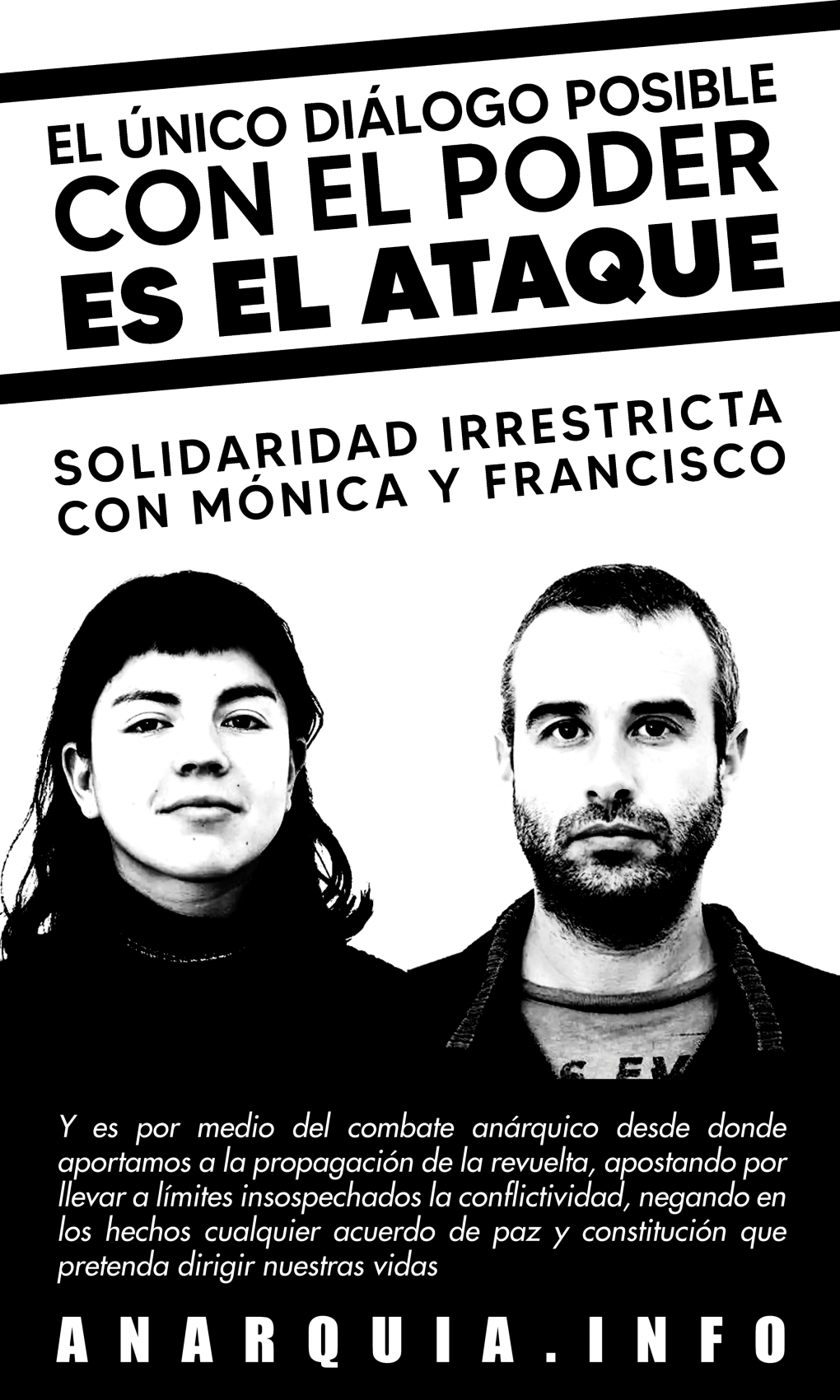
On July 24, 2020, comrades Monica and Francisco are arrested in two repressive operations. The authorities accuse Francisco of sending explosive packages against the former Minister of the Interior Rodrigo Hinzpeter and the 54th police station of Huechuraba (Action occurred on July 24, 2019, claimed by “Cómplices Sediciosos/Facción para la Venganza”), while both are accused of the double explosive attack against the Edificio Tánica in the commune of Vitacura (Action occurred in full revolt, on February 27, 2020, claimed by “Afinidades Armadas en Revuelta”).
During these more than two years of imprisonment, Monica has remained in the module of public connotation of the San Miguel prison while Francisco was initially imprisoned in the maximum security section of the CAS but then transferred, along with other comrades, in June 2021 to the La Gonzalina prison in Rancagua, where he is currently being held.
It is fundamental to emphasize that both of them in this time of confinement have been a permanent contribution to the anarchist and social war debates through their writings, communiqués and articles, realizing that prison is not the end of anything but another trench from where to give continuity to the insurrectional struggle and that its walls, bars and cages are not enough to break the solidarity and complicity among the anarchists. It is also from that place where we must situate that Francisco assumed the facts he is accused of, thus giving validity and validity to an anarchism of offensive action and the need for the continuity of his blows. Continue reading “Chile: In view of the sentences requested by the prosecutors, solidarity and complicity with Monica and Francisco!”→
In the first months of 2021, Francisco together with other anarchist and subversive prisoners carried out a hunger strike that lasted more than 50 days against the modification of Decree Law 321 and for the immediate release of Marcelo Villarroel.
In 2010 Francisco had already put his body as a barricade of combat in another strike of more than 60 days in the framework of the Bombs Case.
It is during the last mobilization that several blood tests were taken from Francisco by the prison administration, including a suspicious situation, where Francisco was urgently admitted to the prison hospital due to the bad result in the blood tests, but a few minutes later the jailers recanted and alluded to a mistake, returning him to prison.
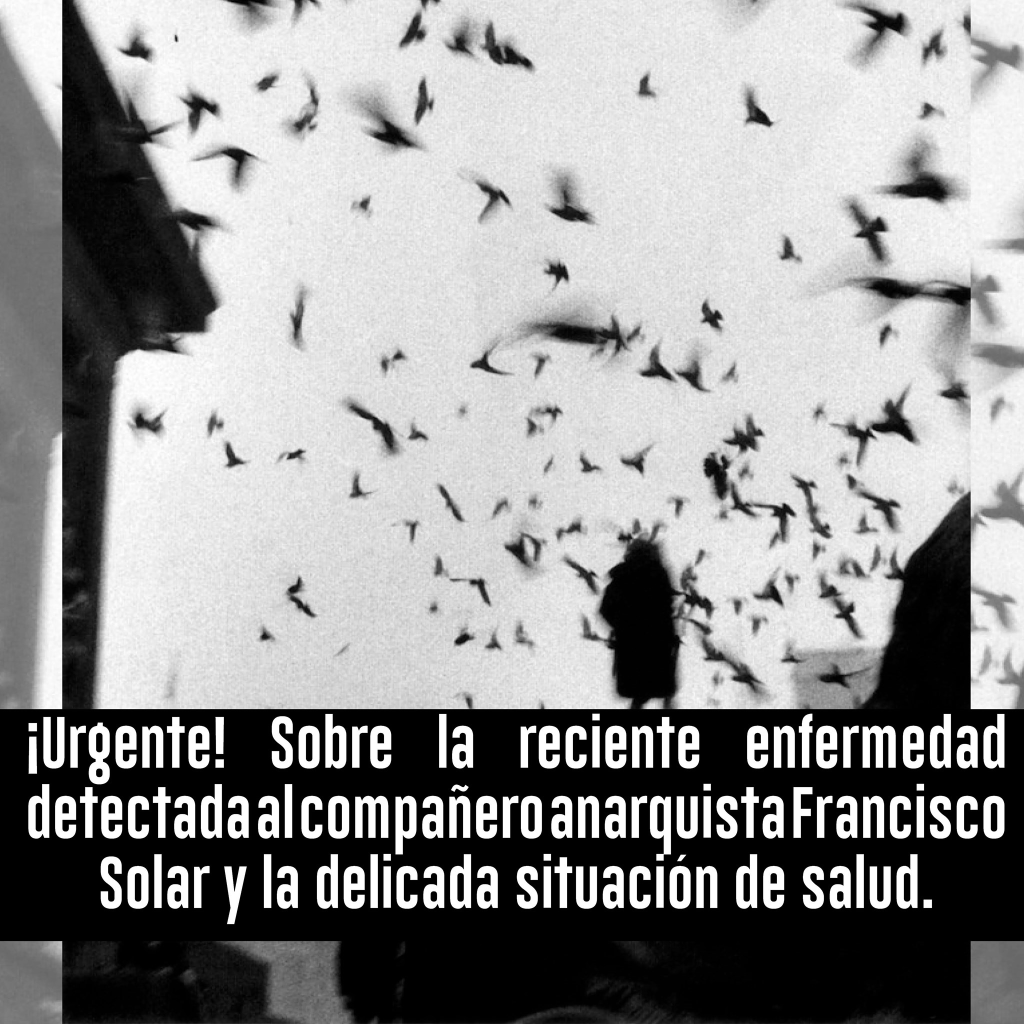
After a slow recovery, continuous cramps, excessive thirst, weight loss, Francisco requested medical examinations after being transferred to the prison of Rancagua. It was not until September 22nd that these examinations were carried out and he was hospitalized urgently. The diagnosis: advanced diabetes with 700 mg/dl of glucose, that is, on the verge of a diabetic coma.