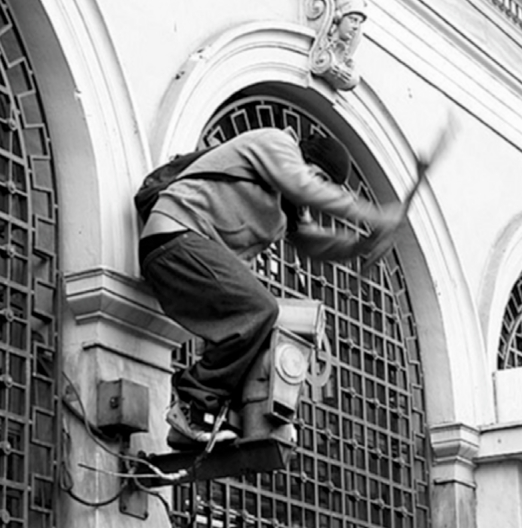
We chose a soft target, a warm up to bigger things. Easy like throwing a dart into a grapefruit!
Around Bristol G.R.C. Security (now linked to Cava Security) have been pissing off travellers for quite a few years, carrying out common law evictions, using their bulk weight violence, the law and threats of fire. So one place they guard and partol is the old mounted police and dog section, now owned by the Caravan Club, which is situated on Clanage Rd., Bower, Ashton at the foot of the Clifton suspension bridge. It was really easy to scale the perimeter fence with identity concealed, then finding a long plank of wood to batter the CCTV cameras and solar panels.
Also a little dickie bird whispered on the ‘grapefruit’ vine that at the Brandon Hill ‘old’ cop shop eviction one of Cava Security’s vehicles lost some air from their tyres. Keep your eyes open for those dart boards!
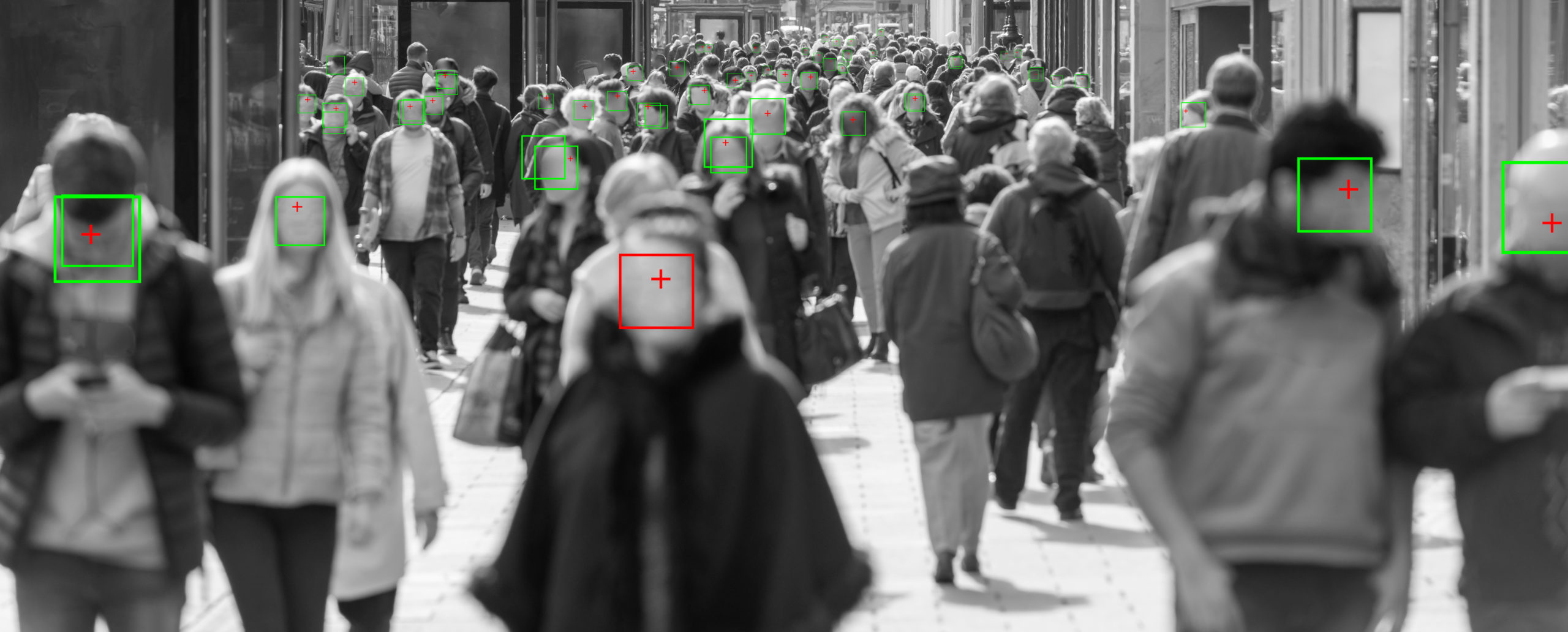
Article 7 of the bill “relating to the Olympic and Paralympic Games and various other provisions”, an article authorizing experimentation with the processing by algorithms of images captured by cameras or drones, was adopted on Thursday by the National Assembly after lengthy discussions. This project, which includes experimentation with so-called “intelligent” video surveillance (i.e., automatically reporting “suspicious” individuals or behavior thanks to their program) had already been adopted by the Senate.
“The Minister of the Interior justified this experimentation with algorithmic video surveillance by saying that “exceptional situations require exceptional means”, referring to the 2024 Summer Olympics. The implementation of this technique will not, however, concern only the Games: it will apply to “sporting, recreational or cultural events” in general, which “by their scale or circumstances, are particularly exposed to risks of acts of terrorism or serious attacks on the safety of people.
Various aspects of the sinister technology have gradually crept in over the years under the excuse of fighting crime or terrorism or, more recently, of combating the spread of a so-called pandemic.
As we saw in our recent article on “15 Minute Cities”, we are now being told that it is all about urban planning and making life generally more pleasant for everyone by reducing traffic congestion and pollution.
Anyone who sees through this greenwashing attempt is dismissed as a paranoid fool or as a dangerous conspiracy theorist spreading fear and disinformation.
And yet the whole premise of this official spin is blown out of the water by the fact that smart infrastructure (Self-Monitoring, Analysis, and Reporting Technology) is being rolled out in contexts that have nothing to do with private vehicle use.
We have got hold of a very interesting document from Transport for London on the current testing of smart surveillance at Willesden Green tube station, which is due to continue until March 31, 2023.
If this project were really about “providing the best possible service” to passengers on the British capital’s underground railway network, as claimed, then you would think that it would be loudly and proudly announced and discussed, with information widely available in a democratic public consultation.
But the fact that the document, entitled “Smart Station Proof Concept”, is marked “restricted” for internal TfL use reveals the secrecy being deployed to sneak through this new stage of the incremental theft of our freedom.
In the public interest, we have decided to publicise its contents.
The “exciting” project for the Jubilee Line station combines existing CCTV cameras with “visual analytics technology” to provide 24-hour real-time monitoring, via a “Smart Stations Dashboard”.
As well as counting everyone entering and leaving the station, the smart spies will be issuing “notifications” for a range of “triggers” including not just gate-jumping or smoking, but also “loitering” or a “person sat on a bench (Excessive Time)”, which turns out to be anything more than ten minutes! Continue reading “UK: London’s secretive “smart stations” roll-out”→
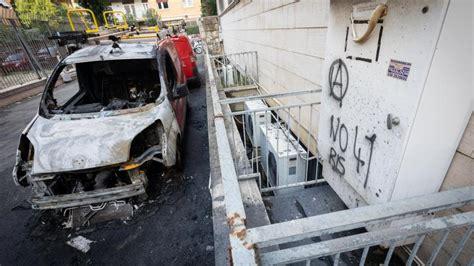
In the early hours of the night of Monday, January 30, we carried out an incendiary action against TIM. The attack was conducted by breaking into the parking lot of one of its offices and setting fire to 5 vehicles. Tim actively collaborates in social control through the installation of the fiber optic network, cameras and electronic bracelets.
Power and its ramifications are everywhere, and anyone who wants to strike at it is spoiled for choice. Take action today, without waiting for more propitious moments or compromising, just as power rages daily and hourly against our lives, revolt must also be daily and permanent.
Let the fire of denial blaze more and more in the cities with an indomitable force to spread chaos in your world of order and repression.
Let the murderous state and the bosses know that this is only the beginning and more than a threat it is a promise.
Solidarity with Alfredo Cospito in fight against 41bis Solidarity with Juan, Anna, Ivan and all anarchists held hostage in state jails LONG LIVE ANARCHY
China is probably ahead of everyone else in turning the country into a digital concentration camp. CCTV cameras are installed almost at every step and residents are very tired of the constant monitoring, believing that the state thus interferes in their personal lives.
However, for every action of the state, a person looks for counteraction.
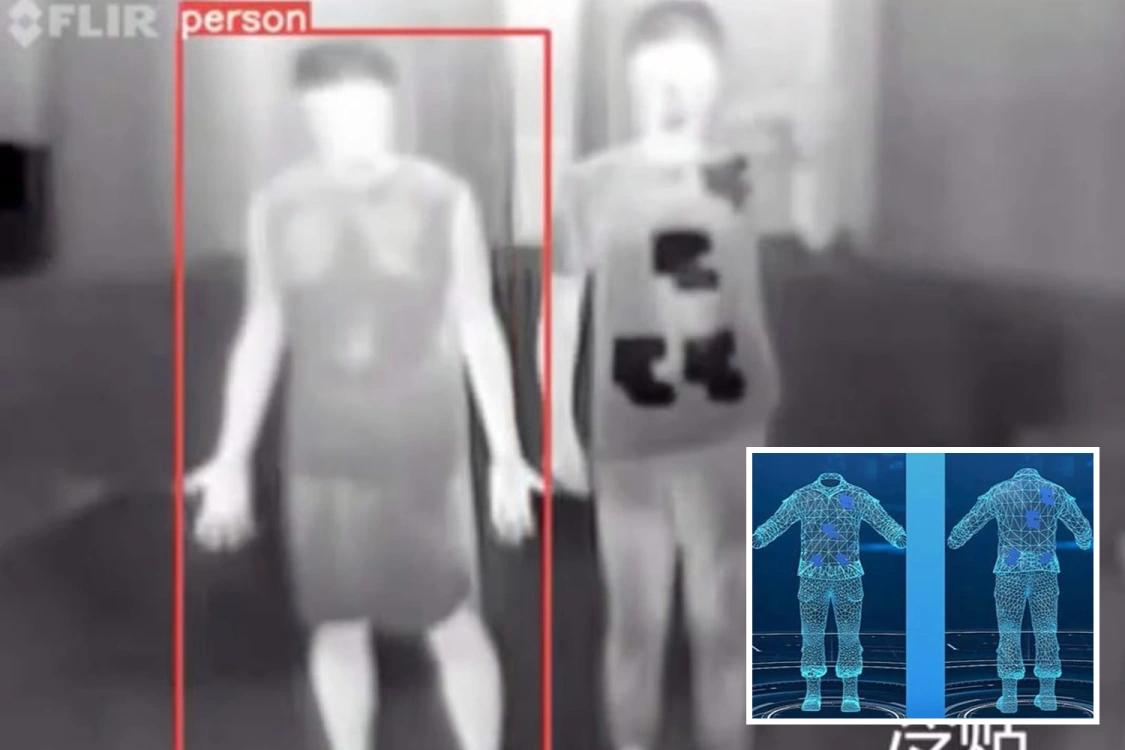
Graduate students from Wuhan University won Huawei’s cybersecurity innovation competition, demonstrating a coat whose camouflage prints can hide a person’s identity from AI cameras.
The contest winners say the prints were created using artificial intelligence. The whole point of the pattern on the fabric is to reflect light, so that surveillance cameras can’t react to visible light. At night, special devices, with which the coat is also equipped, distort the thermal radiation and thus manage to deceive the infrared sensors of smart cameras.
The “smart” coat is called InvisDefense. The creators are confident that they have found a reliable way to bypass human recognition technology. Engineers tested their development on campus surveillance cameras. According to the results of the tests, it became clear that in reality the detection accuracy is 57%.
In the future, the developers intend to create “invisible” objects for AI cameras. It can be all sorts of objects or even a car. They are also studying the possibility of bypassing other types of cameras that use remote sensing of satellites or aircraft.
The developers themselves say that their work is intended to identify vulnerabilities in the surveillance system in order to improve it. However, stealth coats are already on sale and at a relatively low price.
This conversation between Paul Cudenec and the Italian group Resistenze al nanomondo was first published in the July 2022 issue of the printed journal L’urlo della Terra and has recently also been made available online, again in Italian.
1. Resistenze al nanomondo: Can you can tell us about your story, your path, when you started developing a critique of techno-scientific developments and what thinkers you learned from?
Paul Cudenec: I don’t think I could separate my critique of techno-scientific developments from the rest of my opinions and analysis. I have been an anarchist for 30 years now, but even before then, in my youth, I felt a strong instinctive aversion to high-tech consumer society. On the one hand it was associated with everything that I most disliked – big business, the state, the military, authority and control in general. On the other hand it stood against everything that I most appreciated – nature, freedom, community, a sense of historical and cultural continuity. The arrival of CCTV cameras in England was a wake-up moment for me. I worked at the time as a journalist with a local newspaper in one of the first towns to have cameras installed and, since I knew for a fact that there was very little crime there, it was clear to me that this project was nothing to do with fighting crime, as was claimed, but was the roll-out of something much more sinister. I wrote a punk song about this in the mid-1990s (which I put online last year), warning about “the cameras that steal our liberty” and the techno-tyrants who were going to scan our DNA, put microchips in our brains and turn us into robots. With the local anarchist group, which I subsequently helped to create, we used to hold annual protests against the cameras, marking the anniversary of their installation as “Big Brother’s Birthday”.
As you will gather from the above, George Orwell was, unsurprisingly, an influence on me. The history of the Luddites was another inspiration (via Kirkpatrick Sale among others), along with anarcho-publications like Green Anarchist, SchNEWS, Do or Die, Anarchy: A Journal of Desire Armed and various EF! publications. I also read David Watson’s Against the Megamachine, Fredy Perlman’s Against His-story, Against Leviathan, the Unabomber Manifesto plus a lot by John Zerzan and Derrick Jensen. I have more recently been influenced by reading the likes of Miguel Amorós, Jacques Ellul, Theodore Roszak, Charlene Spretnak, Renaud Garcia… But intertwined with that thread of my self-education have been other inspirations. The English nature mystic Richard Jefferies has been very important to me, as has René Guénon, who combined his metaphysics with a strong critique of modernity. I have also read elsewhere about sufism, Taoism, comparative mythology, English folklore, Indian philosophy, German idealism, Jewish anti-capitalist romanticism, Jungian psychology… What interests me, above all, are the connections between these accounts and traditions, or rather, perhaps, the new space that is opened up for our reflection when we consider them together, in the same conceptual context. Continue reading “Resisting Techno-Tyranny: A Dialogue”→
As you may have already understood, on the buses, in the streets, in the shops, cameras are watching and recording our every step. The social media industry has made us accustomed to the presence of cameras at events, in marches and in our daily lives (in workplaces, schools, etc.), so that our resistance to them is diminishing. It seems as if there is no other way and this leaves us no room to breathe.
The state is installing cameras to protect its infrastructure, to record demonstrations and to monitor its citizens. On the other hand, the petty bourgeoisie use them to protect their sacred property while their visual material is always available to the cops and is used as incriminating evidence in court cases. Under the pretext that this system of surveillance and control will create greater security, it shields the system of domination.
Cameras have never prevented any “crime”, nor have they ever “protected” anyone. The goal of surveillance is to create a sense of constant monitoring of our every step, every social media post is recorded and creates profiles with data that can be used against us.
Then we start to think twice, where we go, what we say, who we talk to and what we do. This superstitious obedience is part of repression and self-censorship. When we are not anonymous we do not act and speak as we would like, but according to what is socially acceptable.
A guide to putting Toulouse’s cameras into early retirement.
This guide only deals with methods of destroying camera cabling. To destroy the camera itself you have to knock down the mast or climb to the top to break the camera, this requires heavy and cumbersome equipment (disk cutter, ladder …) and is therefore another story.
1 – Scouting
The location:
Movement of people and vehicles, cameras (public or private) with a view of the targeted camera, nearby cops/vigilantes/etc.
What the camera is attached to:
On a wall, on a mast, the type of mast (old style light grey or dark grey and smooth for the new ones).
Cabling:
Cabling outside the mast, protected by a simple sheath (flexible or rigid), cabling inside the mast.
The fixing of the trap door (in the case of wiring inside the mast):
Allen type screws, triangle type screws, hatch doubled (or not) by metal clamps.
2 – Preparation
The route:
Ideally, don’t take the same route on the way there and on the way back, plan routes that avoid as many cameras as possible (especially on the way back) thanks to the website toulouse sous surveillance (https://toulouse.sous-surveillance.net/), depending on the number of people present for the action and the layout of the place, plan small roadblocks to slow down the cops.
Be careful, scouting on the internet is good, scouting in real life is better. Google street photos are often several years old, and on the website toulouse sous surveillance some cameras may be missing.
Clothes:
For the action, wear gloves, something to mask your face (but really well because their cameras are full HD), disposable clothes (black and without distinctive markings). Then “normal” clothes under the disposables, and discreet shoes (important because it’s not practical to change them).