Hands off anarchist comrades Marianna M. and Dimitra Z.
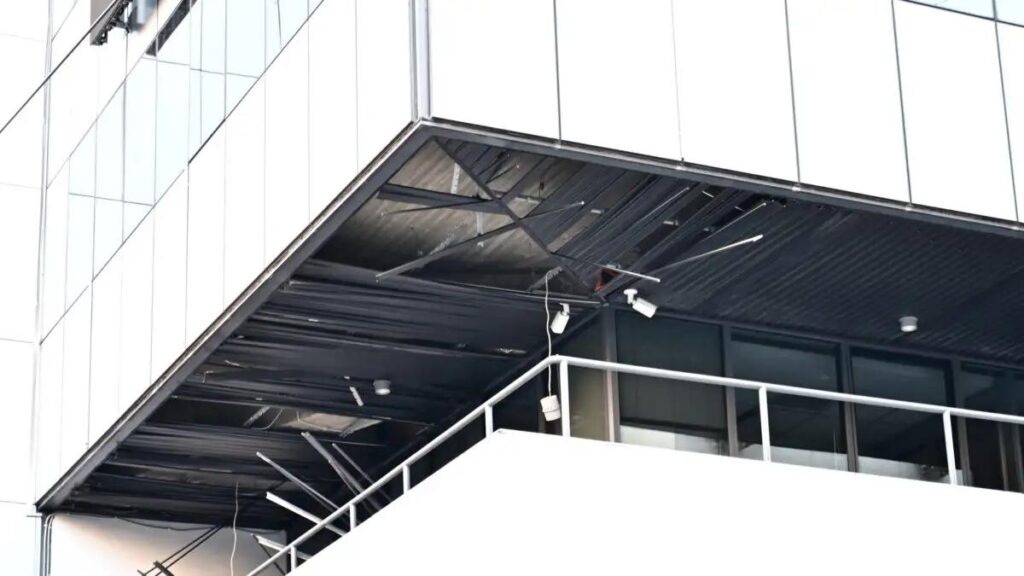
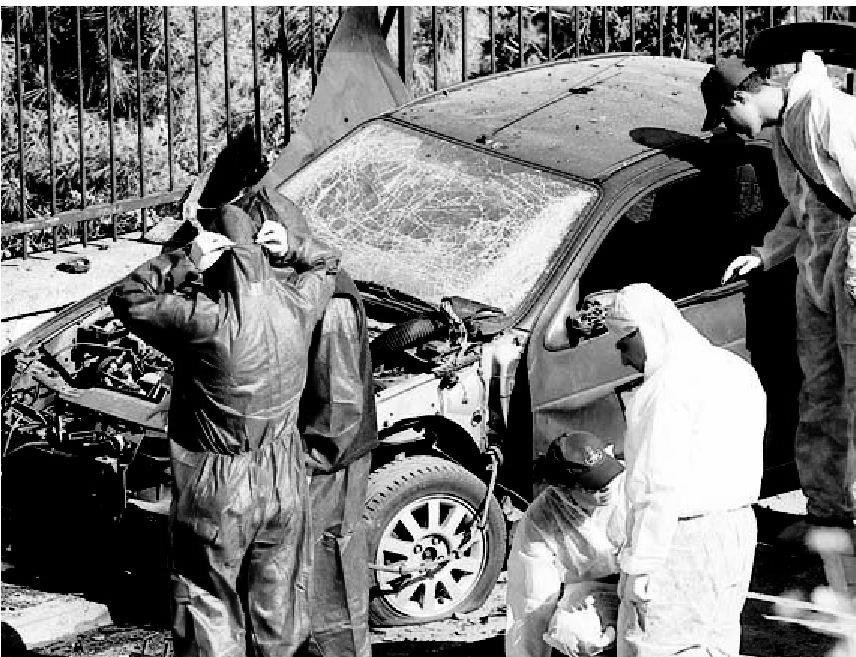
On 31/10/24, following an explosion in an apartment in Ampelokipi, the anarchist armed fighter Kyriakos Xymitiris fell in the battle for social and class liberation, while the anarchist comrade Marianna M., who was also in the apartment, was severely injured, hospitalised and guarded in the ICU of the “Evangelismos” General Hospital. The following days, comrades Dimitra Z., Dimitris and Nikos R., as well as A.K., were remanded in custody.
From the very beginning, state violence was applied to comrade Marianna. With her transfer to Korydallos women’s prison just one day after the second operation she underwent, her hospitalisation was violently interrupted while she still had open wounds on her face, she could not walk or fully care for herself, was dizzy and in pain. The “Evangelismos” General Hospital discharged her as a patient in this condition, knowing full well the miserable environment of the prison to which she would be transferred, where there is not even any kind of hospital and therefore no possibility of providing her with extremely necessary medical care before she fully recovers.
Her torture in Korydallos prison continues to this day. Her serious health condition, as well as the risk of long-term complications, are the result of the deprivation of necessary medical post-operative care. From the very beginning they deprived her of the provision of pharmaceuticals and forced her to stay in cells full of cockroaches, in extremely poor sanitary conditions. While to this day – four months later – necessary and urgent diagnostic tests have not been initiated. To her request to be assessed by a doctor and immediately initiate a brain CT scan requested by an outside doctor who visited her a long time ago, the response of the prison neurologist was “if you don’t fall down with an epileptic seizure, we won’t take you to hospital.” A response that accurately reflects the condition of vindictiveness, punishment, and torture that the rulers impose on anyone who finds themselves captured in the cells of democracy.
To the already heavy situation of confinement was added the appearance of intense rashes and itching in comrade Dimitra. A short time later, the comrade Marianna also showed similar symptoms and only then was the diagnosis of scabies made, while they have been torturing Dimitra for two months with their icy indifference, attributing the symptoms to psychological reasons and administering sedatives to her without having ruled out pathological causes.
On 31.10 on the third floor of an apartment in Arkadias Street (Athens), during the processing of explosives by my comrade and guerrilla Kyriakos Xymitiris, an explosion took place with the tragic consequence of his death. For a few moments, with me in the next room, time froze, everything went black and I was unable to move. The condition was incomprehensible, the development inconceivable. Buried in the wreckage trying to figure out what had happened;asking for help, searching for my partner with my eyes. Slowly realizing that while the thread of my comrade’s action would be abruptly cut short, his life and his choices in struggle would be a historic flash of determined resistance, consistency and dedication; a springboard and inspiration for further struggle. Two figures appeared offering help while I showed them the spot where I last saw my comrade, the spot where our guilty gazes met, gazes full of anger at the world we live in, full of faith and appetite for moments of true freedom.
Within a few minutes I was in the hospital “Evangelismos”. I was immediately subjected to examinations and operations. I had a hematoma on my head and countless stitches on the upper part of my body. I remained intubated and completely unconscious for the next three days. Enough time for the “anti-“terror scumbags to come to the hospital demanding a blood sample. On the Monday, I regained consciousness and was transferred to the ICU where I was confined for the next three days. The conditions there were decent with medical staff eager to assist in my recovery. However the room was surrounded by police forces who entered the ICU room during the 5-minute visits from my family.
After two days I was transferred – for no apparent reason – to an isolation ward guarded by several static and as many mobile cops in the hallways and on the floors. The door to my room was constantly open leaving zero privacy even during medical examinations. Under the “watchful” gaze of every single cop I had to eat, be examined, and have my body cleaned. Following instructions, the majority of medical and nursing staff maintained a distant attitude, showing zero empathy even in the most basic things, for example when they carried out an examination with the presence of a male police officer.
The insistence of the 22nd investigator of the Athens District Court on conducting the interrogation procedure despite my physical and mental weakness also contributed to the vindictive atmosphere. After asking for a certificate of my sufficient ‘functionality’, which she read at her discretion, she finally gave me the sham extension of 30 hours. She thus confirmed the fact that her priority was my predetermined pre-trial detention and prosecution under 187A.
On Friday 15.11, and just one day after the second operation I underwent, I was transferred to the women’s prison in Korydallos. My daily life, under these circumstances, was difficult. Under deplorable sanitary conditions and with unhealed wounds on my body and head, the repressive mechanism was playing with my health. I was without the necessary medical care and without access to the necessary medication, a condition that all prisoners face as they are perceived as second-class citizens with no right to medical care, with superficial to non-existent medical examinations by prison doctors, with prohibition of necessary medical procedures, with discontinuation of medication taken before incarceration, with long waits for months for emergency examinations in outpatient hospitals.
THE GEOMETRY OF THE ANTI-TERROR UNIT
While I am still unconscious, only a few hours after the explosion, the judicial apparatus follows the instructions of the anti-terror squad and constructs an indictment of an abomination. The processing of (small amounts of) explosive materials and devices with only comrade Kyriakos and myself present and aware, was baptized an organization. The apartment, to which we had only had access to for a few days, was christened a yafka (illegal bunker). The legitimate objects found in the apartment where I lived with comrade Kyriakos and which were presented on the daily news were dubbed suspicious. With these facts, the anti-terror police prosecuted me on the charge of “terrorism”. At this point, however, I will not focus on the legal aspect, nor will I speak in the context of innocence and guilt. I refuse to accept an indictment based on 187A, especially when it instrumentalizes the death of my comrade in the most vulgar fashion. And I intend to deconstruct whichever repressive scenario they construct. But I will defend until the end my choice to be in this apartment, I will defend the necessity of struggle by means not limited to the framework of civil law, I will defend my comrade’s choices, his memory and our relationship.
By carving concentric circles, the anti-terror police weave their own repressive web. It places me and my comrade Kyriakos at the centre and, with shaky geometry, it adds friends, comrades and strangers. In the first cycle it places the arrest of the anarchist comrade Dimitra, who presented herself voluntarily in a Hollywood-style operation at the Athens airport where – in contrast to the femicide of Kyriaki Griva – the police car in the role of a taxi picks her up and takes her to the GADA (Athens central police station). The only “clue” was that she had given the keys to the apartment in Arkadia Street to me and Kyriakos under the pretext of hosting our acquaintances from abroad, without her knowledge of the true purpose of the flat’s use. It is worth noting that on the day of the explosion she was abroad, where she had been living for the last few years. She too is being prosecuted under 187A. In the second circle they place the comrade Dimitris, who also presented himself voluntarily at GADA, because he had handed over the pair of keys of the apartment in Arcadia Street to the flat’s owner, something which had been requested of him by Dimitra. With the only involvement being the delivery of the keys, without having known anything more and having been at work at the time of the explosion, he also faces the aforementioned charges. Twenty days later the”anti-“terrorists secure the next cycle, with the arrest of the anarchist comrade N. Romanos. In his case, the repressive mechanism unleashed its vindictiveness by using as proof a faint fingerprint on a transportable object – a bag – found in the apartment in Arcadia. Two days later A.K becomes part of the last cycle when he is arrested due to the ridiculous “clue” of the fingerprint on the same bag. Apparently within 20 days the “efficiency” of the ELAS (greek police) laboratories managed to implicate two people with whom I have no connection, by unearthing a fingerprint, while the tons of xylene in the Tempi massacre have not been found for two years now. The last two arrested also face the same flimsy charge.
LXS REVOLUCIONARIXS NO SE «CORRIGEN» NI « SE MEJORAN MORALMENTE»
Una vez más, por sexta vez consecutiva, el tribunal plenario de delitos menores de Lamia me honra con su decisión de rechazar mi solicitud de libertad condicional, con el argumento de que ¡no me he «corregido» y que no he mostrado «mejora moral»! ¡No puedo sino admitir que tienen razón!
En efecto, un militante consecuente, un revolucionario, un anarquista como yo, no podría ser «corregido» y «mejorado moralmente» por la cárcel, no importa cuántos años esté encarcelado. Un militante consecuente, un revolucionario, un anarquista, puede dar su vida por la lucha, como el compañero de la Lucha Revolucionaria Lambros Fountas, puede arriesgar su vida por la lucha, puede arriesgarse a ser asesinado por los pretorianos del estado, como casi ocurrió en mi caso, puede pasar muchos años en la cárcel -yo ya he cumplido 12 años por la Lucha Revolucionaria y otros 4 antes de eso- pero no se le permite dar un paso atrás, mostrar arrepentimiento o revisión, o en otras palabras y en el lenguaje del tribunal, una mejora «correccional» y «moral». Así que, desde este punto de vista, todas las decisiones de los tribunales y juntas judiciales, las seis del tribunal plenario y la una de la junta de apelaciones, me honran y me demuestran que sigo en el camino correcto. Si dijera lo contrario, empezaría a preguntarme si me he equivocado y he violado mis principios y valores morales. Mi única objeción es la referencia del tribunal sobre un “pretencioso” buen comportamiento por mi parte. Esto realmente me hace injusticia. Si tal cosa fuera cierta, en las audiencias del tribunal, en manera completamente «pretenciosa», contraria a lo que creo por lo que he sido condenado y por las faltas disciplinarias que he cometido, estaría murmurando disculpas y lamentos como hacen la mayoría de los presos penales para lograr su puesta en libertad. Pero tal cosa es impensable para mí.
La última decisión negativa del tribunal plenario de Lamia me excluye efectivamente de la posibilidad de la libertad condicional, a pesar de que ya he cumplido más de 4/5 de mi condena.
Dentro del endurecimiento general en los últimos años, de la legislación penal y «correccional», en cuyo marco se han aumentado los límites de las penas, y los límites para la concesión de la libertad condicional y de los permisos; basicamente el derecho a la libertad condicional y a los permisos estan bajo abolicion. Se han introducido carceles de maxima seguridad (algo parecido a las antiguas prisiones de tipo C para peor), probablemente seré la primera persona con una condena de 20 años que cumplira la condena completa -las 5/5 partes de la misma- sin posibilidad de libertad condicional, acercándose a una cadena perpetua, es decir, 16 años según el antiguo código penal.
Este endurecimiento de la represión penal y «penitenciaria» es una consecuencia y un eslabón de una larga cadena de curso evolutivo sociopolítico, que parte de la derrota de la insurrecction social y popular contra los memorandos de 2010-2012, el retroceso de las luchas sociales y desemboca en el totalitarismo estatal y de régimen que vivimos hoy.
Nikos Maziotis, condenado por la Lucha Revolucionaria
“What is worrying is that the extreme polarisation that is being created is the best fertiliser to further develop the anti-establishment climate. And it certainly sends by itself the people to the squares of 28th February, reinforcing he conditions of destabilisation of the country. I suppose it’s hard to explain what that means in a world that’s becoming increasingly unstable after the rise of anti-establishment in the US…”
To Vima [mainstream Greek newspaper], G. Papachristos, 24-2-2025, The fertiliser of destabilisation
“In the age of global madness, we could easily leave the rails of logic and get into a phase of non-governance and chaos. The Greek society, however, knows to avoid disasters, perhaps because it brushed past one such disaster ten years ago. We have matured. […] Many of the citizens who went to the streets know well that they will have no choice other than Mr Mitsotakis when the ballot boxes are set up again.”
Kathimerini [mainstream Greek newspaper], A. Papachelas, The resounding message of anger
In the immediate period preceding the 28th of February for the 57 dead in Tempi, a number of publications described the “disturbing findings of the polls, which cause dark thoughts”, about the “danger of anti-establishment” as “Greece stands on the threshold of an era of new adventures”. Opponents of the rally, journalists, analysts, government deputies and ministers, tried in every way to discourage people from participating, because then the participants would turn into an object of exploitation by the “populists”, with the result that “the new division” would have disastrous consequences for “democracy and institutions”, “stability” and the “hard-won normalcy”, while also hiding “national dangers”.
Social media accounts modified the poster of the “Tempi 2023” association calling for non-participation in the rallies. In the original poster there is only one word: “justice”. In the modified one, it reads “I will not go, I trust justice”
Efforts to weaken the rallies of 28th of February and to consolidate the climate of terrorrism continued with prosecution orders for criminal investigation and persecutions against “online incitement to commit violent riots”, but also announcements about policing, preventive prosecutions, arrests and “zero tolerance” by the 6,000 police officers who will monitor the protesters.
And yet, all of these designs failed miserably.
As we were emphasising recently, the “return to normalcy” was set as a common ground for the political system, whether it was promoted as a project of anti-left orientation or as an anti-right political project, with the reconstruction of the “progressive faction”. But the vision of a “return to normalcy” has faded, and it is no longer persuasive, as it is no longer persuasive the kind of logic of “the glass is half-full, not half-empty” or “certainties” of an unbroken general opposition and aversion in the social sphere to new “adventures and instability”. As we wrote shortly before the elections in the summer of 2023, the “new normal”, however, symbolises further social inertia for its left- and right-wing creators and for the securing of social peace. They are counting their chickens before they are hatched. Neither the benefits, nor the micro-amenities, nor the “beautification” of the health and labour system, nor the family ministries and the digital “paradises” promised by Mitsotakis’ state can hide the reality.
For this very reason, the ivory tower of the current administrators of state affairs is proving to be very fragile, while at the same time the next most “suitable” administrator after Mitsotakis emerging is “Nobody”, according to a number of polls, reaching the same level of social denial and questioning of parties, institutions and politics as that recorded in the years of the crisis, especially in 2010-2012. We have to repeat here that the left, socially discredited and exhausted in its capacity of assimilation, is suffocating and is unable to mobilise even its few members and its bored followers, let alone to exploit a social anger that remains politically unsupervised.
According to Max Weber, the emergence of the “charismatic” leader presupposes the manifestation of “crisis”: “The charismatic leadership […] always appears in extraordinary, especially political or economic, circumstances, in unusual mental, especially religious, situations, or when the above coexist”. So, in times of “crisis”, the “charismatic leader” appears as the “called-for”, that is, the one who is “called” to help, the “comforter”, with “extraoridnary” duties, and with “extraordinary” mission. Let’s not forget that today’s political caricature, called Tsipras, wore exactly this mantle of the “unparalleled” and “charismatic” leader in monents of “crisis” and greate collective “over-agitation”, while also demanding blind obedience and loyalty of the subjects to the “mission” he embodied.
Mitsotakis emerged in 2019 again as a “called-for” leader, that is, as a technocratic politician, who dominated by stepping on the evolving political disintegration of the ruling left, appearing as the “only one”, and therefore as the “charismatic” one, who could wield the “new normalcy” and even through a global exposure.
On 16-5-2022, an article in the German newspaper Handlesbatt stressed that Mitsotakis will become the first Greek prime minister to address the US Congress and “will do everything to distinguish himself as a trusted partner of the alliance”. In early September 2024, Mitsotakis receives the Global Citizen Award from the Atlantic Council think tank (American think tank in the field of international affairs, favoring Atlanticism and founded in 1961 based in Washington). The Atlantic Council, it should be noted, has as its founding objective and mission to encourage the continuation of cooperation between North America and Europe, which began after World War II. The prize was awarded to Mr. Mr Mitsotakis by the chief executive of Pfizer Albert Bourla, who described the Greek prime minister as “a visionary champion of a new era of economic prosperity, a leader committed to his country, who has won the trust of the Greek people. A humble leader, whose re-election has shown that he keeps his political promises, while having the respect of the world’s leaders.”
Since then it seems as if a century has passed!
The change of administration in the US, the developments in Ukraine, the fragmentation of interests within the so-called collective West, and even the questioning of the usefulness of NATO by the American “friends”, seem to place the current managers of state affairs in the Greek space, rather, on the wrong side of international relations. Moreover, the “right side of history” in these terms has been judged in every historical period, and even more so in the current broader period, in which the post-war order of things is changing dramatically.
***
As we have already described, the crushing failure of the orchestrated campaign against the 28th of February demonstration proved to be more than monumental. All the methods used to slander the demonstration and its participants were not enough to prevent or even mitigate the earthquake, which was recorded by the largest Metapolitefsi gatherings in Greece, a total of 262, as well as 124 demonstrations in European cities, Turkey, the USA, Australia and even Mexico, Japan and South Korea.
In Athens, an unprecedented influx of protesters began at 9:15 a.m., with the area around Syntagma Square already flooded by 11 a.m. Hundreds of thousands of protesters continued to approach the city centre from many areas of Attica, flooding Patision, Vasilissis Sophias from the height of Ilision, Syngrou from the height of the Acropolis metro and then, the main avenues and streets, Vas. Amalisas, Vas. Sophias, Panepistimiou, Akadimias and Stadiou. For many hours almost all the central districts of Exarcheia, Kolonaki, Victoria, Clathmonos Square, Omonoia and of course Syntagma remained suffocatingly crowded.
Around 1:00 p.m. and while the speeches were over, hundreds of protesters launched a fierce attack on the Parliament and against the repressive forces in the courtyard area, with Molotov cocktails, stones, marbles, smoke grenades, as well as metallic and other objects. Protesters were also setting fire to a compartment of the Evzones regiment. Violent attacks against the forces of repression continued for hours, in scattered locations around Syntagma Square, along the entire length of Vas. Amalias Avenue, which resembled a quarry, on the Sygrou Avenue, through the columns of Olympian Zeus, in Kallirois, in Panepistimiou, in Stadiou, around Omonoia, up to Patisia.
In total, both in the prevention phase and during the attacks, the repressive forces detained 220 people, of which 73 turned into arrests with dozens of protesters being referred for criminal acts, while dozens of injuries were recorded among protesters and police officers.
Rallying of Anarchists
Posted in ΔΙΑΔΡΟΜΗ ΕΛΕΥΘΕΡΙΑΣ [ROUTE OF FREEDOM], issue 257, March 2025
and have a separate preference for playing in the closed hallway
and every day they grow in our hearts, so
that the pain under our ribs is no longer from deprivation
but from growth.”
Giannis Ritsos
The Direct Action Cells take responsibility for the placing of an incendiary device at the entrance of the house of Eliza Wozemberg in the Varkiza area in the early morning hours of 26 February. We visited this piece of trash to place our small piece in the mosaic of acts of revenge against those who have cynically stained their hands with blood in the murder of 57 people in Tempe and have tried to cover each other’s asses in a coordinated manner. The chronicle of the crime and its cover-up is pretty much known. The vanguard to save the shattered government’s reputation is made up of some shit-sucking mouthpieces of the right-wing bloc, whether they are MPs and ministers or journalists (like an old acquaintance of ours, Portosalte, who doesn’t seem to have a brain) or even “simple and humble” executives and party members who in the social media also reproduce the party’s main line of laundering the money of those directly involved and attacking the victims’ relatives. Wozenberg could not stand back and keep a low profile. She stood out from this shitty crowd and attacked Karystianou, the mother of one of the victims and president of the Association of Relatives of the Tempi victims, accusing her of deceit, of slandering the country internationally and of having no right to accuse Kostas Karamanlis. For our part, we responded to Wozenberg as she deserves. We answered her because the dead in Tempi could have been us, our brothers and sisters, our mothers and fathers, our friends and comrades. We ask no one for an account to avenge our dead. This is our answer to Wozemberg. With fire, as she deserves.
“You hit one to scare 100” Mao Tse-tung
The reason our team targeted Wozemberg is because of the dirty role she has played at the European level in covering up the Tempi crime. Mitsotakis took advantage of his lobbying support for the re-election of Commission President Ursula von der Leyen and that support was compensated for, with 2 buffers. The appointment of Wozenberg to the position of chairman of the Transport Committee in the European Parliament and the appointment of Apostolos Tzitzikostas to the position of EU Commissioner for Transport and Tourism. In this way the Mitsotakis regime has also secured European immunity for its crimes as the 2 main positions in the EU dealing with transport issues are held by New Democracy appointees. Therefore, the New Democracy ensures that there will be no unexpected consequences for the crime of Tempe and its subsequent cover-up on the part of the “European institutions”.
Besides, Wozemberg had the audacity to recognize in Karamanlis an innocent minister without responsibility and at the same time to desecrate the memory of the dead by accusing their relatives of being politically motivated. She has probably forgotten the times when her ancestors (during the monarchy of Otto, which is her lineage) would have already sent people like Karastianou and anyone who would have questioned their God-given right to rule us to the gallows. That’s why, after all, she got what she deserved. Just as we also understand that it makes sense that a proud descendant of a royal family would become a shield for a descendant of a stinking family of politicians like the Karamanlis. A family that still has some property titles in the New Democracy so that so far at least it has managed to save from criminal liability the tub of guts who was angrily protesting train safety just days before their clash. One hand washes the other and the two together attempt to push the dead of Tempi into oblivion as an accident of the rank and file.
We are outraged that all these scumbags like Wozemberg, Mitsotakis, Adonis, Karamanlis, Voridis, Markopoulos, Voultepsi and dozens of other members of the government mafia come out without fear and with enormous arrogance to attack relatives of the dead, scientists and experts who question the government’s narrative. It infuriates us that this arrogance and the tone of a thousand hearts with which they speak is also stepping on the support of a section of society. A rotten piece that only looks out for themselves, the little extra money they make and supports a government of proven mobsters and murderers. On February 28th those of us who demand street justice must do everything in our power to break this arrogance of theirs. We should cut out their tongues and send them to the dustbin of history, that is, where their natural habitat is. Continue reading “Athens, Greece: ‘Direct Action Cells’ – Responsibility claim for the incendiary attack on the house of MEP Eliza Wozemberg”→
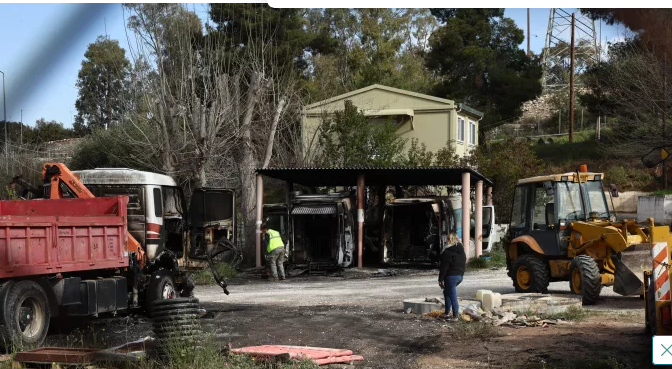
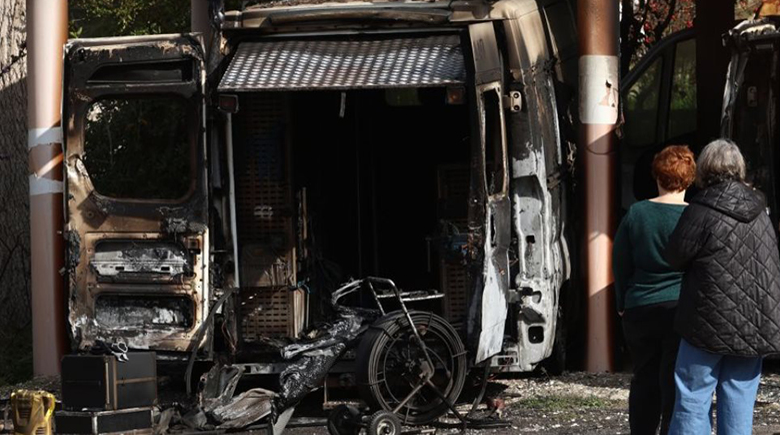
The GEK TERNA conglomerate counts among its losses a staff transport bus, on 24/01/2025, due to arson. A giant company that is responsible for the greatest disasters in the Cretan environment, the Greek territory, but also internationally.
It does business and secures its profits by destroying forests and leveling mountains. It uproots people, animals and plants.
Capitalism has its own ethics: profit above all else. Arguments, logic and justice are unnecessary. As long as they’re profitable, they’ll keep going, even if they leave behind nothing but debris.
It’s not the metal sheets or the tires that are burning and smelling, it’s not the financial damage, even though they make us happy. The fire speaks for itself. It chases the sky, however elusive and distant it may seem. From the spark to the flame, and from the flame to the fire. May we bring fire to the cities, may we burn to ashes the ethics of profit and its supporters.
“Flyover” is part of a programme of 30 projects aimed at transforming Thessaloniki into a “metropolis of the Balkans”. Through it, a complex of environmental destruction, capitalist expansion and tightening social control is revealed. Opposing this design through a radical perspective allows us to attribute a material basis to a system that would like us to believe is unmistakable.
The project includes the overhaul of 13.5 km of Thessaloniki’s regional road and the addition of a 4 km Flyover, for which 187 hectares of the Sheih Su forest will be destroyed. To ensure social acceptance of the Flyover project, managed by the AVAX-Mytilineos consortium, a conscious green-washing practice is used. Its main argument is better regulation of traffic to reduce CO2 concentrations in the city. However, it is proven that larger transport infrastructures tend to increase traffic. In addition, Flyover will further cement the nature of the area, harming fauna and flora and favouring the ‘heat island’ effect, i.e. the rise in local temperature due to the heat-absorbing property of the cement.
In other words, this is all bullshit! But even if the project was viable, it would remain problematic. This is an issue with important socio-political implications which should not be dealt with solely from an environmental point of view.
Control: the spacetime of the metropolis
Capitalism needs infrastructure to ensure its enforcement and maintenance. Infrastructures like Flyover help to further control the movement of people and therefore define the relationships we build with each other.
In recent decades, global capitalism has been reorganized around regional metropolises. A network of production units that destroy the earth, exploiting the lives of humans and non-animals. With rural reforms and the use of land for infrastructure, quality of life and employment opportunities are becoming increasingly scarce in rural areas, forcing their inhabitants to move to cities. And in turn, this exponential growth of metropolises leads to further destruction of natural areas. The continuous expansion of the metropolises strengthens the power, strengthening our dependence on the capitalist-state system.
As the metropolis expands, city centres are refined and standardised. What used to be a place of residence, meeting and organisation, it is now becoming a showcase for attracting business and tourism. In the metropolis, the city itself is a product. Those who disturb the superficial ideal, the “undesirables”, the working class, the immigrants and the squatters, are pushed to the periphery. This ‘cleansing’ is made possible as roads, the metro and other modern means of transport allow displaced people to move daily from the degraded neighborhoods where they live to the shops, offices and factories where they are exploited. And as the metropolis expands, so does the portion of their day devoted to commuting. As a result, leisure time is constantly being reduced, absorbed by overtime work and transport.
At the same time, public spaces become smaller, more controlled, uninviting (when they simply do not disappear), or are replaced by cafeteria terraces, parking lots or Christmas markets. The “third places” are exhausted, with every corner of the city being used for financial profit. There is no place for socialisation without honor, let alone political organisation, which is increasingly difficult as spaces that offer alternatives (squats, universities, squares, etc.) are attacked. The only form of protest that is accepted is not only the non-violent, but the one that either does not disturb the production-consumption cycle or actively feeds it. Political discussions are transferred to the online world, social media posts replace our presence on the streets and walls of the city. We are building our own surveillance. Our opposition to the system is expressed solely through our lifestyle, from where and what we consume. Therefore, activism, as it lacks its necessary social character, turns into individual consumer practice, supplying dominant systems instead of opposing them.
So, through the control of space and time facilitated by roads and modern transportation, governments direct our behaviors to prevent any disruption to the capitalist machine.
Moreover, for this transport system to work, it requires a high level of organisation and specialisation of work that only the state can provide. It creates a vicious circle where it is at once the means, the consequence and the source of capitalist expansion. It operates in every aspect of the economy: urbanisation, fossil fuel extraction, agribusiness and nature management. A chain reaction, where the capitalist-state system spreads like a virus until it consumes every living creature, every piece of land and wildlife.
Disconnection: the nature of the metropolis
To assert and maintain its dominance, the capitalist-state system must appear as the logical evolution of our civilisation, inevitable if not desirable. And to trap our consciousness, it shapes our horizon.
In the world of the metropolises, the ground is covered by behemoths and shopping malls, motorways and railways, parking lots and data centres. People penetrate the mountains with tunnels and dig the land for minerals. They mix the limestone and the clay they get with sand from exhausted beaches to make cement and concrete. Containers and giant fishing boats empty the seas, while planes fill the skies. And as capitalism colonises wildlife, the smell of fresh air, the sense of grass and the songs of the birds disappear from our daily lives. In the smell of exhaust fumes, in the sounds of car horns and in the hasty crowd of the city-worker, we find isolation and alienation. By separating us from the natural world, the capitalist-state system separates us from each other.
In the name of the god of profit, it plunders fauna and flora, reducing them to resources that are sacrificed on the altar of civilisation. Non-human animals become meat, winds become kilowatts, trees become oxygen, soil becomes building materials, people become labour. Everyone and everything becomes a commodity.
Although capitalism has driven ecosystem destruction to unprecedented levels, most civilisations have been promoting human domination over other species for centuries. Anthropocentrism, the idea that human civilisation is separate from nature, that man comes first, allowed them to naturalise the unbridled exploitation of the rest of the living beings. A multitude of dipoles runs through our world to ensure the machine runs smoothly: male-female, white-non-white, civilisation-nature.
Many environmental discussions don’t question anthropocentrism and therefore don’t challenge the system. But it is not about “conserving our natural resources” to ensure the future of humanity, nor about “defending nature” as an unattainable ideal separated from us. It’s about refusing to stay on paths that others have mapped out for us. The non-human world is not ours to destroy or protect.
Interview between the band La Lira Libertaria in Chile and JURNAL ANARKI in Indonesia.
1. What motivates you in creating this band? The song “Armate” feels like a homage to the memory of insurrectionary Mauricio Morales, how do you elaborate your music and band with anarchist revolt?
The band was formed to show political solidarity and fill the spaces that we frequented around 2009 and a little before: squat houses and social centers mainly. At first the Lira was a paper piece of popular poetry that we printed that year and that rescues the tradition of the popular poets of the late 19th century and early 20th century, but with anarchist content. The formation as a musical band began later around 2010 in the context of the “Bombs Case” and sought to contribute to the spaces that were hit. The song Ármate is undoubtedly a tribute to the comrade Mauricio Morales Duarte who fell in action on May 22, 2009. The lyrics are an adaptation of one of his poems, and the girl who sings it with us was his partner, which is little known. We wrote it for the second commemoration of his death, and we presented it at the now defunct “Cueto con Andes” social center, where Punky Mauri himself visited and contributed to. Some time later, comrade Luisa Toledo would make her words even more well-known: beautifully violent. Sometimes people confuse this and think that they are words from our dear grandmother Luisa, but she took them because it was her favorite song by the band. That way, the songs and its stories are directly related to our recent political processes, and to the revolt and resistance against the neoliberal model in Chile.
2. From our informal discussion in the past you hinted that most of you come from the specific tendency of combative anarchy, can you tell us more about this?
Yes, we all met at the time we were studying, around 2006 onwards, and we were part of the riots and street-based struggles, like so many young people in Santiago. That is why we lived through the processes of the student rebellions of those years and the protests for the release of political prisoners, environmental projects, the denunciation of capitalist democracy and the anarchist movement.
The insurrectional anarchist movement was constantly attacking the system in that decade and even later, when the band was already formed. That’s what our songs are about, that’s why in them there are stories of attack, escape, prison and joyful rebellion too. The band grew up with this marginal discourse, and with the October 2019 revolt it achieved greater notoriety, since it had been talking about the contradictions of the capitalist model for a long time.
3. People from non-latin speaking countries are amazed by the growing anarchist tension in Chile, especially the diverse anarchic movement, the regeneration of the youth, and the especially heavy repression that the anarchists faced amidst all of this yet still retain their combative and insurrectionary action – what’s really making all of this possible?
As I see it, the commitment to the struggle is explained since it is part of generations and generations of combatants, since the times of dictatorship (1973-1990) and even before. It is linked to our families, to our disappeared detainees, and to the indigenous culture itself, which tells us that the Mapuche tirelessly resisted the Spanish.
In that political environment we grow. This is even stronger considering that democracy stained its hands with the blood of the fighters against the dictatorship, and imprisoned those who continued fighting against capitalism. Figures like Claudia López, murdered in the commemoration of the coup d’état in 1998, and so many other Chilean and Mapuche young people, this fueled since childhood our desire to fight, our desire for freedom and our love for our compañeros.
Perhaps that is the most important component, and what explains everything: the love of the struggle and the memory of the comrades who fell fighting and those who still fight to this day. That is why anarchists, despite being beaten time and time again, maintain their action, because it is also a way of carrying within us our beloved compañeros who were taken from us.Continue reading “Chile: Interview with the band La Lira Libertaria”→
On October 31 our anarchist comrade Kyriakos Xymitiris was killed and our anarchist comrade Marianna M. was severely wounded in an explosion in an apartment in Athens. She was brought to the Evangelismos Hospital, where she was treated under constant police surveillance, and later transferred to the pre-detention prison in Korydallos. In the aftermath of what happened that day also our anarchist comrade Dimitra Z, our comrades Dimitris and Nikos R. and another person have been arrested and imprisoned in the same case.
Since then sorrow and rage have been present in our lives. Sadness for losing a comrade who committed to the fight to the end and by all means; anger because it is this capitalist, racist and patriarchal system that killed him. Kyriakos did not choose to close his eyes on the economic and political interests of a few who condemn us to a life of misery through the sale of houses to vulture funds, labor precariousness, feminicides, borders and wars. In the city of Berlin Kyriakos he has been committed for years in the defense of released spaces and against gentrification, in the internationalist struggle, in the abolition of prisons, as well as in all social and class struggles.
His passion and believes for a new world free of oppression leave a huge emptiness in those who were around them, as well as in the struggle itself. However, his imprint through words and actions encourages us to keep the thread of the insurrection alive, thus continuing the vision of the social revolution present in our hearts and minds. A revolutionary action that understands the armed struggle as a decisive medium in favor of those of the bottom in the balance of power, which tries and manages to return to the state part of the violence that every day imposes us.
We understand that through the defense of his memory we also stand next to all those who gave their lives or and were imprisoned to fight against injustice, inequality and exploitation.
For all this reason and collecting the call of February 7 and 8 of the Greek comrades from Athens, we want to face those who try to pervert this memory. As well as express our solidarity to the comrades imprisoned in the same case. For this reason we decided to have a short wild demo through Friedrichshain where we had shared together many collective moments of happiness and rage. Obstacles were put on the streets, graffiti in memory of Kyriakos were sprayed. Afterwards in Rigaer Street arriving forces of the occupiers were fought with stones.
This neighborhood of Berlin, as well as other metropols in the world, has faced a huge process of gentrification. In the last years where collective spaces where evicted to be transformed in yuppi restaurants and shops, people with low sources are getting displaced to the periphery, the airbnb are rising while the rents are becoming unbearable and the policies about how to use the public space are more repressive.
We, as Kyriakos did, can’t turn our eyes away of this process that destroys the city and the different communities living there. We, the ones that believe in a better world, want to go out of this precarity where the ones not conforming the norm are condemned. For this reason, as many other protest and answers are taking place in different cities, we want to stand against it and continue the path that we already walk with our friend and comrade Kyriakos. This path that cost his life. Him in our minds, his ideas in our hearts. Together taking back the streets of Berlin and Athens again. Revolutionaries hearts burn forever!
Freedom for our comrades Marianna M., Dimitra Z, Dimitris and Nikos R.!