
Tag: Alfredo M. Bonanno
Italy: Juan Sorroche – ‘Reflection on the General Context of the Causes of the Struggle’
Regarding my convictions and trial charges and the nexus of non-systemic revolutionary struggle action practices and “my” meaning of the anarchist vision
“(…) The reality is precisely this complex thing that cannot be traced back to the results of a judicial proceeding. This will always be arbitrary and will be based not on evidence but on force, not on logic but on domination. Difficult reasoning? Maybe so, but reasoning that once done can never be forgotten” [Published with the title “Noterelle su Sacco e Vanzetti. In margine a un convegno di studi”, in “Anarchismo”, n. 63, July 1989, pp. 36-40].
Alfredo Maria Bonanno, A mano armata, Pensiero e azione, Edizioni Anarchismo
In remembrance, and a warm greeting and see you soon comrade Alfredo!
Note:
To facilitate the writing of the text, I chose to use mainly the masculine as a gender ending. Aware of the importance of rejecting and countering gender abuses (as of any kind), I trust in the reader’s understanding so that no one feels discriminated against.
Premise:
Hello to all, compañeras and to all, compañeros
I am Juan Sorroche, an anarchist prisoner arrested on May 22, 2019 and I write from the AS2 section of the Terni prison where I have been locked up for 5 years.
After my heavy sentence on January 26, 2024 in Rome in the Court of Cassation trial for the action against the Lega Nord, a party that was and is part of the government of the Italian State, a strongly racist, misogynistic and xenophobic party.
As an anarchist prisoner I would like to make clear to comrades, revolutionaries, outcasts and oppressed the connection of the causes of the struggle for which I am here in prison today as an anarchist prisoner.
In the first instance, even though the prosecutor had removed the charge of “political massacre” (285), I was sentenced to 28 years in prison plus 3 years of probation. On appeal, almost half of the sentence, I was sentenced to 14 years and 7 months. A few days ago, the Court of Cassation definitively sentenced me to 14 years and 7 months, a significant and exemplary sentence for the attack.
In the first instance, I want to say that I entered prison already having spent a cumulative period of about 8 years behind bars for my struggles in Italy, which is why I escaped into hiding in 2016 to continue living-fighting. Of these 8 years, 4 years are for the “NO TAV trial”. Subsequently, the other 4 years were different trials related to anti-prison and anti-CPR struggles, anti-fascist and anti-democratic struggles, struggles against technologies, GMOs, “environmentalists”, in which I took part, always trying to include the anti-state and anti-capitalist aspect of anarchism in Trentino as well as in different Italian situations. Including the Susa Valley, a path that I had taken in the past years in the NO TAV struggle against one of the projects of capital and the State and the devastating tentacle of the high-speed train. I was arrested, among many others, for the days of struggle and violent clashes of July 3, 2011. During the trial and during my imprisonment at the time, I claimed with a personal statement those days of struggle and the paths of opposition to the TAV and more generally the anti-state and anti-capitalist aspect. I refused the defense in the “NOTAV Trial”, positioning myself anti-juridically even trying to fight in court by refusing the trial, believing that I should not “defend” myself in that judicial theater, and for this I was sentenced to 4 years and 6 months. And I take those decisions with my head held high.
In May 2019, after 2 and a half years on the run, I was arrested together with another comrade accused of having supported my being on the run, and then the comrade was sentenced for aiding and abetting to a year and a half, a sentence that was significant and exemplary as we had not seen each other for years, and it gave us a hint of the new tenor of the trials to come.
When I was arrested, little by little, I became aware of a series of investigations and trials that see me accused of several attacks (with terrorist aims) in Italy:
– the bombs at the headquarters of the Lega Nord in Treviso for the attack of 12/08/2018, regarding the two explosive devices, one exploded and another full of nails discovered by the bomb squad in the form of a trap to carry out the components of the building and the police; these were placed in the headquarters of the Lega Nord in Treviso and were claimed with the claim:
“Let’s hit them at home!!!: (…) to specifically attack racism and exploitation. To strike at the state, capital and its perpetrators. Direct action makes it clear to us why and how. For an internationalist, rebellious, and anarchist solidarity! Solidarity with all prisoners (…). And to all the rebels locked up in the homeland prisons of the world!”
Haris Hatzimihelakis Cell/Black International 1881/2018
– the bomb at the Surveillance Court of Trento 2014. Sentenced in the first instance to 3 years and 2 months, then acquitted on appeal, I must soon go to the Supreme Court. Claimed anonymously: in solidarity and to give voice to the prisoners who struggle with dignity in all prisons and to the anarchist comrades who were in prison isolated in AS2 in Italy and other anarchist prisoners in the world.
– the bomb against the POL GAI (police academy) claimed by cell H, I report some sketches of the published claim:
“(…) as a cell H (C.A.A.) akin to the Black International and we join the call to action for a BLACK DECEMBER. We attacked one of the armed arms of the state. In this “school” cops from all over Italy and other countries are educated. This is a small signal against war. We stand in solidarity with all the people who are fighting against all states and capital. Our thoughts go out to the many comrades who have been repressed, locked up, tortured, or killed in the present and in the past. In solidarity with all the detainees who are struggling.”
This is in the context of the campaign launched by anarchist prisoners in Greece for a Black December, called international in the context of anarchist action in 2015.
A trial that I will begin shortly.
To date, I have accumulated 23 years in prison.
Actions that I agree with because for me they are part of the history of our movement of struggle in non-systemic revolutionary anarchism of action and of the struggle for freedom of all the oppressed in the world. Regardless of whether or not I am responsible for these facts. And I am determined to move forward in my anarchist life in order to live-fight within my limited possibilities as a prisoner. Continue reading “Italy: Juan Sorroche – ‘Reflection on the General Context of the Causes of the Struggle’”
Chile: Interview with Espacio Fénix EN/ES

ES: (Chile) Entrevista a Espacio Fénix
Opening the tensions of dialogue, we present the following section of interviews with individuals, collectivities and related spaces that make up the anarchic body in different parts of the world.
The interviews are a valuable contribution to the observation in detail and depth; they come, in a certain way, to broaden the view to give us feedback among comrades and to debate with perspectives and projections, that although they may be different, they converge in the ideas and practices of freedom against all authority.
Without further ado, we have in this first venture of dialogues the comrades of Espacio Fénix.
1-How and when did Espacio Fénix arise, and what projects converge in the space?
Espacio Fénix was born in the middle of the pandemic, at the beginning of 2021, in the midst of a series of ridiculous mobility restrictions and increased police intervention under the excuse of controlling and preventing the spread of covid-19.
Thus, a group of compañerxs got together, seeking to open a crack, a fissure within the asphyxiating panorama that was regulating everything, imposing the rhythm of power and where many seemed to be accommodating or waiting for the authority to give us “permission” to resume our lives.
We embarked on the idea of opening a physical space where comrades could converge, where anarchic material could circulate and where new comradeships could be woven and articulated. Thus in May 2021 we opened the doors of the space, we began to set up its infrastructure and in July we held our first activity in memory of compañero Santiago Maldonado.
Claustrofobia Ediciones, the Biblioteca Antiautoritaria Sacco y Vanzetti and various anarchic individualities converge in the space.
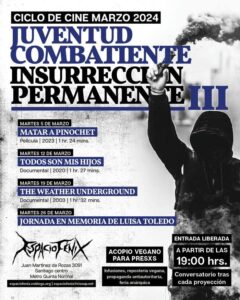
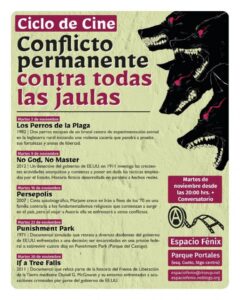
2-The “Ciclos de Cine” (Film Cycles) is the tool you have used the most to carry out activities. What is the significance for you of the screening of films, documentaries, etc.?
We started with the film cycles in October 2021 and we have not stopped every Tuesday, month after month, grouping the films by specific themes, seeking to stress our ideas and nourish our arguments with content, it is the beauty of the feedback between colleagues with diverse experiences and views.
From the very beginning, we proposed the screening of films as an excuse to sit down and converse, because after each screening, the central part of the activity comes to life, which is the discussion about what has been screened. There the words run, without leaders, where everyone can expose their dislikes, their liking or the results and analysis that is made of what we have seen. With this gesture we also seek to break the logic of passive spectators, of consumers, very typical of socially imposed roles.
In this sense, we have screened diverse audiovisual material, industry films, documentaries made by compañerxs, films that we like or dislike, always aiming at the discussion and tension between compas.
We do not seek to fill the cultural gaps of authority, nor to be the free panorama for those who lack resources; we seek, by different means and tools to spread our anarchic and anti-authoritarian ideas/actions, therefore the film cycles are just one more tool we choose.
3-Regarding the written material, what is the importance and power that you perceive in it?
The written material certainly has another power, another depth and transcendence, of course the spoken thought is important, but writing allows the ordering of ideas, so as to be able to reflect more carefully on what is going to be exposed and to assimilate/discuss more deeply on what is read.
In a present where immediacy, image culture, the digestible and pyrotechnical, where almost the medium is the message, emptying of content many of our tools, writing/reading is a weapon, which can also serve as a refuge, where to continue polishing and sharpening our ideas.
The written material is an instrument that impels us to grow, to argue and continually revise our positions, widening our views, shining light where there was darkness.
On the other hand, it is necessary to say that written material has always accompanied anarchists, as propaganda for the dissemination of ideas, it is an effective tool to enter into dialogue with more comrades wherever they are: in the street, in prison, or other territories. It is important because it nurtures individual thinking, as well as possible collective discussions.
The written material as propaganda can bring together comrades and depending on the objectives and projections that we have, we can realize initiatives of various kinds. In the same way that we can find ourselves on the path of anarchic struggle, we can also distance ourselves from people who spread anarchist propaganda of other tendencies, for us those who are called to participate in the electoral circus, appeal to platform organization, dream of unity and large federations and those who reject legitimate political insurrectional violence – to give just a few examples – puts us in another place on the sidewalk and in several cases as enemies.
4-There are political-cultural spaces that coexist peacefully with power, while others attract police attention. Why do you think this happens? Are there more dangerous ideas-practices? If so, what would these be?
We don’t think this was the intention of the question, but it is worth clarifying to avoid pejorative atmospheres. For us, anti-power spaces/ideas/practices (truly anti-authoritarian and anarchic, leaving out and fighting the bullshit of “popular power”) by definition do not coexist peacefully neither with power, nor with authority, nor with the police and their investigators of all kinds.
Police eyes and ears are always there, to believe otherwise is naive and dangerous. They let themselves be seen or directly attack depending on conjunctures or panoramas that mark a change of rhythm.
In this sense, it is not the police harassment that defines our comrades’ ties -it is defined by our ideas, values and projections- because valuable initiatives that are undoubtedly a contribution to the anarchic tide, may not receive the police onslaught in an evident and grotesque way and not for that reason be considered “legal”, “innocent” or in any way aspire to coexist peacefully with the power. For example, at present there are activities that do not receive police interference, but that 3 or 4 years ago were seen as a danger and received harassment; we are talking about common pots or self-defense activities. It does not change the activity or the background, but it changes the perception of power or the effect it seeks to achieve as a chain reaction (fear, disarticulation, etc.).
Now, it is important to emphasize that these types of practices carried out by those in power are part of their work, and must be understood as such. They have always existed and will continue to exist, we do not say this in an alarmist way, much less to call for immobility or to “disappear” from certain spaces. Simply because it must be clear, those who consciously decide to undertake a confrontational path to power and propagate it in multiple ways, may encounter those enemy dynamics, therefore, the consequences must be assumed. Continue reading “Chile: Interview with Espacio Fénix EN/ES”
‘Not Just Buttons’ + ‘From Marx to the Uri’ by Alfredo M. Bonanno

Both texts taken from Alfredo M. Bonanno’s ‘Palestine, mon amour‘ published by Elephant Editions & translated by Jean Weir.
Not Just Buttons
A police force is always a police force for the simple reason that a State, even one in tatters such as the Palestinian one, is always a State.
Now, for whoever in his time has struggled for the ideal of the liberation of the Palestinian people (each in his own small way may have given some contribution), the thing takes on a particular significance. To think that comrades in struggle, a struggle that once spread like an epidemic more or less everywhere in Europe and beyond, are now donning the shiny buttoned uniform, a bad imitation of the English cops, is quite indigestible.
But policemen do not just wear uniforms, they don’t just polish their buttons; they control, repress, beat and on occasion shoot and kill without giving it a thought.
Gaza is not a large city, it has few tarmac roads and, as in so many other parts of the Arab world, those there are look like little village lanes. Arafat’s policemen are now present in the area where the Israeli Shin Beth were once stationed. Not just policemen, but the court, the prison, and the secret services. All small, not very efficient, but it’s the thought that counts.
What has happened to the Intifada?
It goes on, of course, against the bosses old and new. So boys and girls are arrested, taken to the multifunction building of Palestinian State repression, interrogated by condescending investigators and judged by improbable judges. They are also children, just a little more grown up, born in the concentration camps. What can they say under the illuminated strategic direction of the great Leader?
In the same way that it took us years to convince ourselves that the Israelis were torturers even though they had just come through the extermination camps, now goodness knows how long it will take to see that the Palestinians, comrades once upon a time, can become torturers today.
Reality evolves, and in evolving the masks men hide behind in order to recite their roles change. But often the role behind the mask also changes, without anyone noticing.
[‘Non solo bottoni’, published in Canenero no. 20, March 24 1995, page 2]
From Marx to the Uri
Many things are changing in Palestine. Many others have stayed as they are. Poverty and hatred are rife as always, especially hatred of the occupying forces, that is of the soldiers of Israel still present in the Territories.
What could be more natural than to hate invaders? Only politicians who have sold out to the enemy and contracted the possibility of an internal government and a puppet of a State rather than the continuation of the struggle, could think differently. Many Palestinians, are not prepared to accept cohabitation based on the defence of the interests of the strongest.
That explains the spread of resistance, which presents itself almost uniformly under the insignia of Hamas, inside the same newborn State of Palestine. This is certainly the most consistent armed group of the present time. It is doted with considerable means, as became evident in the explosion a few days ago [1995] that blew up a whole arsenal.
There’s nothing easier in that region than to find a young boy between twelve and sixteen, born and brought up in the poverty and violence of the concentration camps, who is disposed to listening to arguments against Arafat and his project of a free Palestine coexisting with a free Israel. Nothing could be easier than to push these boys to carry out a suicide bombing.
That is what those of the Izz al-din al hassam, the armed wing of God, who are not boys but religious fanatics, are preparing the former for — a holy death in the war against the infidels.
Twenty-five years ago, in conditions that were certainly not any better than those of the present time, the struggle of the Palestinians was based almost entirely upon a different kind of indoctrination, the Marxist one.
At that time intermediaries with long beards promised them help in the form of money and weapons; now Islamic priests are promising eternal life in a paradise full of Uri.
[‘Da Marx alle Uri’, published in Canenero, no. 22, April 7 1995, page 2]
Mexico: In memory of Alfredo M. Bonanno
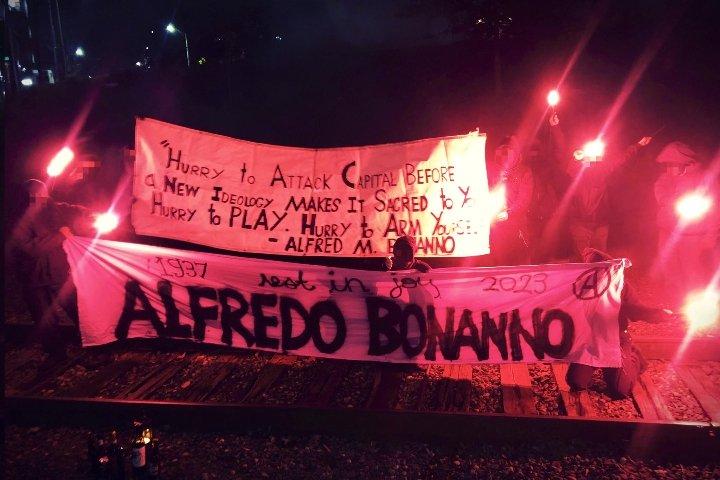
In memory of Alfredo M. Bonanno
(Catania 04/Mar/1937 – Trieste 06/Dec/2023)
…no one is totally the fruit of himself and each person, individual, it is certain that he is within a framework of relationships that can provoke him and affect his reactions, emotions and even the logic brought to that point.
– Antonio Lombardo
Before I began to think about these lines, I had given myself the task of searching and compiling data to write -with the intention of leaving a clue- about some of the many insurrectionary anarchist actions in contemporary Mexico that, although they have been sporadic, have not been recorded by the “official” historiography, either from “our side” or from the academy. The year 2023 marked the sixtieth (60) anniversary of some small attacks in the city carried out by the Libertarian Youth of Mexico, but I left it on the back burner, because I was taken by surprise by the news of the death of comrade Alfredo.
I did not have the opportunity to exchange impressions with him, the closest I got was when I briefly collaborated in the coordination -ten (10) years ago- of the Informal Anarchist Days / International Symposium, in Mexico City. [i] I did not consider it necessary to have a direct approach -because I refuse to pay homage to personality-, since in my opinion everything said about the “insurrectional project” (including the debate around insurrectionalism), was already circulating in our language since the beginning of the year 2000 in some anarcho-virtual forums, and to a lesser extent, in printed form his ideas were also circulating in some publications although only short articles or one or another lecture were disseminated. Unfortunately, no complete text of this tendency could be found; for this reason, in 2005 I acquired several copies of the Cuadernillos Incendiarios collection from the Chilean region, in order to distribute them in these latitudes.
Insurrection vs. Revolution
…there are people who are so miserable that even talking about them makes you dirty. And then, in the society in which we live and with which we have to deal with; we have many other more powerful (and even more serious) enemies and adversaries that we can easily overlook the “bites” of some “mistake”.
– Gianfranco Bertoli to Alfredo M. Bonanno
In spite of the little dissemination of these contributions in our region -which by then were no longer a novelty-, in 2001 informal actions began in different states of the country. At the time, these first attacks would not be claimed. This shows that the “insurrectional project” was already being debated in small groups among a few comrades and was being put into practice by concretizing the praxis. That is to say, from the need for action and, from the experience acquired in a sequence of attacks, theory was generated which, in turn, fed back into action to later distribute in print the new theoretical contributions and consolidate the debate through the international exchange of similar positions. Finally, some Bonannist postulates were abandoned and the attacks began to be vindicated by the different informal groups in operation. Continue reading “Mexico: In memory of Alfredo M. Bonanno”
$hile: “Words from the confinement, necessary letters” by Marcelo Villarroel

On December 16, 2009 I was expelled from Argentina after 21 months of confinement in different units of the province of Neuquén to be at the disposal of the Chilean state and it has been 14 years since then.
In 2014 I was sentenced to 14 years for two bank robberies. Strictly speaking, I am serving this sentence in its entirety, from beginning to end, without any benefit and it ends today December 16, 2023 and still the state keeps me behind bars.
According to the gendarmes, I must serve 12 more years of imprisonment to be able to apply for some intrapenitentiary benefit only in 2036. According to their retroactive modifications of the illegal Chilean law, in 2056 I will definitively expire my sentences, all of them from events that occurred more than 30 years ago.
A madness of numbers and years typical of Pinochet’s military justice shamefully in force and still today endorsed by recent rulings of the Court of Appeals of Rancagua, of Santiago, of the Supreme Court and the Constitutional Court of this amnesiac country governed today by the Communist Party, the Broad Front and all the progressive and social-democratic scum always at the service of the interests of the great god of capital.
In this context, a few days ago, Mónica and Francisco, anarchist comrades of action who received the full revenge of the state, were condemned by the capital’s democratic inquisition, particularly Francisco to whom the domination imposed 86 years, becoming today the revolutionary prisoner in the Chilean prisons with the highest sentence and whom we must know how to accompany from the daily practice without pauses since the road will evidently be longer. Always from the complicit affinity and never from the victimization!
On the other hand, in the occupied wallmapu, in the same week, the racist Chilean justice declares Peñi Luis Tranamil Nahuel, who these days is about to receive a hefty sentence, as well as Peñi Nelson Queupil, who faces an imminent sentence, both walking the path of the weichan, are in Chilean prisons, fists raised, living the onslaught of the state offensive of occupation. Continue reading “$hile: “Words from the confinement, necessary letters” by Marcelo Villarroel”
UK: Letter from anarchist prisoner Toby Shone for comrade Alfredo M. Bonanno
Farewell, Alfredo
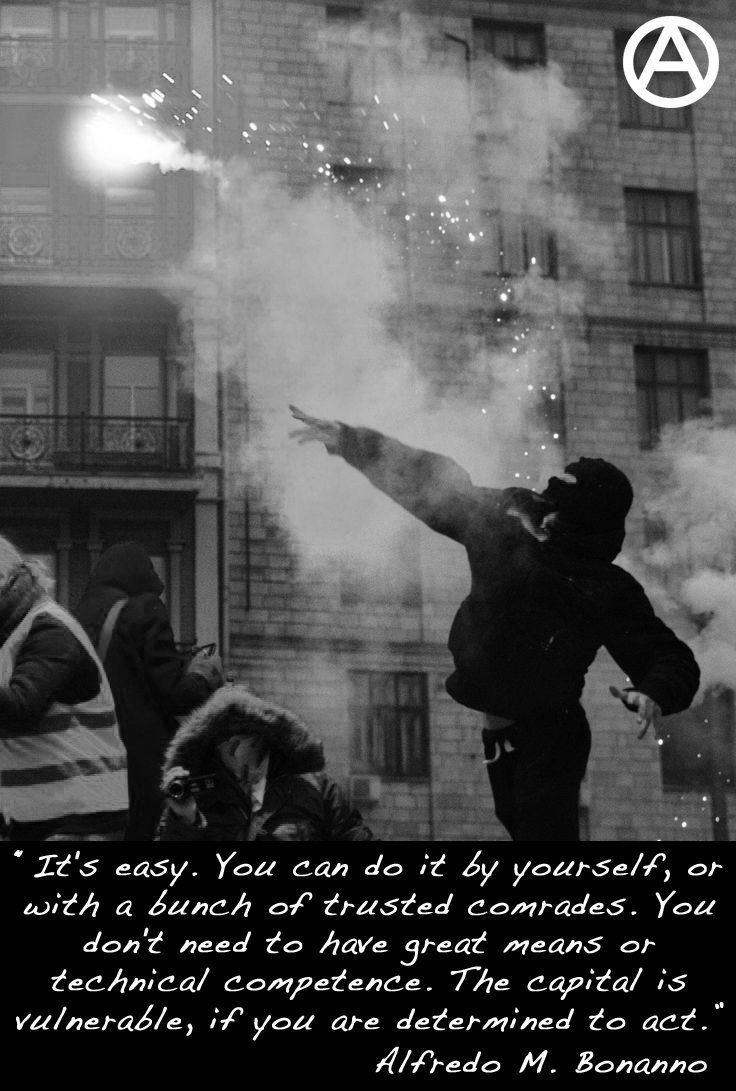
I heard today by telephone as the morning winter sun shone through grey clouds into the confines of my cell that our comrade Alfredo Bonanno passed away during sleep surrounded by the love of his close ones. I too send my incendiary embrace to all those who feel his loss and assert that a combative memory will remain. Alfredo’s contributions to the anarchist movement are undeniable, critical, insightful, and prescient. One of Alfredo’s texts, ‘What are Anarchists?‘ had appeared in an investigation file against me for which I was accused of distributing. His booklet published under the title ‘Locked Up‘ by Elephant Editions is one of the most important documents on the topic of imprisonment in my opinion. Alfredo’s writings for which he was investigated and incarcerated are never mere collections of words but emerge directly from lived experiences, his own and that of the comrades that participate in our struggle for freedom. Affinity groups, informal organization, direct action and the critique of technology and systems: these concepts form the most potent section of today’s Anarchy, let’s put them into practice!
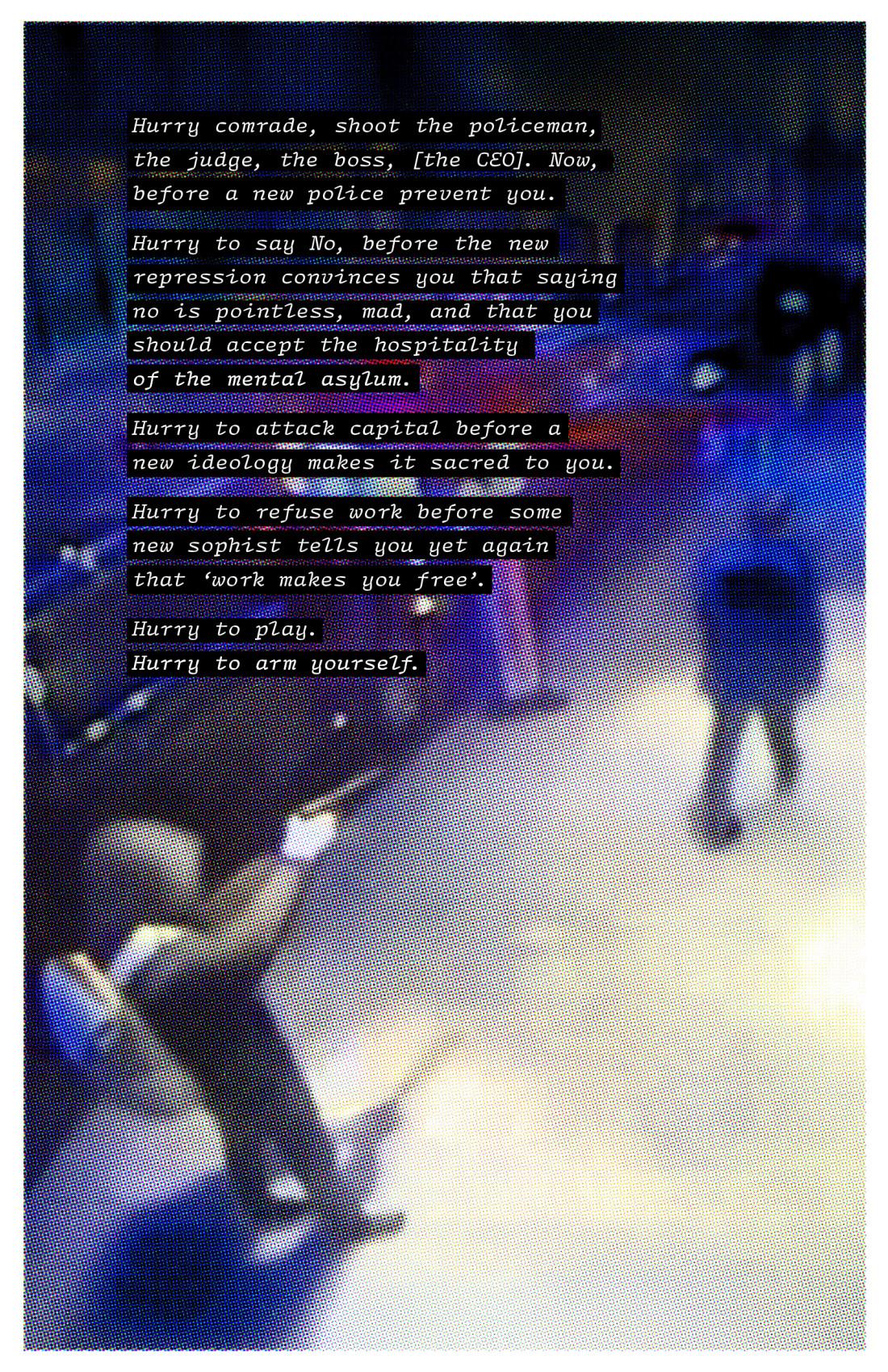
“Hurry Comrade”
Toby Shone
12-12-2023 HMP Garth
Greece: For Comrade Alfredo Bonanno from Nikos Maziotis, Member of Revolutionary Struggle
Comrade Alfredo M. Bonanno has passed away at the age of 86. He lived a whole life in the world of struggle and anarchy. He was one of the main representatives of the insurrectionary tendency of the Italian anarchist movement with a great theoretical contribution and editorial work. He was editor of the magazine Anarchismo and other anarchist publications. For his activities he was repeatedly persecuted and imprisoned by the Italian state together with other comrades in the 1990s, e.g. for the O.R.A.I. case (in 1996), the armed expropriation of the Serravalle Rural Savings Bank in the Trento area in 1994 and other attacks.
He had come to Greece several times. The first time I met him was in January 1993 when he visited me in the military hospital 424 in Thessaloniki after 50 days of a hunger strike I had carried out. I had just been released from being a prisoner in the Thessaloniki military prison for refusing to serve my military service. In 1999 he had also come to Greece and had testified as a political witness for the defence in my trial for the bombing of the Ministry of Development in December 1997 as an act of solidarity with the then dynamic struggle of the villagers of the Strymonikos Gulf villages in North Greece – Halkidiki (Olympiada, Varvara, Stavros, Asprovalta) against the installation of the Canadian multinational gold company TVX GOLD, which has been succeeded today by Hellas Gold, a subsidiary of Eldorado Gold. It was a historic political trial in the then annals of the Greek anarchist movement where for the first time in Greece after the fall of the junta there was a defence of armed-dynamic forms of action. In that trial, in addition to the Greek comrades/compañeros, in addition to Alfredo Bonanno, Costantino Cavalleri, a comrade of the insurrectionary tendency of the Italian anarchist movement, and the comrade Hellyette Bess, who was a member of the French guerrilla organization Action Directe and had been imprisoned for several years for her participation in the organization, had testified after an international call for solidarity. The 3 then imprisoned members of Action Directe, Jean-Marc Rouillan, Joëlle Aubron and Nathalie Ménigon, had also sent a written message of solidarity to the court.
The last time I saw Comrade Alfredo was in 2010-’11 in Korydallos prison when we were in custody for our participation in the Revolutionary Struggle. He was also in custody on the charge of expropriating a bank in Greece. With Comrade Alfredo, despite our different approaches to struggle and mode of action, we were connected by an invisible thread, as are so many other comrades around the world who dedicate their entire lives to the struggle to free humanity from the shackles of the state and capital.
THE COMRADE WILL LIVE ON IN MEMORY AND IN OUR STRUGGLES
Nikos Maziotis, convicted for the actions of Revolutionary Struggle.
source: https://athens.indymedia.org/post/1628067/
Via & translated for Abolition Media by Nae Midion
Anarchist comrade Alfredo M. Bonanno has died on 6th December at the age of 86
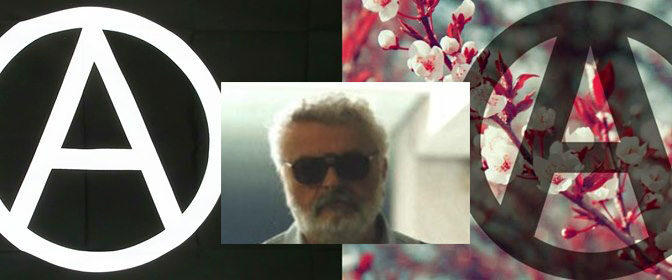
You will always be alive with us through our action and our lives. “ACTION REPLACES TEARS”
Alfredo Maria Bonanno, born in 1937 in Catania, Sicily, is one of the most prolific contemporary anarchists, responsible for Anarchismo editions and other publishing ventures. In 1977 he was sentenced to 18 months in prison for his book La Gioia Armata (Armed Joy). This book had been published at a historical moment when the Italian revolutionary movement was openly going on the offensive, while similar conditions existed in other European countries (Germany, Spain, England, Greece, Chile and more) and the question of violence was on the daily agenda. His contribution lies in a celebration of the pervasive class violence that liberates and satisfies the individual, but at the same time he sounds the alarm about the emergence of the armed party, which reduces the class conflict to a militaristic dimension, imposing the mediation of a small minority of armed men on the complexity of tens of thousands of people struggling by all means against the current reorganization of Capital, which at that moment seemed weak.
In the spirit of the book, all authentic liberating and destructive action comes from a logic of satisfaction in the struggle, not a self-sacrificing duty in accordance with the dictates of a micro-bureaucracy. The Italian Supreme Court ordered the destruction of the copies of the book that were in circulation, and sent a circular to public libraries to dispose of any copies they might have had.
Several librarians objected to this Nazi-inspired tactic. Its circulation was generally banned, and copies were confiscated from the homes of anarchist militants in the context of police raids on houses.
Shortly afterwards, the author was accused of being an “instigator” of the Azione Rivoluzionaria, an armed organisation of 1976-79, which operated on the basis of “affinity groups” throughout central Italy, mainly against newspapers and party offices, and similar “manipulative mechanisms of consensus-building”. In 1979 the organisation was practically dismantled with the arrest of 86 people and the arrest of Salvatore Cinieri and Gianfranco Faina. The first went on to die in prison in a scuffle with criminal inmates when he defended a prisoner suspected of submitting an escape plan, while the second was released to die of lung cancer after being diagnosed with a tumour while in custody.
With the retreat of the movement, the author’s interest turned to the critique of traditional trade union and organisational structures, as well as to the new metropolitan uprisings that have been re-emerging in the West steadily since the 1980s, without the guidance of any party, without open demands, etc. Continue reading “Anarchist comrade Alfredo M. Bonanno has died on 6th December at the age of 86”
Chile: Words in memory of Alfredo M. Bonanno by Biblioteca Antiautoritaria Sacco y Vanzetti
Words in memory of Alfredo M. Bonanno by Biblioteca Antiautoritaria Sacco y Vanzetti
One death always makes us think of many more and it is the beautiful thing in the midst of sadness, our dead come out to dialogue, with us and with each other.
Bonnano did not share the relationship that many comrades on this earth have with those who have died.
Ironically today, his physical departure, makes us remember so many moments around his analysis, also the discussion with him in 2013, after his expulsion, the harshness of his phrases, but the beauty of the meeting, even in virtuality.
Alfredo did not connect with many of our ideas, but he fed many of ours.
Comradeship is also that, to grow in the clash of ideas, to feed tensions, to look for ways, to assume disagreements. It is not calm or permanent affirmation.
The ideas and analysis that he sowed in each one of us, perhaps he never reached the dimension, but they are alive, in practices, in actions, in resistances and offensives.
His seeds are also contained in books, get to know him, there are several of his texts in the library, discuss with his ideas, feed your own.
Reading is the engine of imagination, use it to fight against domination.
We embrace you Alfredo… trying to keep Anarchy alive.
Biblioteca Antiautoritaria Sacco y Vanzetti [Antiauthoritarian Library Sacco and Vanzetti]
December 2023
bibliotecasaccoyvanzetti@riseup.net
Source: Informativo Anarquista