For the lasting interruption of deadly techno-industrial progress.
On the night of April 26-27, we set fire to a cell tower in the Kaulsdorf district of Berlin.
Data flows and the telecommunication network are the sinews of progressive domination. The result of this technological capitalism was, is and will always be the exploitation and destruction of all forms of life. It is not enough to make a simple verbal and long-standing criticism against this state of affairs… The shit has to burn!
There are infrastructures scattered throughout the city and its periphery that are relatively easy to find and access, and are therefore vulnerable.
A thought for Serge, who is currently fighting for his life after the French cops shot a tear gas canister into his face.
Alongside Boris, incarcerated in France for sabotage actions, who became quadriplegic after a fire in his cell.
A good recovery to Alfredo!
Greetings to Anna and Juan in Italy!
For the diffusion of the revolutionary and destructive action
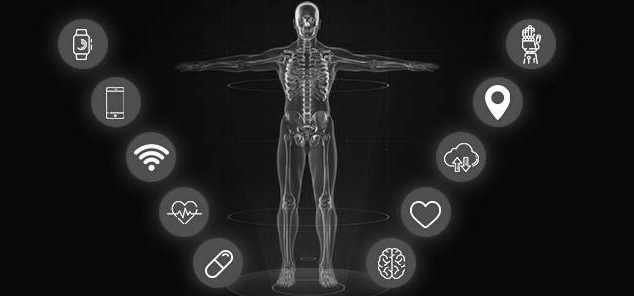
The Internet of bodies: the body as a technological platform
Introduction
It has not even been ten years since the Internet of Things made headlines and fueled the dreams of technologists around the world. Smart clothes that can measure your mood and update your cell phone, smart glasses with which you can overlay reality with a second layer of your own, e.g., with personalized realities, smart and inexpensive light bulbs charged with carrying the burden of your eco-consciousness by turning on only when you are in the room or when you give the command from the controller of your life aka smartphone, smart coffee makers, ingenious mugs, wi-fi-enabled sinks, and the list goes on. All this new “smart” and illusory life promised by the universal interconnection of everything on the Internet has turned out to be, at least so far, a mere fantasy. But is this proof of the failure of the Internet of Things? In a sense, the answer should be yes (again, at least for now), at least if one is to take such promises at face value. On the other hand, the Internet of Things can be considered as much of a “failure” as any new model of an automobile-based society is a “failure” because its drivers end up spending most of their time moving at the pace of a sloth on Alexandra rather than with feline grace on open roads, vast expanses of open country, or meandering, scenic roads perched on green mountains, as they should, given the commercials. The crucial difference in the case of the Internet of Things, which will provide the measure of any failure or success, is that it was not simply an attempt to promote a product or even a range of products. What was widely promoted or even mandated was not so much and not only the lures of smart devices, but the very idea of universal connectivity, the notion that information can be drawn from anything and that this information can be valued, exploited and enhanced.
There have been many, too many, probably the vast majority of individuals in Western societies, who have seemed all too willing to take the bait of all kinds of smart devices. Finding themselves with the hook of universal interconnectivity stuck in them, perhaps not yet sufficiently aware of the consequences of the position they have found themselves in. The oceans of psycho-intellectual novocaine in which they swim daily (courtesy of social media and subscription lobotomy platforms) do not leave them much room to maneuver. The extent of this retreat of conscience and panicked concession of battlefield positions that would once have been considered non-negotiable has become evident, if nothing else, with the recent issuance of health certificates. The docile readiness with which the subjects display the symbols of their unworthy conformity to a paranoid regime (even for unnecessary movements, such as those related to work or studies) is a low point but not the nadir of political and aesthetic-moral decline; at the other end of the sewer are those who assume the role of controllers, not infrequently enjoying their role, even if they do not openly admit it, perhaps not even to themselves (their tone of voice and body language are, however, irrefutable witnesses). A marvelous social condition that allows microclimates and alveolus to be created everywhere, within which the mushrooms of petty authoritarian attitudes acquire the status of the self-evident: the teacher checks the pupils (a mischievous person might say, “this is not a new role for teachers”), the clerk checks the teacher when he shows up as a customer, the waiter checks the clerk when he goes to buy coffee, etc. Everyone is given the opportunity to assume the role of the examiner; but no one is spared the role of the examined: in other words, the definition of the cannibal condition.
A nontrivial reminder: all these things owe their “success” in large part to the fact that they are mechanically mediated. The smartphones that promised the blossoming of a life in which everything would be available at (or even before) the push of a button seem to have first spread the manure of social barbarism in the form of mutual surveillance. It is obvious that without the ability to instantly scan and identify a certificate, the entire “medical” surveillance regime would be unstable and to such an extent that it might eventually collapse. But who would dare to oppose such practices among those who, for the sake of any free “convenience,” have become spineless data bleeders through their interconnected devices of all kinds? Continue reading “The Internet of bodies: the body as a technological platform”→
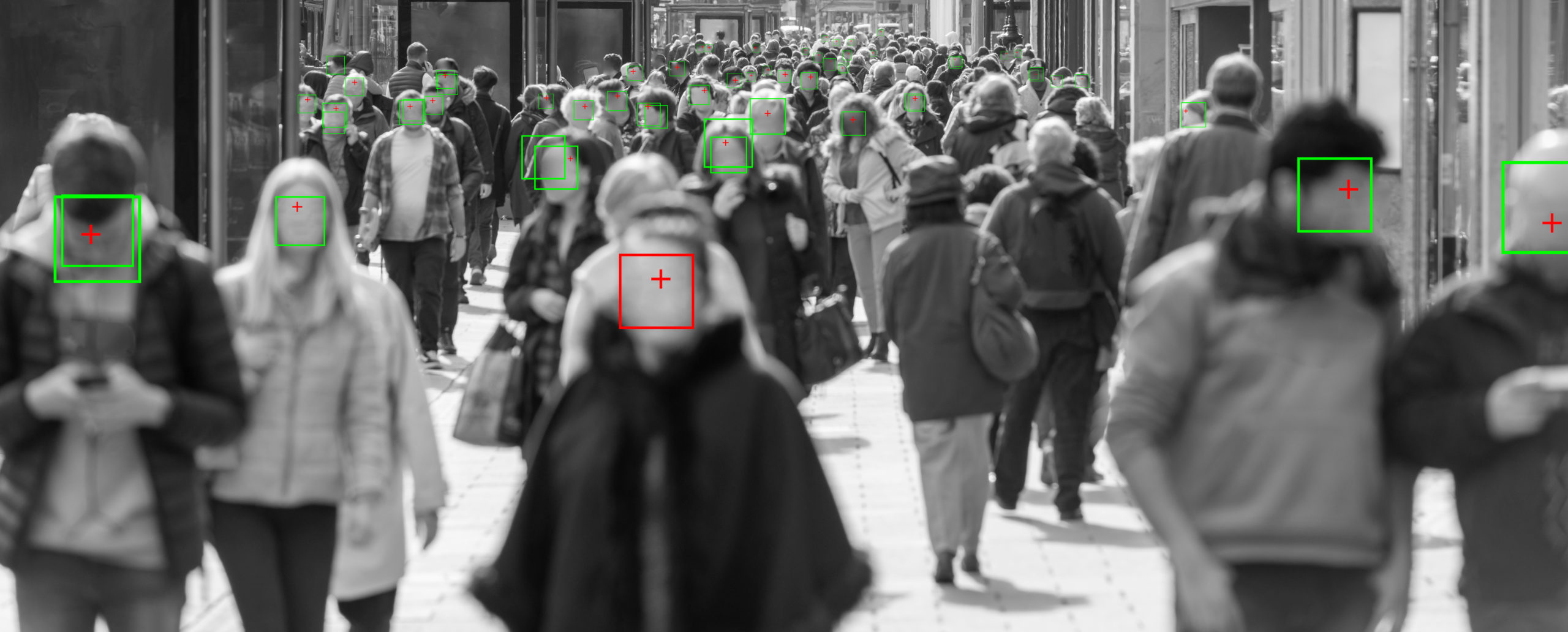
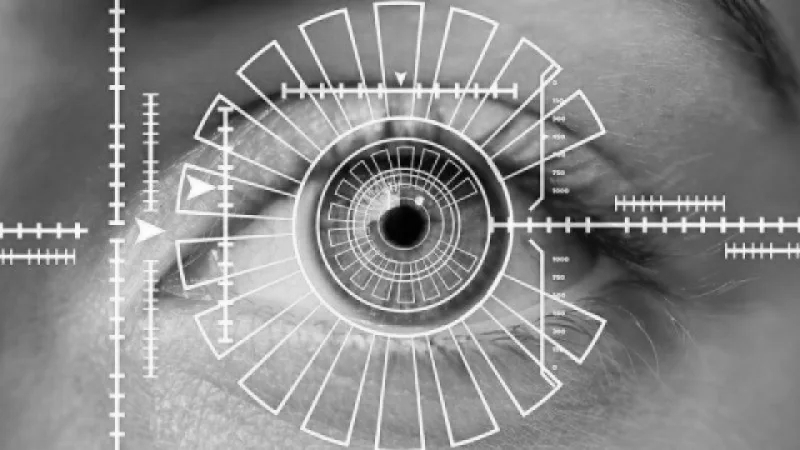
Article 7 of the bill “relating to the Olympic and Paralympic Games and various other provisions”, an article authorizing experimentation with the processing by algorithms of images captured by cameras or drones, was adopted on Thursday by the National Assembly after lengthy discussions. This project, which includes experimentation with so-called “intelligent” video surveillance (i.e., automatically reporting “suspicious” individuals or behavior thanks to their program) had already been adopted by the Senate.
“The Minister of the Interior justified this experimentation with algorithmic video surveillance by saying that “exceptional situations require exceptional means”, referring to the 2024 Summer Olympics. The implementation of this technique will not, however, concern only the Games: it will apply to “sporting, recreational or cultural events” in general, which “by their scale or circumstances, are particularly exposed to risks of acts of terrorism or serious attacks on the safety of people.
This increasingly pervasive and intrusive society is now entirely illuminated by the beacon of science, and it treads, step by step, the path indicated by it.
This light is not only nefarious but is leading us toward a point of no return, toward a deadly precipice.
Although this is well known, it is also pointedly reiterated by scientists and members of the political class themselves.
In a speech a few months ago, the former minister of ecological transition, Cingolani, said that every “breakthrough” procures more problems than it solves, but that nonetheless it is progress and therefore we must move forward.
This “moving forward” translates into the “green” model.
Everything is or must become green: green economy, green nuclear power plants, green technology to which the digital revolution belongs.
It is yet another transformation of society, no longer political as at the time of the French Revolution, nor economic as in the various restructurings of the capitalist model, but techno-scientific.
The various sectors of the capitalist economy either adapt or disappear, and politics supinely carries out the various impositions dictated by science.
The current transformation has certainly taken advantage of three major opportunities that have come its way: climate change, covid-19 and the war in Ukraine.
– Climate change, in the public eye, has led millions of people to demonstrate and thus bring attention to our society’s environmental impact on the planet.
Since very few are actually inclined to radically change their lifestyles, but want to enjoy all the comforts they are accustomed to, their protests are already a blunt weapon from the start. The power system has found in this a nice proposal to renew itself by initiating the so-called “ecological transition,” which consists of a major restructuring of the way of producing energy (renewable sources) and consumer products that are more “sustainable,” that is, with less environmental impact, thus killing three birds with one stone.
THE FIRST political: thus dampening the protests and making it clear that the voice of the governed is close to the hearts of the rulers; one never knows that these, despite the reigning social peace, if unheeded will not seriously disturb the sleep of the masters.
THE SECOND economic: a profit opportunity for companies that can launch new products on the market and by appearing “friendly” to the environment, attract to themselves a slice of new consumers and consequently new earnings.
THE THIRD scientific: the chance to experiment, research in hitherto untrodden fields and further increase their influence on living things.
– The covid-19 has given a strong impetus to medical science, which by appealing to fear and a desire for a return to “normality” has in fact imposed compulsory vaccination without, moreover, waiting for the necessary testing time of a serum before it can be “safe”; a testing on billions of individuals.
Not only to medical science but also to technical applications to monitor and card all those people refractory to the vaccine. The various green passes and permits to be able to travel or work could not be effective without widespread control of individuals, control made possible by the increasingly new and invasive technological apparatuses. Continue reading “Voltaggio, Italy: ‘HE WHO HURTS BY WAR, BY WAR … EARNS!’ Relay Antennas sabotage in solidarity with Alfredo Cospito”→
The Palestinian’s lining up at the checkpoint near Hebron are being watched by the occupying army of the the IDF, but the child in the line looks up hesitantly at another eye, one that is not human, that of the camera, of the artificial intelligence powered gun that watches his every move.
If the repressive control of the wall that devides up the occupied Palestinian region is not enough, now they are watched over by automated weaponry supplied by Israel’s very own designer, developer, and manufacturer of AI weaponry Smart Shooter. The IDF claim that the gun only fires non-lethal projectiles such as tear gas or plastic bullets. We do not need to be reminded that the Israeli military’s word means nothing, the countless Palestinians that have died rising up against the occupying forces are testimony to what non-lethal means, just as any police force around the world, that are all resembling their own armed forces more and more.
The Smart Shooter gun relies upon facial and gesture recognition, that if it is deemed an agressive act or any act out of the ordinary is recorded, the automated weapon will fire on its own accord. This is the insanity of a techno-prison world we have arrived at now, where the prison that has been built around Palestine will now be guarded by all kinds of automation and robots. A kind of digital dehumanisation is occuring in the existence we occupy, where all actions, all decisions are being removed, even that of life and death.
The Israeli far-right state is no stranger to its use of technology to repress those who resist it. The Israeli security forces have used drones to drop tear gas on rioters and protesters several times on the border, even recently in the brutal repression on the Temple Mount. The same military tech company Smart Shooter have supplied them with an armed drone system to hit stationary and moving targets while flying, named SMASH Dragon. With “One Shot – One Hit” precision, the SMASH is also based on Artificial Intelligence, Computer Vision, and Machine Learning technologies, SMASH is also designed to interconnect with other operational resources to form a micro-tactical network that delivers real-time situational awareness. It can incorporate various types of assault rifles, sniper rifles, 40mm, and other ammunition. According to reports, the concept has completed live-fire testing and is at an “advanced stage of development.” Continue reading “‘Staring down the barrel of an artificially intelligent gun’”→
China is probably ahead of everyone else in turning the country into a digital concentration camp. CCTV cameras are installed almost at every step and residents are very tired of the constant monitoring, believing that the state thus interferes in their personal lives.
However, for every action of the state, a person looks for counteraction.
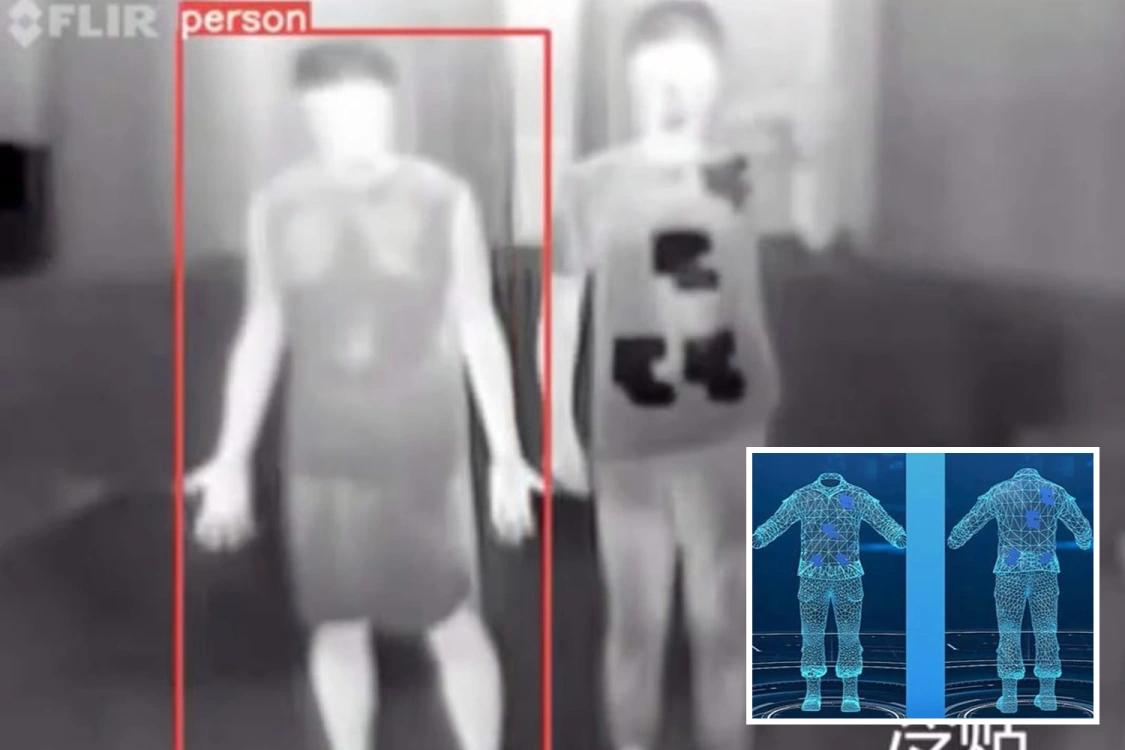
Graduate students from Wuhan University won Huawei’s cybersecurity innovation competition, demonstrating a coat whose camouflage prints can hide a person’s identity from AI cameras.
The contest winners say the prints were created using artificial intelligence. The whole point of the pattern on the fabric is to reflect light, so that surveillance cameras can’t react to visible light. At night, special devices, with which the coat is also equipped, distort the thermal radiation and thus manage to deceive the infrared sensors of smart cameras.
The “smart” coat is called InvisDefense. The creators are confident that they have found a reliable way to bypass human recognition technology. Engineers tested their development on campus surveillance cameras. According to the results of the tests, it became clear that in reality the detection accuracy is 57%.
In the future, the developers intend to create “invisible” objects for AI cameras. It can be all sorts of objects or even a car. They are also studying the possibility of bypassing other types of cameras that use remote sensing of satellites or aircraft.
The developers themselves say that their work is intended to identify vulnerabilities in the surveillance system in order to improve it. However, stealth coats are already on sale and at a relatively low price.
This conversation between Paul Cudenec and the Italian group Resistenze al nanomondo was first published in the July 2022 issue of the printed journal L’urlo della Terra and has recently also been made available online, again in Italian.
1. Resistenze al nanomondo: Can you can tell us about your story, your path, when you started developing a critique of techno-scientific developments and what thinkers you learned from?
Paul Cudenec: I don’t think I could separate my critique of techno-scientific developments from the rest of my opinions and analysis. I have been an anarchist for 30 years now, but even before then, in my youth, I felt a strong instinctive aversion to high-tech consumer society. On the one hand it was associated with everything that I most disliked – big business, the state, the military, authority and control in general. On the other hand it stood against everything that I most appreciated – nature, freedom, community, a sense of historical and cultural continuity. The arrival of CCTV cameras in England was a wake-up moment for me. I worked at the time as a journalist with a local newspaper in one of the first towns to have cameras installed and, since I knew for a fact that there was very little crime there, it was clear to me that this project was nothing to do with fighting crime, as was claimed, but was the roll-out of something much more sinister. I wrote a punk song about this in the mid-1990s (which I put online last year), warning about “the cameras that steal our liberty” and the techno-tyrants who were going to scan our DNA, put microchips in our brains and turn us into robots. With the local anarchist group, which I subsequently helped to create, we used to hold annual protests against the cameras, marking the anniversary of their installation as “Big Brother’s Birthday”.
As you will gather from the above, George Orwell was, unsurprisingly, an influence on me. The history of the Luddites was another inspiration (via Kirkpatrick Sale among others), along with anarcho-publications like Green Anarchist, SchNEWS, Do or Die, Anarchy: A Journal of Desire Armed and various EF! publications. I also read David Watson’s Against the Megamachine, Fredy Perlman’s Against His-story, Against Leviathan, the Unabomber Manifesto plus a lot by John Zerzan and Derrick Jensen. I have more recently been influenced by reading the likes of Miguel Amorós, Jacques Ellul, Theodore Roszak, Charlene Spretnak, Renaud Garcia… But intertwined with that thread of my self-education have been other inspirations. The English nature mystic Richard Jefferies has been very important to me, as has René Guénon, who combined his metaphysics with a strong critique of modernity. I have also read elsewhere about sufism, Taoism, comparative mythology, English folklore, Indian philosophy, German idealism, Jewish anti-capitalist romanticism, Jungian psychology… What interests me, above all, are the connections between these accounts and traditions, or rather, perhaps, the new space that is opened up for our reflection when we consider them together, in the same conceptual context. Continue reading “Resisting Techno-Tyranny: A Dialogue”→
In front of the steamrollers of industrial civilization and progress, one of the last sensible worlds populated by terrifying imagery and enchanted fantasies is disappearing before our eyes: that of the forests. Those that were a fiefdom of the lords who lined the hanged there, or a shelter to escape persecution. Those that represented the darkness where one could abandon one’s hungry offspring or the dense shelter from which to set out on the assault of the existent. Those that harbored mysteries populated by dryads and werewolves or that saw the warship builders and other master forgers come through to strip them en masse. Those that saw in Sherwood daring bandits plundering the rich, in Ariège Demoiselles (*) with soot-covered faces burning and plundering castles, in Courlande of revolutionaries continuing to strike fierce blows against tsarist tyranny, but also witnessing in the Alps or Poland the death by frostbite of migrants driven out by European border guards.
Fundamentally, forests are also ambiguous because of their very etymology, since forest stood for first and foremost the outdoor space not used by villagers-the word savage itself comes from silvaticus, meaning sylvan-before designating vast wooded areas reserved for the nobility and monasteries protected from peasant uses. By a singular inversion of meaning, the word forest, the perilous unknown that Roman civilization could not subjugate, ended up qualifying in a few centuries the territory par excellence of religious and feudal rule, before finally becoming a generic and rather vague term. Continue reading “Silvaticus”→
Adorno defined fascism in his time as “technically equipped barbarism.” While that definition stood out as one of the most precise, it nevertheless left the concept of barbarism in vagueness and ambivalence. Think, in the Marxist sphere, of the successful slogan “socialism or barbarism!”; loaded more and more with positivism and the ideology of a progressive advance toward classless society, Bordiga contrasted it with a resolute and outrageous “communism or civilization!” Not only does industrial and technological development not give birth to communism, it does not in itself “democratize” either customs or social relations.
More than a century ahead of those debates, the very young Leopardi had already centered the issue in one of the first thoughts of his Zibaldone: “Reason is a lamp: nature wants to be illuminated by reason not set on fire.” From this dazzling insight descends the reflection on the oppositional pair civilization-barbarie that runs throughout Leopardi’s work. Barbarie, for the poet-philosopher, is both that which precedes that light and the epoch of the overt and manifest fire, the triumph of a “geometrical reason” that is a “most false system of most true parts,” that is, “reasoned villainy,” the artificialization of lives and passions: in short, excess of civilization.
As the sequel showed, this was not merely a linguistic problem. The world still struggles, and more and more ruefully, with that ambivalence, although it changes its historical forms. Is not “technically equipped barbarism” Islam 4.0 under construction in Iran, a system that merges Sharia, social credit and facial recognition? We read, “Under the new hijab and chastity law enacted in Iran on Aug. 15, women who post their headscarfless photos on the Internet will suffer the temporary loss of certain social rights for a period of six months to a year. In addition, women deemed non-compliant will be barred from entering government offices, banks or traveling on public transportation. Government employees will be fired if their images on social media do not comply with what the Islamic laws dictate. Numerous women have been arrested for not complying with the dress code and forced to confess.” And again, “The Iranian government plans to use facial recognition technology on public transportation. The announcement comes directly from the secretary of Iran’s Ministry of Promotion of Virtue and Prevention of Vice, Mohammad Saleh Hashemi Golpayegani.” Continue reading “Italy: Techno-sharia, morality police and psychopolice”→