War Against The Information Age – PDF
This was originally published in 325 issue #10.
For Mutual Aid & Solidarity
~ Interviewed by Elizabeth Vasileva ~
You recently spoke about the importance of solidarity and connections, between prisoners and with their supporters on the outside. Can you give us any examples of this kind of mutual or collective empowerment in the pushback against prison’s continuous repression?
Shortly before I was released in 2024, violent cell searches by a tactical unit of prison guards known as the National Search Team took place on C-wing of HMP Garth in Leyland, where I was being held. The NST took over the wing with dogs and riot gear. Cell by cell the raid took place with a lot of pointlessly brutal drama. In ones and twos we were handcuffed and placed in a locked wet room. Some prisoners were beaten, abused and a lot of our things were trashed. Some of the guys fought back, flooded their cells, banged their doors or played music really loud as a protest. The next day the whole wing refused to go back into their cells after the early morning unlock hour. As a cacophonous and unruly mob we demanded the immediate return of seized items, the replacement of damaged items and denounced the violence. This lead to the screws backing off. There was nothing at that moment that the screws could do because we all acted together, and without any leader. At the end of the lunch period, the stop-out ended.
Similar things happened in my experience when one of the prisoners was killed by depression or hopelessness. Demonstrations outside the prisons where I was held also were a strong experience that had an impact upon the guards and us. Especially when the fireworks exploded across the night sky and the comrades outside were militant. I found other prisoners to be generally supportive of each other in the roughly anti-system and criminal environment. Whenever I was transferred or moved to a different cell, the local guys usually would come to check if I was okay and if I needed anything. I helped other guys with their legal cases or prison admin, and tried to find common points of interest and subversion. We’d try to back each other, and if I had some problem, the guys would be voicing their demands too. There’s refusals and kick-offs being made in most of the prisons around the country each day about conditions and treatment. I lost track of the number of prison labour refusals and walkouts I heard about when I was inside, they are very common, as is getting on the netting that separates the landings to protest about treatment and poor conditions.
When I heard that comrades outside were carrying out revolutionary solidarity, that is when I felt our power inside the prison, I can say. From hearing about the direct actions with the Adream case in Chile, France, Italy, Indonesia and around the world, to the phone-call interventions that I was able to make from inside prison to meetings of comrades on the outside, I could feel the warmth from the comrades. Also knowing about the censored letters and books, the solidarity funds and benefit events, it was great.
For readers who don’t know 325, what can you tell us about the project and its content?
325 is an anarchist network of counter-information and direct action. In November 2020, Dutch counter-terrorist police took down the nostate.net server which held the 325 website, upon request from their German and English colleagues. The website was a long-running information clearing house of general news, reports, communiques, publications, event listings, etc. Mostly the website covered Europe, Latin America and South East Asia. 325 is also a hard-copy magazine which comes out on an intermittent basis, and dozens of publications have been published by the collective, including the newsletter Dark Nights, which has it’s own website.
Over the years, 325 has participated in an evolving participatory international network based on direct action and the support of prisoners, as well as providing space for various tendencies of anarchist, anti-capitalist and anti-civilisation groups. In recent issues of the magazine the analysis has shifted slightly to the profound new industrial changes in production and technology, such as artificial intelligence, life sciences and automation. The archive of the 325 site is an important document of social and armed revolutionary struggle over a number of years in Europe and internationally. The project started in 2003 and continues. Continue reading “UK: Wildfires will begin: An interview with Toby Shone”

We are not living in the era of the junta, but we are living under the junta of our time. In recent years, and even more so in the last six years, the criminal organization of New Democracy has been ruling the country with the tactics of a monarchy and an authoritarian regime. Amid political scandals and state crimes, it “exploits” security to sell fear to the people. Its main argument in its attempt to gather a few votes is prisons and the harshest repression. In the country’s ostensibly “correctional” institutions and in the otherwise blind and independent justice system that decides who will become an inmate and who will not, their criteria are not evidence of guilt but ideological position, wallet size, skin color, party connections, and the privileged clique to which some belong.
It is clear that Greek courts are anything but incorruptible. Every day, hundreds of trials are held in the country with the aim of repressing and intimidating citizens. For the majority of people, exhausting laws, mass detentions, and illogical sentences have made conditions in the country’s prisons unbearable and inhumane, culminating in the New Democracy party’s repressive resolutions, such as the new penal code and the abolition of all the acquired rights of the state . The way this machine is greased with corruption and bribery, i.e., with big-name lawyers and state visas, to make the obvious happen, such as the finalization of a decision or the timely conduct of a second-instance trial. Furthermore, the ungreased seats do not recognize any mitigating circumstances for the defendants, nor any presumption of innocence. In contrast to the lackeys who form the party backbone of the government of the day, the “law” of impunity applies, with examples that are well known to everyone, but which we cannot fail to mention. The crime in Tempi is the largest criminal organization that has ever existed in the country. The OPEKEPE scandal*, Siemens, and Mitsotakis’ buddies Lignadis and Filippidis, rapists with misdemeanors who enjoy their perverted freedom.
The modern hellholes that are called correctional facilities are warehouses for souls, where thousands of people are crammed together in miserable conditions. There are many problems that require immediate solutions. We will mention some of the most important ones. Overcrowding: inside the walls, daily life is a difficult struggle for survival; whether in cells or in wards, the number of inmates far exceeds the human limit. Health: this is one of the most vital issues that a prisoner has to deal with, as they experience first-hand the decline and indifference of the state. There is a shortage of permanent doctors and medicines, and prisoners with communicable diseases, heart conditions, the elderly, and people with disabilities are crammed into the same wings without any special treatment or care. Shortages of medicines and the failure to transport them immediately to hospitals add to the brutal daily routine. Leave: the limit on leave is becoming increasingly scarce, with the result that prisoners are only entitled to leave at the end of their sentence. This practice is vindictive in nature and in no way rehabilitative. Administrative support: bureaucracy, staff shortages, the incompetence of employees in legal matters, and their indifference are a daily problem, leading to the impoverishment of prisoners. This, combined with the filth, the neglect of the buildings and, of course, the disappearance of funds, they add up to a huge humanitarian time bomb in all the country’s prisons, more powerful than the one we put in the house of the torturer Kostas Varsamis.
Kostas Varsamis, a senior torturer and prison guard, is the father figure of correctional officers, whose sole aim is the vindictive torture of prisoners. It is no coincidence that governments and politicians come and go, while he remains in his position. His authoritarian mindset, indifference, and goal of taking revenge on prisoners are characteristics that find favor with state scoundrels and opposition from all prisoners. The tactics he uses and the way he acts contribute decisively to the torture of prisoners. The countless disciplinary measures he generously dishes out for the slightest thing, the prohibitions on material goods. The deaths of prisoners in disciplinary cells, the cold, the miserable food, the lack of open visiting hours, the loudspeakers that constantly disturb the mental health of prisoners are the daily tactics of a torturer who in the past used to beat prisoners with bats until they fainted. He tries to pass on the same mentality in a newer version to his employees, whom he treats as tools. They are made to believe that they are superior to the prisoners and that they can have absolute power over them. It is no coincidence that his circle consists of the worst scum who work scattered throughout the country’s correctional facilities and in senior administrative positions. It is obvious that we will not mention other names because we may have planned visits to their homes and elsewhere. Those who follow and accept the views and tactics of the torturer Varsamis, and therefore the criminal policy implemented by New Democracy through this type of person, are against us and are our target.
Finally, we want to emphasize that prisoners are normal people and not just numbers behind bars; they are never alone and abandoned in the hands of the state! We chose this particular scumbag to start a series of new attacks on directors, chief guards, employees, judicial officials, and agencies related to laws and prisons. Prisons are boiling over; it is time to put an end to the impoverishment and the repressive mechanism with attacks, riots, strikes, and every form of struggle inside and outside prisons.
P.S. Cops, journalists, columnists, and other loudmouths, keep writing and telling these funny stories and the axe will fall hard on you too… Responsibility for the attack is claimed by the armed organization Sangre Negra [Black Blood].
Source: athens.indymedia
DN Note
* OPEKEPE/ΟΠΕΚΕΠΕ – Greek Payment Authority of Common Agricultural Policy (C.A.P.) Aid Schemes. The scandal involves the 3 billion euros donated each year from the EU, which were channeled by a corrupt network that involved inflating the amount of agriculture there was, one example is claiming Crete has 4 million sheep, more than the whole of Greece combined! Subsidies were allegedly handed out based on fictitious declarations of farmland and livestock. No effective controls were done. No site checks. No satellite data used. Just political favors disguised as development policy, such as vote buying, rewarding of allies, even penalising of dissenters. The foundations of democracy and capitalism at its best.

Documentary from Greece about the prison society, its role in social control and the ongoing rebellion against it…
The film focuses on the prison uprisings against the political repression and social war against the comrades in Greece as well as the hunger strikes against the Type-F prisons in Turkey which soon spread to engulf many of the prisons in Greece. These prisons are similar to the Type-C prisons in Greece, the FIES in Spain, the CSC in the UK and other punitive isolation torture regimes around the world.
During the afternoon R.Z. escapes again, for the last time. A detainee shouts to him, ‘How did you do it?’. R.Z answers: ‘From there at the top… you can’t find a way to escape from those walls, because there are other walls beyond… another prison. You must escape from the roof, and head towards the sun. They will never be able to build a wall between the sun and the earth’.
Our passion for freedom is stronger than all prisons!!!
Vimeo link- https://vimeo.com/108159482
PDF: Filaki- Prison World– zine about the prison uprisings in Greece 2007

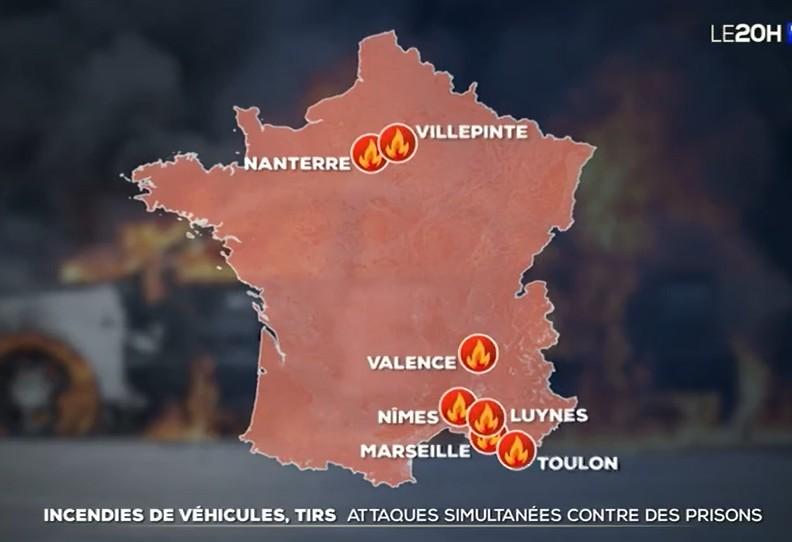
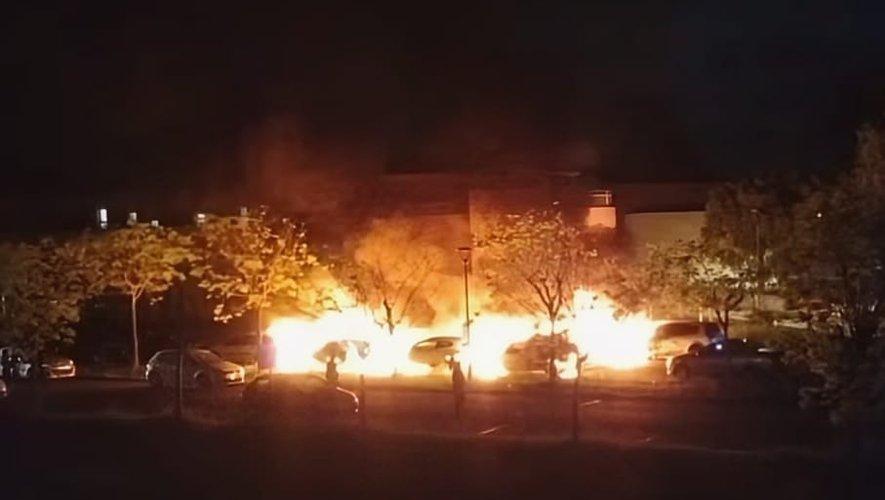
The nights of Sunday to Monday, April 14 and Monday to Tuesday, April 15, were marked by attacks on several penitentiary structures and their minions, in a dozen towns in the south of France and on the outskirts of Paris. Prison staff cars parked in parking lots (Réau, Valence, Villepinte, Aix-Luynes, Nîmes), alongside the national prison school (Agen) or in front of their staff quarters (Marseille, Nanterre) went up in smoke. In addition, the entrance to a prison was machine-gunned (Toulon-La Farlède), and the gate to an ERIS base was set on fire (Aix-Luynes).
This “coordinated attack” over two consecutive nights led the National Anti-Terrorist Prosecutor’s Office (PNAT) to take charge of the investigation, which was then entrusted to the Anti-Terrorist Sub-Directorate of the Judicial Police, local services and the Directorate General of Internal Security (DGSI). The investigation includes “three charges, including terrorist criminal association”, explained the Minister of Justice today, because “the very nature of the action” reflects a “concerted operation aimed at seriously disturbing public order through intimidation”. As for the prison guards, they are naturally disgusted, as Damien Tripenne, national secretary of the CGT penitentiary union, declared on a major radio station: “I have comrades, colleagues, who are bruised because it’s their vehicles that have been targeted, it’s their homes that have been targeted… fear is going to have to change sides” (RTL, 15/4).

In addition, the Ministry of the Interior’s spokespersons pointed out that in several places the tag “DDPF” (interpreted by the journalists as the acronym for “rights [or rather defense] of French prisoners”, named after a Telegram channel) was found, as well as “anarchist slogans”. This led them to put forward both “ultra-left groups” and “drug trafficking” in their chatter. A well-known “source close to the case” told a state news agency that “according to the initial elements of the investigation, the anarchist trail seems to be gaining ground in the vast majority of cases” (AFP, 15/4, 15h50).
Whatever the case, their hypothesis is that these attacks are linked to the struggle of some and others against the construction of vast high-security wards, i.e. veritable tombs where hundreds of prisoners will be buried alive from this summer onwards… and more generally against the toughening of prison conditions (reduced walks and activities, beatings and humiliations by guards…) encouraged by Darmanin’s arrival at the Ministry of Justice.
Here, then, is a first glimpse of this series of nocturnal attacks on the prison administration and the property of its minor personnel:

Continue reading “France: About the coordinated attack on the prisons over the last two nights”

Anna Beniamino: Pathophysiology of the prison monster: poisons and antidotes (October 2024)
Article translated and published in Spanish in “Tinta de Fuga,” periódico anárquico contra las prisiones y la sociedad carcelaria, no. 7, segundo semestre 2024.
PHYSIOPATHOLOGY OF THE PRISON MONSTER:
POISONS AND ANTIDOTES
Stories of mice and men
In pharmacology laboratories, antidepressants are tested with an experiment of exquisitely human cruelty: a mouse, drugged or “nature,” is submerged in a glass cylinder half-filled with water and the time of desperate swimming before immobility overtakes is calculated.
Usually the rodent without psychotropic support tries to climb along the cylinder and jump for 5 minutes before giving up; antidepressants lengthen desperate swimming attempts by a few minutes before resignation overtakes.
Stripped of the cynicism it conveys, the Porsolt or “desperate swimming” test is a useful allegory to illustrate the current situation in Italic jails and this summer’s trickle of suicides and riots in the overcrowded, dilapidated communal sections1, a charcoal of forced cohabitation in cramped spaces, in a word humiliating human dignity: drug-induced apathy and depression, the ubiquitous “therapy,” desperate attempts at reaction that often take self-harming forms, backyard hegemonies, desolidarization, childish brawls, where there is a constant pouring of suggestions and models from TV dramas, which is then the lobotomizing diversion that overcomes “therapy” in the pervasive echoing from cell to cell.
To the pathological infantilization of the individual, the prison works methodically, depriving him not only of freedom of movement, but also of that of minimal choice in the course of the day: the idiotic and incomprehensible regulations, the extreme bureaucratization of every minutia of daily survival. Depersonalizing mechanisms that deprive one’s humanity, the application of which essentially serves to establish the pressure of the repressive structure (and the individual’s capacity for resistance or adaptation), are handled aseptically, feeding a meat grinder where reactions can cover the entire range between anesthetized apathy and revolt as an assertion of subsistence in life rather than claim.
This Dantesque bedlam is overlaid and counterbalanced by the fragmentation and consequent isolation of differentiated sections and circuits. In most compas one finds oneself as well as in small numbers, divided from the rest of humanity in chains, locked between high-security sections and, even more isolated, in 41bis2 circuits.
High-security sections have an additional internal separation to avoid contact between those accused of “terrorism,” domestic and international (AS2) and those of “mafia-style criminal conspiracy” (AS3) and related offenses, to avert, in the eyes of the legislature, monstrous criminal chimeras due to cross-species interbreeding3. Or, more prosaically, even if only to prevent the spread of a basic knowledge of one’s rights as a prisoner, a subject on which political prisoners are normally better versed, as they come from more literate backgrounds on the subject and are more prone to the consequent dialectic.
In AS, with the rubber stamp of the “mafia” or “terrorism” formula, an opposite strategy is applied to the overcrowded common sections: separation between prisoners, removal from the place of residence to make contact with family members more difficult, reduced contact with the outside world (fewer interviews, 4 hours monthly, and fewer phone calls, 2 monthly of 10 minutes each), heavier sentences, with less if any possibility of alternative sentences under the aegis of 4bis o.p. 4.
Then there is 41bis, the bottom of the well, the bottleneck of the repressive funnel where it is easier to get in than to get out, in the highest degree5, with a further exacerbation of solitary confinement, intracarceral and extracarceral: a one-hour interview per month with partitioned glass and audio-video recording; almost total postal censorship; limitation of items allowed in the cell, including books and music CDs, the purchase of which is in any case made very difficult, if not impossible; one hour of air time per day in cramped, netted yards and with socializing with up to three other prisoners (in fixed groups selected by management).
This prologue, unpleasant, is to explain a minimum the difficulties and contradictions experienced, as antiauthoritarians, in facing and fighting prison these days in these shores.
The strategy of isolation, sterilization of human contacts and rescission of solidarity networks is obviously not an Italian prerogative but, as our Chilean comrades are well understanding, a practice that is spreading and being perfected there as well, as in the aggravation of Francisco’s conditions of isolation and the restructuring of the Alta Seguridad. Just as everywhere the restructuring of detention facilities combines punitive logics toward the individual refractor with those of a “Fordist” efficiency of preventive repression aimed at creating compartmentalized and incommunicative levels to more effectively and aseptically manage control, inside as well as outside. Continue reading “Anna Beniamino: Pathophysiology of the prison monster: poisons and antidotes (October 2024)”

We defend political prisoners, but as long as prisons exist, as long as they torture and kill the most ordinary prisoners, including people who are not the most pleasant, as long as criminal cases are fabricated for the sake of “sticks” and “stars,” no one can consider themselves free.
Information about what happens behind barbed wire is rarely and belatedly received. The Verstka Telegram channel recently published information about the victims of police lawlessness in 2023. This year, at least 50 people have died in pre-trial detention centers, special reception centers, police departments, during arrests, and in police cars. These data were obtained through a thorough analysis of reports from government agencies and the media, and, of course, they are not complete.
The highest number of deaths occurred in pre-trial detention centers (SIZO) – 22 people died there over the year, 14 in police departments, five during detention, four in police cars, two in special detention facilities, and one each in court, a FSIN prisoner transport vehicle, and a hospital after being transported from SIZO.
Among the dead were 48 men and two women. The cause of death for 11 people was allegedly heart problems, another 11, according to official data, committed suicide, and nine died after they “suddenly felt bad.”
At least two people died after being tortured by police officers, one detainee in a pre-trial detention center died from a drug overdose, chronic illness, and deliberate failure to provide medical assistance, and one was killed by cellmates. The causes of death for another 13 people are unknown. Continue reading “Russia: Prisons must be destroyed”
We once declared that the first thing to die in war is the truth. Today, along with the truth, morality accompanies death. In war, as painful as it is to realize the necessity of your existence, there are rules. Those rules are once again being broken by my pack of persecutors.
I spent almost two and a half years as a prisoner in their cells of democracy. In hooded interrogation offices, in the corridors and halls of the inquisition, in cages and concrete tombs. And in all these years not a single moment has passed from my mind to bargain my political identity with what it carries as a legacy on it. Today I am back on the streets with a set of restrictions but my conscience is clear for what I have done.
The prison door closed behind me, but not the chapter of revenge. On June 4, a team of bailiffs went to my parents’ home in Volos to announce that due to my personal debts to the tax authorities, my father’s motorbike, which is in my name, is being auctioned. The debts concern accrued administrative fines from cases of economic repression such as refusal to enlist, fines from the curfew during the pandemic period, court costs of my previous court cases, etc., debts that I have consciously chosen not to pay, refusing the individualized administrative face of repression that has been generalized over the last 10 years.
My issue is not the goods we own and the sanctity of property, but the audacity and lack of morality of a repression that regularly turns on my family because it cannot bend myself. A repression that binds a gift from me to my father, sowing fear and blackmail in my family environment. A repression that in the past (both before and during my captivity) has regularly harassed them with stalking, approaches and solicitations, “friendly” chats and neighborhood interrogations about my profile and daily life.
So about the war, let me remind you that, in the historical record, no battle at its end revealed casualties in only one of the two sides.
6 June 2024
Prison Society
Source: athens.indymedia
DN Note
Anarchist Thanos Chaztiangelou has been released since 24th May 2024. Thanos was arrested along with two other comrades Panagiotis Kalaitzis & Georgia Voulgari for an incendiary attack at the Foundation for National and Religious Reflection in the Ano Polis area of Thessaloniki and were later charged with membership of ‘Anarchist Action Organisation‘. Thanos took full responsibility for the attack.
Upon leaving the prison gates, every inmate solemnly swears to never look back. Nearly all pledge this vow…
Returning, the overwhelming sense is that the prison has been awaiting your inevitable return. Stepping into the cells of Nafplio, I encountered numerous familiar faces from Grevena, Korydallos, transfers, detention centers. They now blended seamlessly into the stark penitentiary backdrop. Their histories were familiar to me. They had completed their terms and “settled” their societal debts. Both principal and interest accounted for. No reprieve was granted, not a single day spared. I pondered why they remained incarcerated.
“Revoked licenses, suspended freedoms, ancient rulings forgotten..”
Forgotten souls inhabit the penitentiary system. They are the enduring denizens of confinement with brief respites.
Media hounds in their attire and heavy cosmetics snarl for harsher punishments. They foam at the mouth, decrying the inadequacy of the sentences. “Life means life” they howl.
They are unconcerned by the prevalence of life imprisonments in Greece, issued with alarming ease by the judiciary. They disregard the absurdity of sentencing individuals to 70, 80, 100 years—burdens a convict would require two lifetimes to fulfill, extending even beyond death!
Yet, they boast of their adherence to human rights and European values. At least there is no death penalty here. Yet, indeed, there is…
Though they do not subject the felon to the electric chair’s flames, their lengthy sentences corrode him with the acid of time, forsaken within concrete confines. The enduring aspiration of the convict following the trials’ Golgotha is release and the coveted parole…
With each submission, having met all stipulated conditions, he retrieves his dossier, dons his “finer” garments, and with a substantial dose of hope, encounters his judges.
“Denied… He will not make optimal use of the parole. Denied… The good conduct displayed in prison is merely a show.”
The convict has fulfilled his end, and now the judges’ pronouncement foretells his fate. Frequently, they do not even meet the convict during his appeals. His criminal record suffices, while they proclaim not to judge his past. After all, he has atoned for his past actions.
Prisoners are not without fault, yet if the “remedy” is but extended incarceration, it must be remembered that an overdose of medication poisons the recipient. To address the issue effectively, one must identify its origins. No one is inherently criminal. The penitentiary reflects society’s image. When the convict observes that the state’s ethos comprises corruption, deceit, scandals, he emulates these traits.
Simultaneously, ambiguous court rulings and stricter penalties outlined in the revised criminal code breed resentment and survivalist cunning in the prisoner. Marginalized by society and branded by the stigma of imprisonment, he is compelled to perpetuate his malign persona. The judges’ prophecy of “feigned transformation” metamorphoses into a self-fulfilling prediction.
His freedom is subject to an expiration date.
Outside the prison edifice looms the intangible grand prison… With the dread of authentic captivity, society sequesters itself. Fear, defeatism, apathy constitute its bars… The conviction that change is inconceivable. Individuals persist in meandering within their confined spaces, commuting between home and workplace, placating their incarceration with illusory delights and coveted merchandise. Escalating impoverishment, tangible and spiritual, compels them to lower their gaze even further.
For their liberation, the harshest arbiter is the judicial panel. Their very essence. We alone must elect our manner of existence. Embrace the terms of a contented captive or opt for the requisites of genuine liberation and diginity…
Wishing you all the best…
Christos Tsakalos
Nafplio prison

In the face of escalated attacks against workers, young people, migrants and the living conditions of prisoners, we call for an encounter to learn how we can combine our struggle and understand how to advance our fight for a world without police, prisons and borders.
In the UK as elsewhere, murderous police kill with impunity whilst politicians make way for a vast prison building program that will affect the poorest and most marginalised parts of society. Anarchists, activists and environmentalists are targetted as “extremists” and “terrorists” with special police teams designed to infiltrate and dismantle their campaigns and organisations.
Our communities are increasingly turned into open prisons, “a prison society”, through new technologies of social control. It’s time to stop wringing our hands and instead get organised. What do we have in common and can we build a common platform of action and discussion that helps us build a better world.
The event will take place over a weekend of Friday March 29th to Sunday 31st, 2024. If you wish to participate contact ABC Brighton at brightonabc@riseup.net
—
Subjects to be covered include:
Operation Adream
Kill The Bill (Bristol) cases
Police Brutality
Deaths in Custody
Migration Detention
Work of IWOC
Participating Group Presentations
Text / Recordings from Prisoners
We also hope to have a set-up to allow virtual contributions too.