In this fourth interview, we engaged in a dialogue with our anarchist comrade Francisco Solar, acting as a bridge to spread his words and delve deeper into various topics and contexts of interest. His perspective and participation in grassroots projects are vitally important, as they break with the inaction that prison seeks to impose. Throughout this conversation, we address not only aspects related to his personal experience in prison, but also broader political reflections on the ongoing struggles and challenges facing anarchist circles.
1.- How are you doing now? Could you tell us a little about your experience in La Gonzalina prison? What differences do you see between the prison systems in Europe and Chile?
Almost a year ago, I left the maximum security wing where I had spent almost five years and moved to a high security wing with a normal regime, which basically means eight hours of yard time and the possibility of conjugal visits.
Based on the above, my situation is clearly more favorable, as I am not subject to the restrictions of a maximum security regime. However, sharing my daily life with fellow anarchists and subversives who were already in this unit makes prison life much more bearable. Escaping at times from the harmful authoritarian dynamics that exist among prisoners and trying to practice relationships that are contrary to these is a constant challenge and struggle that involves constant questioning. It is clear that we are not an island within this unit; we deal with contradictions and obviously sometimes reproduce behaviors that we say we reject. However, our dynamics, those of the anarchist and subversive prisoners, are different from those of the rest of the prisoners. Our relationships are not based on the stark authoritarianism of the other prisoners, and that is evident.
My daily routine consists of playing sports in the yard, talking and walking with my compañeros, and reading. As I have pointed out in other writings, it is important to have a daily routine, which, at least in my case, allows me to maintain a certain mental clarity and avoid falling into prison despair.
The differences between the Chilean prison system and that of Spain lie mainly in control. The Spanish prison system has managed to discipline life inside prisons through constant and prolonged adjustments to its control strategies. Through the FIES (Ficheros de Internos de Especial Seguimiento, Special Investigation and Security Unit) and dispersion, the Prison Service has pacified Spanish prisons, even managing to turn prisoners into their own jailers, as can be seen in the increasingly numerous “respect modules.”
Although the Chilean prison system is moving towards exercising control in the “Spanish” (or European) manner, the truth is that it is still a long way from achieving this. The control mechanisms are much more precarious and ineffective, which leads, among other things, to the establishment of certain “rules” imposed by the prisoners themselves within prison life. These rules are based on extreme authoritarianism that produces and reproduces relationships of outright slavery among the prisoners themselves. If solidarity was once present in these dynamics, today such relationships have been virtually relegated to make way for ostentation and the aforementioned authoritarianism that makes prison life a hostile environment. Continue reading “$hile: Interview with anarchist prisoner Francisco Solar”→
An interview recorded illegally by telephone between Toby Shone and the leading occultist and psychonaut Julian Vayne, with added vibes from chaos magickian Peter J Carroll. Recorded and transcribed when Toby was imprisoned in G4S Parc, South Wales, on 23hr lockdown.
The introduction is the transcript of a talk from prison that Toby gave at Ozora psy-trance festival in 2022. The interview was recorded by Julian in 2022, with the result that Jules was removed from Toby’s phone list on grounds of “national security” and “conveying an illegal recording outside of the prison”. This interview was thought so dangerous by the British regime that they tried to suppress it, silence Toby and stop solidarity to his case.
This pamphlet has been available in print format since 2023 and is now being released online.
No gods, no masters!
Designed, printed and distributed by the Anti-Copyright Network 2025
Chile: Interview with synthesis anarchistsBoina Anarquista
Interview between synthesis anarchistsBoina Anarquista in Chile and JURNAL ANARKI in Indonesia.
1. What motivates you to create this counter-information newspaper?
A: Hello, good day. Well, the platform began as a newspaper, edited precariously with Word. What motivated us was that nearly 11 years ago, in 2013, when the waves of the student movement in Chile were still present, we started researching and came across a book about anarchist propaganda in Chile. We were amazed by how much of it existed in the 1920s.
Around that time, there were other physical-format newspapers: El Surco (2009-2013), El Amanecer (from Chillán, in central-southern Chile) (2011-2013), El Sol Ácrata (from Calama, northern Chile; 2011-2024), Acracia (from Valdivia, far south of Chile; 2012-2019) and Solidaridad, a Libertarian-Communist newspaper, aligned with the branch closest to especifismo or platformism (2010-2016).
It was within this context that we decided to found a newspaper called Periódico La Boina (2014), which only released 7 issues. Financial problems, time constraints, and lack of coordination led to its discontinuation, but we noticed that the website’s visits kept growing, reaching over 100,000 per year.
The need to communicate, reflect, critique, share, and discuss with other comrades enriches our ideas and fosters camaraderie, especially through printed propaganda. What I see as a downside—and something we are also guilty of—is that there’s a lot of digital propaganda circulating on social media. While it’s positive to have more contact with comrades from other places, the information becomes more instantaneous, preventing deeper reflection. It also introduces anxiety over likes, making everything faster.
We believe it’s necessary to return to printed propaganda without neglecting the digital. It’s essential to discuss and reflect as the anarchists of the past used to do.
2. In our informal conversation, you mentioned your involvement in a historical archive project. Could you tell us more about it?
A: Yes, I am currently part of a group called Archivo Histórico La Revuelta, which has existed since 2009. The mission of the archive is to preserve the memory of anarchist history. Archivo La Revuelta publishes a magazine called Acontratiempo, where we present research by comrades on the history of anarchism in Chile and elsewhere.
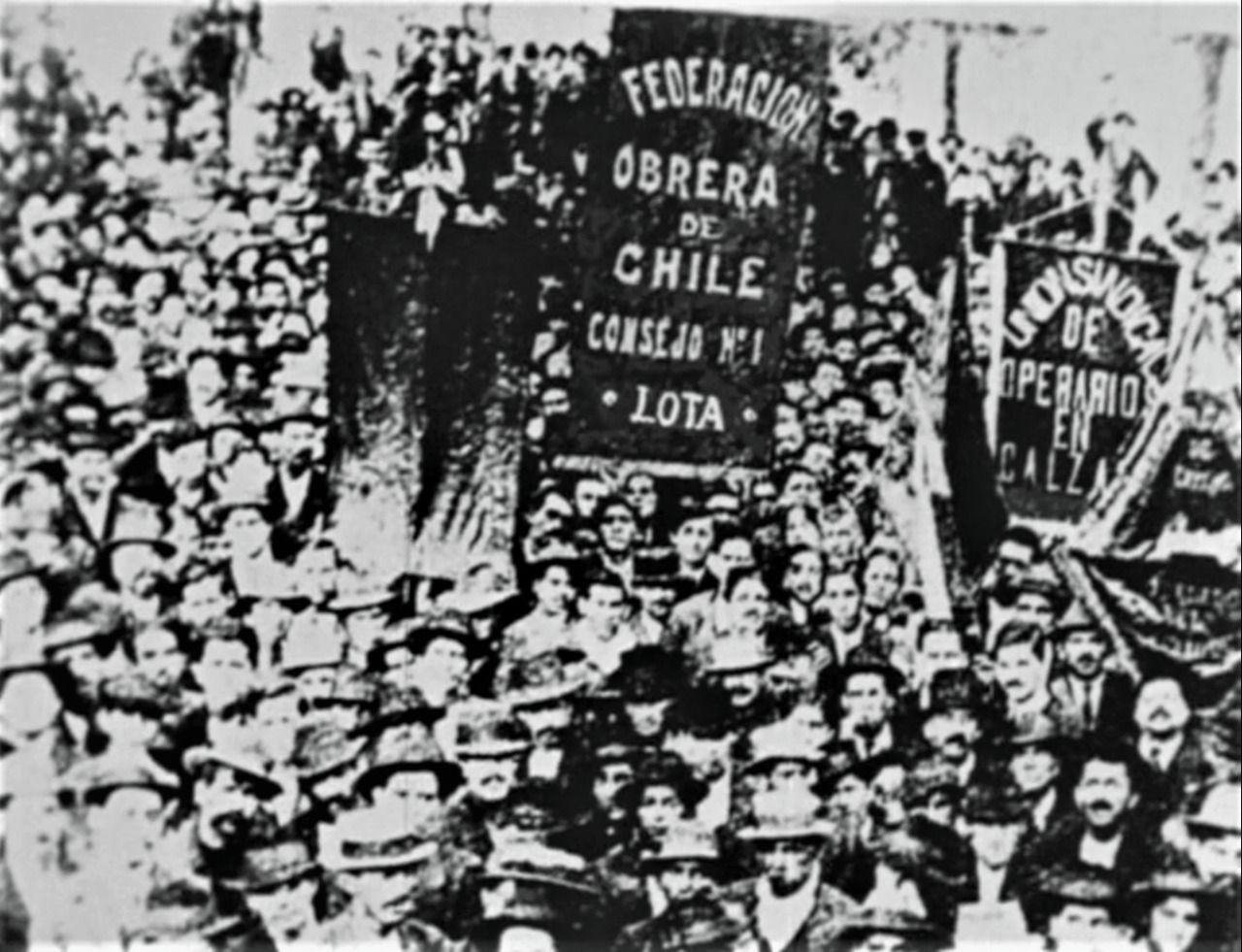
The issue is that, according to some historians, anarchism arrived in Chile in the 1890s and lasted until 1930, when the last mass anarchist unions existed (of course, there were experiences in the 1950s and 1960s, and we have found active comrades in the 1970s, but they are marginal compared to Marxist groups). After that period, anarchism experienced a revival, gradually growing with counterculture and punk in the 1990s. So the archive has the mission of preserving anarchist memory in this region, both from the 20th century and from the late 1990s and early 2000s. There are many struggles led by younger comrades, as young as 16 years old, who may not be as familiar with the struggles fought in the early 2000s, for example.
That’s why the archive doesn’t just focus on the history of anarchism from 100 years ago but also on the present. We aim to collect and reconstruct the history of anarchism from the 1990s, when there were many zines and the first newspapers, to understand what interested comrades of those years and to share those struggles and discussions with younger comrades so they can learn about the efforts and ideas of those who came before them.
On the other hand, anarchist research has emerged in recent years. Its main historians might include Eduardo Godoy, Manuel Lagos, or study groups like the Grupo de Estudio José Domingo Gómez Rojas, which has the Editorial Eleuterio.
Currently, the archive operates in a physical space called Casa Anarquista La Termita, which is shared with other anarchist projects. Also, with comrades dedicated to research, we are also organizing the IV Congress on Research about Anarchism(s) – Santiago – October 2025. The first Congress was held in Buenos Aires, Argentina (2016); its second edition was in Montevideo, Uruguay (2019), and São Paulo, Brazil (2022).
Interview between the band La Lira Libertaria in Chile and JURNAL ANARKI in Indonesia.
1. What motivates you in creating this band? The song “Armate” feels like a homage to the memory of insurrectionary Mauricio Morales, how do you elaborate your music and band with anarchist revolt?
The band was formed to show political solidarity and fill the spaces that we frequented around 2009 and a little before: squat houses and social centers mainly. At first the Lira was a paper piece of popular poetry that we printed that year and that rescues the tradition of the popular poets of the late 19th century and early 20th century, but with anarchist content. The formation as a musical band began later around 2010 in the context of the “Bombs Case” and sought to contribute to the spaces that were hit. The song Ármate is undoubtedly a tribute to the comrade Mauricio Morales Duarte who fell in action on May 22, 2009. The lyrics are an adaptation of one of his poems, and the girl who sings it with us was his partner, which is little known. We wrote it for the second commemoration of his death, and we presented it at the now defunct “Cueto con Andes” social center, where Punky Mauri himself visited and contributed to. Some time later, comrade Luisa Toledo would make her words even more well-known: beautifully violent. Sometimes people confuse this and think that they are words from our dear grandmother Luisa, but she took them because it was her favorite song by the band. That way, the songs and its stories are directly related to our recent political processes, and to the revolt and resistance against the neoliberal model in Chile.
2. From our informal discussion in the past you hinted that most of you come from the specific tendency of combative anarchy, can you tell us more about this?
Yes, we all met at the time we were studying, around 2006 onwards, and we were part of the riots and street-based struggles, like so many young people in Santiago. That is why we lived through the processes of the student rebellions of those years and the protests for the release of political prisoners, environmental projects, the denunciation of capitalist democracy and the anarchist movement.
The insurrectional anarchist movement was constantly attacking the system in that decade and even later, when the band was already formed. That’s what our songs are about, that’s why in them there are stories of attack, escape, prison and joyful rebellion too. The band grew up with this marginal discourse, and with the October 2019 revolt it achieved greater notoriety, since it had been talking about the contradictions of the capitalist model for a long time.
3. People from non-latin speaking countries are amazed by the growing anarchist tension in Chile, especially the diverse anarchic movement, the regeneration of the youth, and the especially heavy repression that the anarchists faced amidst all of this yet still retain their combative and insurrectionary action – what’s really making all of this possible?
As I see it, the commitment to the struggle is explained since it is part of generations and generations of combatants, since the times of dictatorship (1973-1990) and even before. It is linked to our families, to our disappeared detainees, and to the indigenous culture itself, which tells us that the Mapuche tirelessly resisted the Spanish.
In that political environment we grow. This is even stronger considering that democracy stained its hands with the blood of the fighters against the dictatorship, and imprisoned those who continued fighting against capitalism. Figures like Claudia López, murdered in the commemoration of the coup d’état in 1998, and so many other Chilean and Mapuche young people, this fueled since childhood our desire to fight, our desire for freedom and our love for our compañeros.
Perhaps that is the most important component, and what explains everything: the love of the struggle and the memory of the comrades who fell fighting and those who still fight to this day. That is why anarchists, despite being beaten time and time again, maintain their action, because it is also a way of carrying within us our beloved compañeros who were taken from us.Continue reading “Chile: Interview with the band La Lira Libertaria”→
Opening the tensions of dialogue, we present the following section of interviews with individuals, collectivities and related spaces that make up the anarchic body in different parts of the world.
The interviews are a valuable contribution to the observation in detail and depth; they come, in a certain way, to broaden the view to give us feedback among comrades and to debate with perspectives and projections, that although they may be different, they converge in the ideas and practices of freedom against all authority.
Without further ado, we have in this first venture of dialogues the comrades of Espacio Fénix.
1-How and when did Espacio Fénix arise, and what projects converge in the space?
Espacio Fénix was born in the middle of the pandemic, at the beginning of 2021, in the midst of a series of ridiculous mobility restrictions and increased police intervention under the excuse of controlling and preventing the spread of covid-19.
Thus, a group of compañerxs got together, seeking to open a crack, a fissure within the asphyxiating panorama that was regulating everything, imposing the rhythm of power and where many seemed to be accommodating or waiting for the authority to give us “permission” to resume our lives.
We embarked on the idea of opening a physical space where comrades could converge, where anarchic material could circulate and where new comradeships could be woven and articulated. Thus in May 2021 we opened the doors of the space, we began to set up its infrastructure and in July we held our first activity in memory of compañero Santiago Maldonado.
Claustrofobia Ediciones, the Biblioteca Antiautoritaria Sacco y Vanzetti and various anarchic individualities converge in the space.
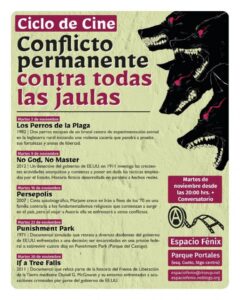
2-The “Ciclos de Cine” (Film Cycles) is the tool you have used the most to carry out activities. What is the significance for you of the screening of films, documentaries, etc.?
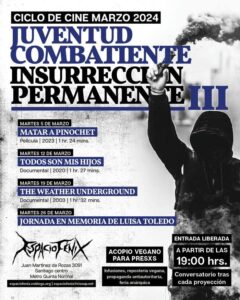
We started with the film cycles in October 2021 and we have not stopped every Tuesday, month after month, grouping the films by specific themes, seeking to stress our ideas and nourish our arguments with content, it is the beauty of the feedback between colleagues with diverse experiences and views.
From the very beginning, we proposed the screening of films as an excuse to sit down and converse, because after each screening, the central part of the activity comes to life, which is the discussion about what has been screened. There the words run, without leaders, where everyone can expose their dislikes, their liking or the results and analysis that is made of what we have seen. With this gesture we also seek to break the logic of passive spectators, of consumers, very typical of socially imposed roles.
In this sense, we have screened diverse audiovisual material, industry films, documentaries made by compañerxs, films that we like or dislike, always aiming at the discussion and tension between compas.
We do not seek to fill the cultural gaps of authority, nor to be the free panorama for those who lack resources; we seek, by different means and tools to spread our anarchic and anti-authoritarian ideas/actions, therefore the film cycles are just one more tool we choose.
Ciclo de Cine March 2024Ciclo de Cine November 2021
3-Regarding the written material, what is the importance and power that you perceive in it?
The written material certainly has another power, another depth and transcendence, of course the spoken thought is important, but writing allows the ordering of ideas, so as to be able to reflect more carefully on what is going to be exposed and to assimilate/discuss more deeply on what is read.
In a present where immediacy, image culture, the digestible and pyrotechnical, where almost the medium is the message, emptying of content many of our tools, writing/reading is a weapon, which can also serve as a refuge, where to continue polishing and sharpening our ideas.
The written material is an instrument that impels us to grow, to argue and continually revise our positions, widening our views, shining light where there was darkness.
On the other hand, it is necessary to say that written material has always accompanied anarchists, as propaganda for the dissemination of ideas, it is an effective tool to enter into dialogue with more comrades wherever they are: in the street, in prison, or other territories. It is important because it nurtures individual thinking, as well as possible collective discussions.
The written material as propaganda can bring together comrades and depending on the objectives and projections that we have, we can realize initiatives of various kinds. In the same way that we can find ourselves on the path of anarchic struggle, we can also distance ourselves from people who spread anarchist propaganda of other tendencies, for us those who are called to participate in the electoral circus, appeal to platform organization, dream of unity and large federations and those who reject legitimate political insurrectional violence – to give just a few examples – puts us in another place on the sidewalk and in several cases as enemies.
4-There are political-cultural spaces that coexist peacefully with power, while others attract police attention. Why do you think this happens? Are there more dangerous ideas-practices? If so, what would these be?
We don’t think this was the intention of the question, but it is worth clarifying to avoid pejorative atmospheres. For us, anti-power spaces/ideas/practices (truly anti-authoritarian and anarchic, leaving out and fighting the bullshit of “popular power”) by definition do not coexist peacefully neither with power, nor with authority, nor with the police and their investigators of all kinds.
Police eyes and ears are always there, to believe otherwise is naive and dangerous. They let themselves be seen or directly attack depending on conjunctures or panoramas that mark a change of rhythm.
In this sense, it is not the police harassment that defines our comrades’ ties -it is defined by our ideas, values and projections- because valuable initiatives that are undoubtedly a contribution to the anarchic tide, may not receive the police onslaught in an evident and grotesque way and not for that reason be considered “legal”, “innocent” or in any way aspire to coexist peacefully with the power. For example, at present there are activities that do not receive police interference, but that 3 or 4 years ago were seen as a danger and received harassment; we are talking about common pots or self-defense activities. It does not change the activity or the background, but it changes the perception of power or the effect it seeks to achieve as a chain reaction (fear, disarticulation, etc.).
Now, it is important to emphasize that these types of practices carried out by those in power are part of their work, and must be understood as such. They have always existed and will continue to exist, we do not say this in an alarmist way, much less to call for immobility or to “disappear” from certain spaces. Simply because it must be clear, those who consciously decide to undertake a confrontational path to power and propagate it in multiple ways, may encounter those enemy dynamics, therefore, the consequences must be assumed. Continue reading “Chile: Interview with Espacio Fénix EN/ES”→
The Final Straw Radio Podcast Interview With Imprisoned Anarchist Toby Shone
US web-based The Final Straw Radio Podcast has a new interview with imprisoned anarchist Toby Shone in which he gives a background to Operation Adream, his arrest and trial and his recent recall to prisons plus the involvement of the security services in his case and the ongoing harrassment that he has suffered in HMP Garth.
The solidarity group for Toby Shone would like to ask that anyone writing to him could also take a moment to let us know that you have sent him a letter by dropping an email to forestcase@riseup.net
HMP Garth are telling him – as have other prisons he has been in – that he has no mail. The State and the pigs are desperate to isolate Toby and to make him believe that he has no support. This is stated in his probation paperwork as a goal of his probation team and the National Security Division.
Let’s not let them win! We have no control over whether the prison gives Toby his mail and books. We do however have control over writing to him and letting his support group know that you have so that even if he doesn’t receive it, he knows it was sent to him. A letter sent by recorded delivery so that we can tell Toby that yes, this letter arrived on such and such a date is even better.
Toby is very resilient and is always in good spirits. However, he has been very unwell, has lost a considerable amount of weight as a result of the lack of food and calorie count typical of Britain’s jails and now faces a month of no visits due to confusion over bookings. So now would be a really really good time to send Toby a postcard, a letter or an email (and then let us know that you have).
Thanks a million.
The State is the Terrorist.
No one is Alone!
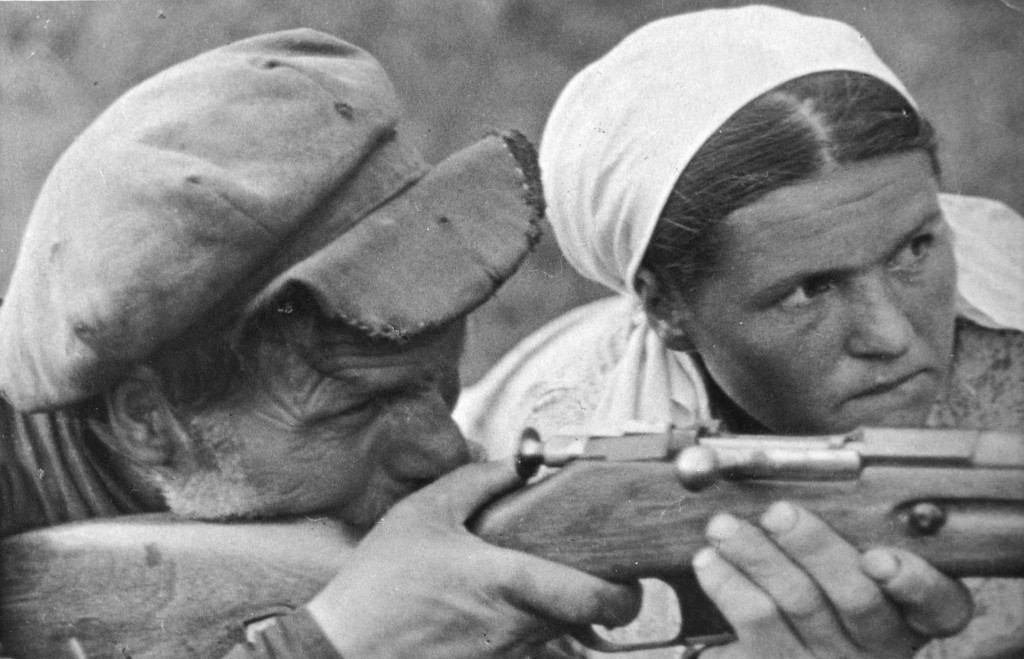
It is important that women’s protest voices be heard from movements with different strategies: we all have something to exchange with each other. Our activists are interviewing representatives of the Militant Anarcho-Communist Organization to remind us that the phrase “women’s place is in resistance” is not just a beautiful metaphor, and sometimes women make the choice to protest radically. For the initiative, whose representatives we interviewed, it is important to damage public infrastructure, not civilians, so all actions are designed so that no one gets hurt. You can read about the women partisans of the past, whom our heroines inherit, in a beautiful text by Maria Rachmaninova.
If you are in Russia, be careful about distributing this material, learn all the necessary cybersecurity guidelines if you are distributing any material about war and resistance.
_________________________________
Do women take part in your guerrilla actions? If so, in what capacity? Does gender affect camouflage and security, maybe women arouse less suspicion and so on?
Yes, we take an active part in guerrilla actions at all stages, from plan formulation and scouting (note: intelligence) to direct action and media coverage. To some extent, the distribution of responsibilities may be due to physical ability, but it often depends not on gender, but on a person’s individual characteristics: some people find it easier to carry a 15-kilogram bucket of igdanite, some can see better, some run faster, and some shoot more accurately.
Gender certainly affects disguise and security: the very presence of a woman in the collective transforms (in the eyes of the public and the police) a dangerous gang of shady types into a harmless group of friends walking late into the night. Because of the sexism ingrained in the ranks of the police, women tend to be less likely to be stopped on the street or in the subway, and less likely to be searched. We’ve had quite a few cases where, for example, when we pass through a metal detector frame, a signal goes off, and the subway policemen and janitors come running and start meticulously checking a young man (who, of course, has nothing to hide), while a girl with a gun stands quietly nearby. So it turns out that sometimes the man is carrying something heavy and the woman carries something dangerous (like a detonator) in a small purse, without arousing suspicion.
Also, in our experience, it is much easier for women in terms of disguise themselves – changing their appearance. At the action itself everyone looks about the same: as blackblock kids, but before and after the action, when it is necessary to look civil, a woman needs to dissolve her hair (wig) and roll up a dress, when as a typical male image, which should not attract attention, allows only minor changes, for example in the color of clothing.
This conversation between Paul Cudenec and the Italian group Resistenze al nanomondo was first published in the July 2022 issue of the printed journal L’urlo della Terra and has recently also been made available online, again in Italian.
1. Resistenze al nanomondo: Can you can tell us about your story, your path, when you started developing a critique of techno-scientific developments and what thinkers you learned from?
Paul Cudenec: I don’t think I could separate my critique of techno-scientific developments from the rest of my opinions and analysis. I have been an anarchist for 30 years now, but even before then, in my youth, I felt a strong instinctive aversion to high-tech consumer society. On the one hand it was associated with everything that I most disliked – big business, the state, the military, authority and control in general. On the other hand it stood against everything that I most appreciated – nature, freedom, community, a sense of historical and cultural continuity. The arrival of CCTV cameras in England was a wake-up moment for me. I worked at the time as a journalist with a local newspaper in one of the first towns to have cameras installed and, since I knew for a fact that there was very little crime there, it was clear to me that this project was nothing to do with fighting crime, as was claimed, but was the roll-out of something much more sinister. I wrote a punk song about this in the mid-1990s (which I put online last year), warning about “the cameras that steal our liberty” and the techno-tyrants who were going to scan our DNA, put microchips in our brains and turn us into robots. With the local anarchist group, which I subsequently helped to create, we used to hold annual protests against the cameras, marking the anniversary of their installation as “Big Brother’s Birthday”.
As you will gather from the above, George Orwell was, unsurprisingly, an influence on me. The history of the Luddites was another inspiration (via Kirkpatrick Sale among others), along with anarcho-publications like Green Anarchist, SchNEWS, Do or Die, Anarchy: A Journal of Desire Armed and various EF! publications. I also read David Watson’s Against the Megamachine, Fredy Perlman’s Against His-story, Against Leviathan, the Unabomber Manifesto plus a lot by John Zerzan and Derrick Jensen. I have more recently been influenced by reading the likes of Miguel Amorós, Jacques Ellul, Theodore Roszak, Charlene Spretnak, Renaud Garcia… But intertwined with that thread of my self-education have been other inspirations. The English nature mystic Richard Jefferies has been very important to me, as has René Guénon, who combined his metaphysics with a strong critique of modernity. I have also read elsewhere about sufism, Taoism, comparative mythology, English folklore, Indian philosophy, German idealism, Jewish anti-capitalist romanticism, Jungian psychology… What interests me, above all, are the connections between these accounts and traditions, or rather, perhaps, the new space that is opened up for our reflection when we consider them together, in the same conceptual context. Continue reading “Resisting Techno-Tyranny: A Dialogue”→
Q: Listeners have probably already had the opportunity to learn about the events that you have lived throughout your long imprisonment in Spanish jails from reading your biography. Let’s start now with the case that led to your current detention in France. What facts does this case refer to?
A: Yes, I have a 10-year sentence set by the Paris Criminal Court on November 8, 2019, for armed robbery and kidnapping. This sentence was recently reduced, a week ago, to five years. And my release date is scheduled for May 16, 2025, so three years from now. This is due to a calculation of the credits for sentence reduction made by the Mont-de-Marsan Prosecutor’s Office, starting from 30 years instead of 25 as the legal limit for the accumulation of sentences in the Spanish system. Well, if this limit had been established by the Public Prosecutor’s Office, if this limit had been enforced, I would have had to be released immediately. Instead, she changed her mind, because she decided that French law should now be applied. A doubly wrong analysis, as my lawyer has already told you in a letter. Technically, it is explained in this way only to understand, in fact, if article 132-23-1 of the French penal code says that convictions pronounced by the criminal jurisdictions of the European Union must be taken into account, on condition that they do not aggravate the situation of the convicted. The legal limit of 30 years of accumulation in French law would therefore be “valid”, in quotations, if I had been sentenced to life imprisonment. This limit would be reduced to 20 years if my sentence had been 30 years, but it is 25 years! So the deliberate error of the prosecutor is obvious. It is Article 362-2 of the French Code of Criminal Procedure. Technically it is quite simple to understand, but when there is a political will behind it that opposes freedom, everything becomes vindictive. Continue reading “France: Telephone interview with Claudio Lavazza”→